Showing posts with label Next Adventure. Show all posts

Sunday, September 3, 2017

IF I DON'T GET PAID, DOES THAT MAKE ME — PROMISCUOUS? : I Perform an Unsolicited Review of the Danuu WingMan Kayak Fishing Seat Accessory Pack


I carefully chose my kayak to be my ultimate photography platform, beer-barge, expedition capable, multi-tasking water-craft, and it has exceeded my expectations.


One thing I hadn’t foreseen, however, was my evolution as a fisherperson.  At first, pressured into fishing by my growing awareness of what I’ll term a sort of ‘karmic imbalance’…


…I soon began to experience brief bouts of not just ‘fishing’, but also ‘catching’, and the catching part turns out to be — really, really fun.


But much like photography, the activity of fishing soon suggests a plethora of accessories and additional tools that need to be juggled in the confines of the kayak cockpit. Obviously, there’s fishing poles and lures and baits and anchors that need to have their places — places where they can be easily and quickly acquired.

The manufacturer of my kayak (Wilderness Systems) is way ahead of me here. They’ve thoughtfully included something they call the SlideTrax Accessory System and of course, a molded cup-holder.  For normal people, these components allow for attaching anything from fishing rod holders to state of the art electronic fish-finders to the point where today’s fishing kayaks begin to rival aircraft carriers in terms of their relative complexity.  But for me, it all turns out to be an elegant way to dump expensive fishing gear into local lakes and rivers (all I did was unloosen a screw — granted a little too much — to adjust the rod-holder’s position, and now it rests at the bottom of Crescent Lake. I can still see that nut, flashing silver, lure- like, as it escaped down the scupper hole.)

Other fisherpeople on a budget have come up with milk crates as a storage solution (with very fine videos available on Youtube showing how to make your own), and while I like the price, I’m concerned about where to put one.


Most fisherpeople seem to put their milk crates right behind the seat, but that spot is reserved for my ice chest, for what I think are obvious reasons.

If only there was something that could fit in that little space between the back of the seat and the ice-chest.


Well, enter the WingMan by danuu Paddle Gear (Editor’s note: to conform to danuu's own logo, our convention will be to spell ‘danuu’ with a lower case ‘d’).

The WingMan is a kayak fishing seat accessory pack, meant to strap onto metal-frame kayak seats. Danuu’s literature says it’s, “Packed with Features! “ Essentially, it has two bottle holders, two rod holders, a central storage pocket and several Gear/Leash points.

Now those of you who are familiar with the Tarpon 140’s seat know that it is not a metal–frame kayak seat. This didn’t escape me either. So when I stumbled upon the WingMan at Next Adventure Paddle Sports Center (624 SE 7th Ave, Portland OR) I asked a salesperson (who called himself Autzen) if it would be O.K. to try attaching one to a tarponesque seat. Autzen not only said it was O.K., but helped me strap it onto the nearest tarpon.


The red arrows show the parts of the seat where I attached the WingMan’s straps, being careful not to interfere with the seat’s own rigging.


Note: If you like your seat back to ride really low, this accessory may not be for you. As attached here, the accessory pack prevents the seat-back from reaching its lowest position.


This side view of my kayak seat shows that the WingMan’s vertical length isn’t really an optimal fit for the tarpon’s diminutive seat-back . Notice how far the lower straps have to reach. Never-the-less, as the straps are tightened, the device proves rigid enough to hold firmly.


My initial trials reveal that the bottle holders are reasonably placed. You don’t have to be a contortionist to reach them, and inflexible as I am, I could easily reach my beverage without turning around in my seat. The fishing-pole holders were a little bit harder, but with practice, I don’t think I’ll need to turn around to get fishing poles in and out of those either. I can already access the pole on my right-hand side as well as fasten and unfasten the Velcro strap that safeguards the pole while stowed. I really like the placement of the leash lash points. Having them right on the rod holder makes a lot of sense. The leashes will mostly be behind me and out of the way, and I have high hopes that this will eliminate the current fishing-pole-deep-water-migration rate of two per season.


The danuu WingMan isn’t designed for my kayak seat, but still manages to provide me with all of its advertised features.  Initially I was concerned that the minimal anchor points available on my seat-back might result in the pack shifting over time with use, but so far that has not been the case.  While it wouldn’t be difficult to undo the straps and remove the WingMan after using the kayak, I prefer leaving it attached. It has a low profile when empty and folds out of the way with the seat-back during kayak transport.

Spiffy Kayak outfitted with Danuu's WingMan Kayak Fishing Seat Accessory Pack
at Rock Islands in The Narrows on the Willamette River above the Falls.

I think danuu’s kayak fishing seat accessory pack is a good idea and a good product.  I’d be pretty happy if danuu came out with an accessory pack specifically designed for Wilderness System’s Phase three seats, but not as happy as I would have been if I hadn’t already bought one that isn’t. I’m glad I took a chance and decided to give this new storage solution a shot. Hopefully, enough information is presented here to help you make similar decisions for your own kayaks.


Editors’ note:  This essentially has been an exercise in writing a review for an actual real world product. I have not received any compensation, samples, or even minimal political influence for writing this blog entry. But why not ask yourself (if you are a businessperson) if you think you could find a use for high quality images like these and honest reviews for your product(s) — because I know a guy…

Wednesday, March 4, 2015

Test Paddling the Thresher 140

Wilderness Systems has broadened their sit-on-top offerings this year with the introduction of the Thresher (this includes a 14 and 15.5 foot version). The Thresher seems designed to bridge a gap between overly stable, relatively slow fishing platforms and sleeker more touring-orientated craft, all for the sake of fisher-people who need to cover significant distances to reach their intended fishing locales, whether that's in the middle of a huge bay or out beyond the breakers in the open sea


The characteristics that make this boat a good fishing option, should also make it a killer expedition photography platform/beer barge. I knew my test trials wouldn't be complete until I auditioned this state of the art bid for kayak fishing supremacy.


The Thresher 140

I've probably been remiss for not highlighting this before, but the reason I've been able to rent and evaluate various sit-on-top kayaks is because of the reasonable and renter friendly policies of the Next Adventure team at the paddle sport center on S.E. 7th and Alder. For 35 bucks, they give you a kayak for 24 hours, a paddle, and a personal flotation device (if you need one). The staff is friendly and they are knowledgeable about - even experienced with - the products in their inventory.

I'd been waiting for an opportunity to try the Thresher ever since I started seeing articles about its pending release last summer.


Unfortunately, Next Adventure allocated their only rental Thresher 140 to the Scappoose Bay Paddle Center, and that outfit's 'water-front service' with exorbitant hourly rental rates is punitive in comparison to the excellent deal available at 7th and Alder. When you rent a kayak from Scappoose Bay Paddle Center, you're essentially going to go kayaking in Scappoose Bay. They don't let you car-top the boats and take them elsewhere. They also roll the kayaks down to the dock for you, so you can't really evaluate whether or not you're going to be able to put them on top of your car.  I noticed the Thresher doesn't have traditional side handles, but instead has recessed hand-holds built into the cockpit area plastic. I have no idea if that's a good idea or not. The bow and stern handles are sized just about right for the Hulk and are probably not breakable, even when he is angry.


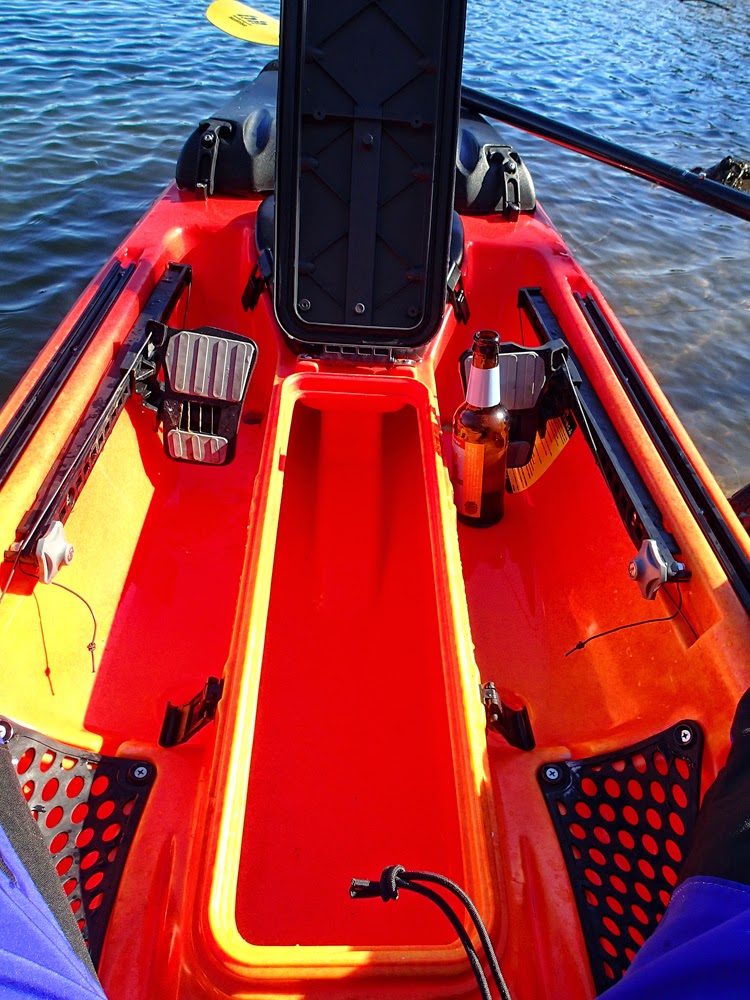
Where the Tarpons have a sealed hatch for internal storage in the front of the boat, the Thresher has a distinctive storage compartment covered by a big plastic hood. The plugged up scupper holes in this compartment should have served as foreshadowing that this compartment is not really intended to be dry. For those who intend to do a lot of fishing, it seems like the thing you'd want to do is maybe take those plugs out and fill it with ice and then periodically throw in the fish you catch. But me, I just assumed a new fangled fancy hood would be water-tight and I put my old dry bag in there.


The next new feature down from the hood is something called a 'flex pod sonar console'. This is a fishing specific item that is intended to hold a fish finder and its battery.


The idea is that you can pull this whole module out at the end of the day, throw it in your car and go home, or vice-versa.


Underneath the module, there's a protected hole that goes all the way through the boat. That hole is where the transducer goes, and I'm told that there's enough space in there to keep the transducer from getting scraped off when the boat runs aground... but since I've never installed a fish finder, I'm going to bet you might want to measure all your particulars before you take my word for it. 


My rental Thresher came outfitted with a rudder. The pedals are a new style compared to the kind that were in the Tarpon 160 that I tried back in January. The old style pedals slid backwards and forwards in the guides bolted into the side of the boat. The new style pedals are stationary, and you press on them just like you do a gas pedal. I had a hard time correlating the percent I pressed on the pedal to the percent I actually turned the boat, but I imagine that it all becomes more clear with experience. Conditions were such that I really didn't have any use for the rudder. I also found the giant adjustable knobs at the end of the pedal guide (see arrow) uncomfortable against my calves.


The second hatch on the Thresher is a long rectangular hatch that opens up into the interior of the boat. While this hatch doesn't high-center you like the one on Ocean Kayak's Trident Ultra 3.4 when you try to access the storage at the front of the boat, it is kind of narrow and it didn't easily accept my dry bag. 


Looking forward into the interior of the Thresher, it appears this space is designed to easily accommodate fishing poles, spear guns and perhaps exceptionally long baguettes.


The back of the boat consists mainly of a sizable tank-well. Besides the adjustable bungee straps that criss-cross the tank-well, the Thresher also has two built in gear straps to make sure something like an ice chest isn't going anyplace if you tip over.


I don't think I've ever spent any time detailing Wilderness Systems' seats. I've never really noticed them, but I mean that as a compliment. The one time I noticed a kayak seat was that one time I rented the Trident Ultra. Honestly, with the ample natural padding I already come equipped with, you wouldn't think I'd even really need a fancy kayak seat, but the Trident Ultra taught me how much my kayaking pleasure depends on the comfort provided by Wilderness Systems' seats.


     Thresher                                             Tarpon                        

I took a pretty careful look at the hull of the Thresher to determine why it's supposed to be such a great boat for punching through surf and taming the 'big' water.  At first glance, the design looks kind of Tarponesque. But then the rocker becomes fairly obvious and the nose begins to look a little more bulbous and the bottom doesn't look so flat, and yet, it still manages to look sleek and dolphin-like, or at the very least, Beluga whale-like.


I paddled the Thresher out to the Warrior Rock lighthouse where I knew there was sometimes a sizable eddy. I was pleased to find that the kayak joyfully leapt into the roiling water like a Labrador eager to please. I found I could cross the eddy-line backwards, forwards and sideways, headed upriver or downriver, or spinning in circles, and to someone who learned about eddies the hard way with a canoe, it was a little bit like magic.


There's a lot to explore at Scappoose Bay. There's an eerie expanse of old pilings and inscrutable concrete blocks at the northern tip of Sauvie Island. There's access to the Ridgefield Wildlife Refuge just across the Columbia, there's abandoned industrial docks and a finger-y network of sloughs and minor tributaries...but with an exorbitant hourly rental scheme hanging over one's head, one tends to make conservative decisions about what's worth exploring. It doesn't help that the hourly scheme is modeled after complex algorithms designed to mislead you about how long you can go before you just say, 'screw it, give me the daily rate.' And that's not even considering that they'll charge you an extra hundred bucks to send a boat out looking for you if you don't have the kayak back a half hour before they close.


It was time to head back. The sun had passed it's zenith, but without the cover of Sauvie Island's treeline, I quickly began overheating in my dry-suit. The conditions were finally right for practicing wet exits and re-entries.

I've practiced re-entries in my Tsunami, and I have a special paddle float that makes it manageable for a sit-inside kayak, but it is still a challenge.
After my session with the Thresher, all I can say is that while it is relatively easy to right the kayak and drape yourself over the top (without a paddle float), you still don't want to get overconfident when you try to spin your butt back into the seat.


This underwater view makes me seriously question why I bought a snorkel last year.

While I didn't realize it at the time, this was also where I filled the front compartment with water. Sometime later, at the dock,  this would help reveal that my old dry bag isn't really water-tight anymore. Also noteworthy, the sonar console thingy, the one that's supposed to hold a battery...that also half-filled with water.


Throughout the day, the Thresher proved to be extremely maneuverable and I kept wishing I had picked a day with scarier water to fully test its capabilities. 


It took a couple more detours, but I finally resigned myself to the idea that I'd be paying the full day rate. I cracked open a beer and prepared for a leisurely paddle back to the kayak center. The beer, which utilized genetically modified hops to present a subtle citrus flavor tasted exceptional. Usually, at work - or in almost any social situation - I feel a little bit like Gilligan. But there in the waning sun, commanding the Thresher, I began to feel like a unique combination of the Skipper, the professor and the millionaire.
I picked up my paddle and scanned the cockpit for a place to set my beer down...and that's when it hit me.


No cup holder.


Sunday, January 4, 2015

Test Paddling the Tarpon 160 (finally)

The problem with 'objectivity' is that it's usually 'subjectivity' cleverly disguised as objectivity.

I've wanted the Tarpon 160 ever since I saw it sitting in the rack at the kayak shop. However, I'm trying to take the universal advice of the broad community of kayakers who suggest that choosing a kayak is a personal choice based on how a particular boat fits one's body and objectives, and so, going through the motions of due diligence, I've finally come to the day when I actually get to paddle my dream boat.

It doesn't escape my attention that I seem to have a Wilderness Systems' bias. The first kayak I ever sat in was their 12 foot plastic Pungo which delivered me down the Sandy River without making me a candidate for the Darwin Awards. The first kayak I ever bought (so far the only kayak I ever bought) was their Tsunami 125 which has, over the last eight years, patiently taught me everything I know about kayaking except for that bit of advice from Bernadette and Keith about paddling with your core and not your arms so much.

Mostly, my kayak acts as a platform and facilitator for my photography, taking me to places where nature still looks pretty natural for the most part. But as my expeditions become more ambitious, I find I need more easily accessible storage space. I've also noticed that my 12.5 foot Tsunami struggles to make headway over big water in the wind and chop of inclement weather. Even in optimal conditions, even if I was not always pausing to unwrap my camera and seek ideal shots, I can't seem to keep up with others in their sleek longer boats.


Enter the Tarpon 160, touted as the fastest of the Tarpons and the go-to reference when reviewers make speed comparisons, such as, "The ACME Sting Ray isn't quite as fast as the Tarpon 160, but we've slapped a couple of extra flush-mount fishing-pole-holders on this one to help justify the steep price."

If form follows function, then the Tarpon's long slender hull speaks about speed. But I'm not a hull designer, I realize, and I may be confusing aerodynamic sexiness as a solution for a problem better suited to hydraulic equations. Striving for objectivity, I go on to note differences I think I see between the tarpon and the Trident Ultra 4.3. The bow of the Tarpon seems pointier and streamlined, without the fast flared bulging that seemed evident on the ultra. Does this mean that the Tarpon will poke through waves instead of riding up over them? The Tarpon doesn't seem to have any rocker...and if it's supposed to, then this one has lost it, its 16 foot length of heavy plastic slowly collapsing over time. Perhaps the Tarpon 160 is testing the balance between structural rigidity and weight.
The keeled ends of the kayak quickly transition to a long flat belly with multi-chine sides.


Two long grooves, like negative-space rails, travel the length of the flat belly, perhaps as a kind of novel keel substitute...or perhaps a means to architecturally stiffen the hull.


Without the helpful Next Adventure's employee available to help me unload the Tarpon, I quickly gain an appreciation for how heavy this boat is. Without a traditional cockpit to stick a shoulder in, there doesn't seem to be any balanced way a single individual can carry this behemoth. The Tarpon 160 (with rudder) is listed at 79 pounds. If it was a bar with free weights, it wouldn't be a problem, but this thing is 16 feet long and bulkier than a log and something like a sail in the wind. I grab onto one side handle and heft it thigh high while stumble-walking down the long boat ramp. Crap. I wish I had my little sister here to carry it for me.


Originally, I had hoped to launch from Clackamette Park and explore Willamette Falls, but when I got there, I did some rough calculations concerning the speed of the water flowing past my intended launch point, my relative fitness, and the number of fishermen lining the banks and their likely inclination to either laugh or help if I should tip over. What I came up with was a scenario analogous to Lucy and Ethel sitting at an assembly line trying to wrap passing chocolates.

So...Willamette Park.

The thing about sitting in an unfamiliar kayak is the first moment when you first lean a little bit and go "oh shit!" because you almost tipped over right at the beginning...except, you don't tip over and after a few more minutes, you get a feel for the boat, and then after that, you have to try to turn over if you want to turn over. If a person were to exit the kayak after the initial 'Oh shit" moment, that person would conclude the kayak is unstable. That same person might form a very different opinion if they endured, say, four more hours or so.

I did my best, without thigh straps or other braces, to lean the Tarpon on edge and carve turns, but they were big ass turns. Though flat on the belly, the omission of rocker means even in still water, you're not going to do much spinning.


Heading up river, the Tarpon demonstrated a pronounced sensitivity to current - that is, strong currents and eddies had their way with it, just like rapists have their...umm...O.K., that's probably an ill advised metaphor, but should serve to hint at the frustration I experienced at having my navigational intentions violated. As the river constricted around massive bridge pilings, construction barges and various emerging foundations, the cold muddy water became annoyed and confused.


The umpteenth time I got turned sideways by roiling water, I determined to figure out the rigging for the rudder (something not available on any of my previous rentals) and eventually yanked the line that caused it to satisfyingly boink into place. With the rudder in play, there was an immediate welcome reduction in the ratio of corrective-directional paddle strokes to straight-ahead-power strokes. Kayak purists may frown on rudders, but I now suspect I'll be shelling out extra money to get one, whichever kayak I end up getting (They come in handy).


Immediately in front of the seat is a storage hatch with access to the open interior of the boat. There's another bigger hatch on the bow, also accessing the boat interior. There do not seem to be any bulkheads. Like the Tarpon 140, the 160 has a well placed cup holder. The crackers are multi-grain with generous portions of smoked Gouda cheese.


Both hatches are hinged. They open and close easily with simple lever locks and I consider both of them easily accessible while paddling.


Usually I worry about how I'm going to get gear into my kayak. With the Tarpons, you need to start thinking about how you're going to get your gear out of the kayak. Small items may slide the length of the boat.

The hatches have thin O-ring type seals, but I remember how those worked on the space shuttle during cold weather. They seem fairly water tight, but there always seems to be some small amount of water inside the kayak which means you want to invest in numerous hatch-width dry bags.


Turning around in your seat reveals...


...a spacious tank well. On a Tarpon 160, that's almost enough room to hang a hammock.


On the second day of the new year, temperatures started to creep above freezing.


...and I forgot my paddling gloves.


So I had to stop at my new apartment.


A long straight stretch of river before the turn to Elk Rock gave me plenty of time to test the Tarpons vaunted capacity for speed. It does seem to glide along, but is it significantly faster than the Tarpon 140?  It feels like it. But is it enough to make up for what I perceive as decreased mobility? I'm not so sure.


The trees making up my west horizon, as seen by water. The sun warns me twilight is coming. Time to turn around.


The Sellwood Bridge with the Portland skyline in the background.


The Sellwood Bridge as seen by water.


O.K.  I did add the moon.

(We like the moon.)

In conclusion, the allure of the Tarpon 160 has diminished for me somewhat. Up until now, I had never considered buying a rudder before. In the case of the 160, I probably wouldn't buy it without one. It's possible I don't have the technical skill to turn that big boat like it ought to be turned, but until I do, it feels like too much has been sacrificed for the sake of speed.

Next up: The Thresher 140

Featured Post

EVOLVING ROADS: Car camping with Kip and Rico (Part One)

I don’t know how it started for sure. Some intrepid band of Homo sapiens maybe walked over a land bridge from Russia or navigated the seas i...

POPULAR POSTS

The Narrative Image NAVIGATION AID