Showing posts with label fire hydrant. Show all posts

Saturday, December 22, 2018

Padding My Resume with Dubious Skills: Antique-Fire-Hydrant-Gnome-Painter-Oner

I have a creative friend with a whimsical nature who is in the process of designing and building a dog park. There are ever expanding trails and benches and points of interest featuring eclectic artwork. Because it is a dog park, she figured a natural addition should be a fire hydrant...and so she found one on the internet and bought it. She offered to let me restore it.


The first surprise was that the fire hydrant weighed about 300 pounds. To my brain, that seemed like an amount of weight that, while heavy, should have been manageable. But my 58-year-old knees had some input on that idea, and when they initiated a labor embargo, my back also came up with some heartfelt complaints.


The first step was to smooth out the previous paint job(s) which turned out to be something of an ordeal because of the thickness of the enamel paint and my uncertainty about whether or not the old thick paint was the kind that had lead in it. Even though I am past my formative years, I felt I didn't need to breathe anything that might affect my brain or nervous system so I went to the hardware store to pick up a particle-filter mask.


Unfortunately, the summer's wildfires were peaking at the time, and I found the shelves at hardware stores and paint stores barren of all but the most expensive respirators.


I went back to the apartment and rummaged through my old stuff, trying to find the gear I used as a painter. But all I was able to find was my full face respirator from the biotech company. It wasn't ideal because it doesn't allow me to wear my glasses —  and for detail work I really kind of need to see. But I also felt like I need to have a functioning brain, so I did a little bit of compromising in both directions.


The wildly spinning wire brushes kicked up a fine powder that turned my sweaty forearms red. So I'm probably screwed anyway.


After I got all the loose paint off and all the rough edges feathered, I sanded the whole surface with a vibrating hand-sander and fine grit sandpaper at which point, I deemed it ready for a heavy coat of metal primer.


I applied the primer with a brush and determined that painting chains is among my least favorite kinds of painting.


I found a red enamel paint suitable for safety equipment and applied two coats by brush. It was tricky to apply it smoothly without drips, and I found it best to divide the hydrant into manageable sections at logical break-points. 


It was at this point that my friend discovered that some people had painted hydrants as characters, some even as gnomes. While I thought some of the examples she showed me were clever adaptations, I felt that the simple idea of a classic fire-hydrant in a dog park was already an elegant idea.

The simulation of a gnome hydrant I worked up via photoshop, I thought, showed rather conclusively that a gnome's physique was not well suited to the fire hydrant's physical constraints.


Instead, I was surprised that my friend found my rough sketch adequate to be a satisfactory sort of proof of concept. Despite my misgivings, she reassured me that as long as it suggested a gnome, it would be fine. Well —  almost. I was soon informed that green coats are more rightfully associated with leprechauns and found it necessary to adjust my color scheme accordingly.


I sprayed on a bright yellow coat.


...and finished it out with blue pants, a primary color combination designed to absolutely not blend in with the natural colors of the forest-setting in which it would be placed (another design constraint that wouldn't occur to me).


As I began to contemplate how to proceed with the face, I realized suddenly that I'd probably been talking out of my ass when I reassured my friend that I was capable of executing a gnome hydrant. It suddenly became very clear to me that I hadn't painted a portrait since college, and certainly hadn't used oil paints since I was 14 or so (When I took beginning oil-painting classes from Bette Brodhagen in a store-front in the Hollywood District).


I looked for faces that had forced smiles because I was anticipating that my hydrant-character was eventually going to be pissed on — perhaps on a daily basis.


I couldn't remember exactly how to do an underpainting, but I did the best I could trying to block in lights and darks, and fix the position of the features for future refinement. The eyes started migrating upward because, proportionately, they needed to be just under the heavy hat, but this made the nose too long and threw all the other features into disarray.


Working from photographs isn't optimal, because it forces you to copy a two-dimensional interpretation of reality instead of the 3d interpreting you'd be doing if you were looking at a real model. I found a model to wear a yellow jacket for me, but she wasn't interested in posing in my garage so I had to take pictures.


As summer faded and the weather became cooler, I found that the oil paints weren't drying very fast. Honestly, they weren't drying at all. So I bought a special oil that had a drying accelerant in it. This worked at first, but it also increases the danger that the paint will later crack so I used it so sparingly that my painting sessions had to be spaced far apart. 


The next puzzle that troubled me was how to make a big white beard that didn't look completely out of place. I decided to re-enact the stages of growing a beard and add touches of gray as it grew out. At first, whenever I added white, I soon found I was working with a muddy gray that spread out and obliterated my darks and lights. I bought several more small brushes and tried going from dark to medium to light in three different layers.


Despite being 300 pounds or so, and partially wet, I wrestled the little hydrant gnome into the truck and transported him to a heated shop across town.


In the heated shop, the layers stiffened up fast enough to allow my layered approach, provided my layers were slightly transparent.


I continued refining the gnome until I was satisfied it was good enough to piss on. When I was sure that it was dry enough, I tested a portion in the back with a clear-coat to make sure it was compatible with the oil paints.


Then I applied two spray coats of a tough enamel clear-coat.


I intended to surprise my friend by setting the gnome up in the dog park via a 4:00 AM stealth delivery made possible with the aid of my brother.


I still can't decide if it looks like a gnome or not.

Wednesday, March 16, 2016

TIME TRAVELING: Clackamas River Edition

Thousands of years of human exploits ought to be recorded around here, but the roads that native Americans pioneered, or earlier, the 'highways' employed by whoever it was that thought traveling across a cold land-bridge from Russia was a great idea, have either been reclaimed by the ocean or been paved over by opportunistic Europeans.


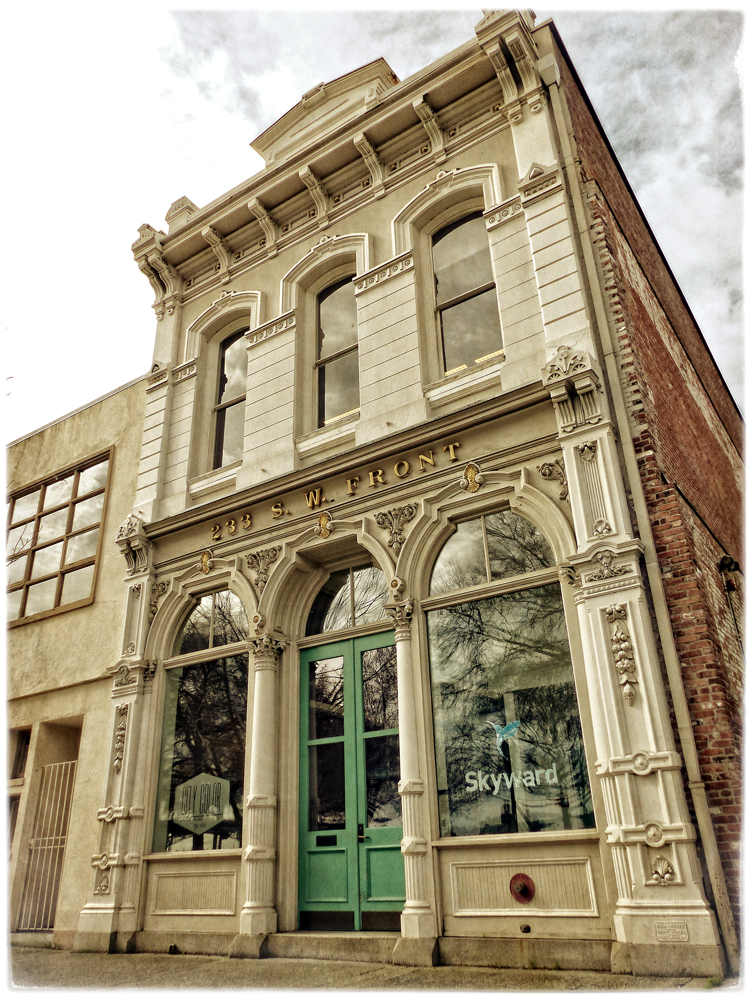
Prominent in this image is the Fechheimer & White building (approximately 131 years old). The smaller building just to the left is the Hallock-McMillan building, thought to be Portland's oldest existing commercial building (maybe 159 years old).

The oldest buildings in Portland are barely one-hundred and fifty years old


A small architectural accouterment at the North end of reservoir #1 on Mt. Tabor.

There is no Acropolis on Mt. Tabor weathering the millennia - no birthplace of Portlandian democracy - instead, crumbling concrete reservoirs are poised to become ruins at the tender age of one-hundred and twenty-two.


01

Just half an hour from the boundaries of our modern city, the landscape quickly becomes indistinguishable from what we imagine primordial forests might look like, if primordial forests had patchworks of clear-cuts. I guess it isn't surprising that in watersheds where clouds simply sink into the creased landscape, keeping the shadow-lands perpetually wet, painted messages (if any) run off rock, their colors dispersing in rivulets of rain and condensation, human memories transmogrified into mineral supplements for moss and mushrooms.


12

Red oxides accent evidence of human encroachment otherwise obscured by creeping vines and mosses. 


02.  Memaloose Road Bridge

So it is intriguing to read of abandoned water works on a tributary of the Clackamas river. To give credit where credit is due, I first read about the South Fork Clackamas/Memaloose Falls hike in a post by Shane Kucera at Outdoorproject.com. 


There was enough information to get me to the trailhead...


...though the effects of a forest fire have resulted in the closure of the road that leads to it, which adds a little over a mile of uphill-walking to the mileage tally.


03

The first time I went, I found the ropes left behind by previous benevolent trailblazers, but when I took Sgt. Rock, we overshot and ended up straying too far South.


04

The terrain is steep and the brush thick.


06

But watching Sgt. Rock bound up steep hills, 


...much like a deer,


05

...helped me appreciate his value as a forward scout.


07

We found more information about the hike from a post at OregonHikers.org by Brian Edwards. When there was another break in the weather, we found the ropes leading into the canyon. From there, following the trail is pretty straightforward.


08

This tunnel is in close proximity to Memaloose falls.


09


10

Past the tunnel, I went off trail and descended down to the base of the falls. Meanwhile, Sgt. Rock previewed the rest of the trail.


11

Sgt. Rock was able to confirm that the trail was passable all the way to the Clackamas River.


28

So the next time the rain let up, we assaulted the trail by river, thus cutting out the mile long climb to the trailhead (thanks once again to the luv2kayak evangelical outreach).


13

An incongruous fire hydrant.


14

Tunnels along the way.


15

Lower falls on the South Clackamas fork. Note the pipeline just to the right of the falls.


16

Valves and wheels along what looks like a stone retaining wall mark (perhaps) where pipelines from Memaloose Creek and the South Fork Clackamas converge.


17

The Memaloose Creek pipeline crosses just below the convergence of Memaloose Creek and the South Clackamas Fork. A short distance up the trail are the remains of what some have called a settling pool. Watch that last step off the bridge headed East.


18

This is the end of the long tunnel that leads to the top of the big falls where the diversion dam is located. The last tunnel is long and the floor is dominated by a deteriorating elevated wooden walkway featuring plenty of pointy things that could easily enter your skull cavity through your eye-socket if you should happen to trip in the dark. I recommend a reliable artificial light source.


19


20


21


22

Headed back down to the high bridge.


23

Notes about the bridge:
If it's wet, it's very, very slippery.
At the end of February, it was rated at a load capacity of 280 pounds...one way.


24

The detour around the high bridge is short, and in comparison, relaxing.


25

26

Constrained by time, we commandeer giraffes to cover more of the harsh terrain before the sun sets. For provisions, we carry plenty of 3 species tacos.


27

Possible bigfoot sighting. 


Approximate positions of numbered photos
Brown dots = trip A
Yellow dots = trip B
Red dots = trip C 

Featured Post

EVOLVING ROADS: Car camping with Kip and Rico (Part One)

I don’t know how it started for sure. Some intrepid band of Homo sapiens maybe walked over a land bridge from Russia or navigated the seas i...

POPULAR POSTS

The Narrative Image NAVIGATION AID