Showing posts with label St. Johns Bridge. Show all posts

Saturday, January 16, 2016

My Tenuous Connection to Water

In the summer I seek out shade.
In the winter, I get in touch with my inner flower.

If the winter sun should happen to poke a finger through Portland's perpetual cloud ceiling, and if the wind is not blowing at gale-like velocities, I'll throw the kayak on the truck - well O.K. - I'll strenuously leverage it onto the ladder rack (all the while making old man sounds) and head for a nearby river or lake. 


This is how Smith & Bybee Lakes looked two weeks ago. The fickle sun had stopped diddling the clouds by the time I got to the lake, but I had been taking steps to make friends with the rain, even if my camera had not...


...and so I launched my kayak anyway and enjoyed the spectacle of cat-like clouds stalking the Willamette valley, looking for some dry place to lie down.


Sunday, the Sun wasn't teasing anymore. It grabbed the cloud ceiling firmly in two hands and yanked (like a housekeeper yanking the sheets off a hotel mattress) to uncover a radiant blue sky that went all the way up.


But this time, Metro's canoe launch at the East end of Smith Lake didn't come anywhere near to reaching the water, so I drove on to Kelly Point Park and launched into the Columbia Slough from their dirt and gravel boat ramp.

A man in a canoe exiting the slough reported that the tide influenced water had stopped retreating. Anticipating minimum resistance from the Willamette, I chose to head up-river.

The surface of the water started out smooth like a mirror and doubled the number of suns, the lower one flickering and blinking like a strobe light. No matter how I folded the edge of my stocking cap or how low I pulled it over my eyebrows, I was unable to devise a satisfactory brim. While in the gaze of the sun, one could almost believe it was spring. I squinted back into the blinding light, my right eye all closed like a pirate, salty forehead sweat following creases to the corners of my eyes...


...until, sun-tears leaking down my cheek, the river relented and turned a bit and the sun stepped a few more degrees off towards the horizon, and a tiny breeze shattered the river-mirror into amorphous infinite pyramids that scattered the sun's binary stare. I regained my vision.


Once the sun set behind the West Hills, the wind - the real wind - escaped from wherever it had been confined for the day and raced down river to tease me about not wearing my dry suit. The wind's henchmen, the rolling waves, pushed me around to see if they could get me to cry.

Compared to my old Tsunami, I felt vulnerable perched atop the sit-on-top. Wind spawned waves rose out of the long fetch stretching from distant Swan Island. These amplified waves with their impressive running starts would eventually collide with equally impressive bow wakes of loaded barges being pummeled upriver by  tugs . Those waves, in turn, were reflected off various concrete retaining walls resulting in a dynamic chaos which is fun in the summer but less so as dusk falls over very cold water. Since my confidence in my ability to stay upright in a kayak has been pretty much shattered since last summer's John Day trip (when I toured significant portions of the river upside-down), I hugged the shoreline to hide from the wind and made sure I could swim to shore if necessary. When I could recognize them, I steered into the biggest waves, but mostly I just kept on paddling because feeling the water's resistance against the blades of my paddle connected me to the river.


Presumably, this architectural feature was implemented on purpose.


Dark shadows cast from the West Hills chased the last of the day's light up these towers and scared it back into space.


Empty piers with their piling teeth collaborated with tugboat wakes to hamper my progress. I appreciated the wind's inclination not to chase me into darkness.


Without cloud cover, the last of the day's heat radiates out into space inspiring me to apply a wind-proof layer to my ill chosen Spring ensemble. Keeping a wary eye out for tugboats (one is visible to the left of the pilings on its way upriver), I also utilize this brief pause to rig my boat with its running light.


Lights blink on against the fading pastel colored sky. The scene seemed  vaguely Hopperesque to me and I expected to see Dean, Monroe, Bogart or Presley leaning on the railing.


From these outposts, we launch our grains and goods across the Pacific. The scale of our man-made creations is overwhelming when inched up to in a 14 foot plastic boat, but standing mutely beyond the Washington shore, the blasted rim of Mt. St. Helens is a blunt reminder of geologic time scales - how an Earthly burp and shrug can make our efforts moot.


The Portland taking on grain at the Port of Portland in Portland.


If the dust that was blowing over the side of this ship wasn't some kind of wholesome grain...then I'm probably going to get cancer.

Editor's Note: Alert viewer Bernadette gleaned the following information from Kenny Macdonald, Marine Media Relations Manager.
"Thanks for your interest in the Port of Portland. What a lucky day for Scott to see the bulk carrier "Portland" at the Port of Portland! You can track its progress here:
http://www.marinetraffic.com/en/ais/details/ships/shipid:712692/mmsi:538003411/imo:9497854/vessel:PORTLAND

What we are looking at is the 57,000 ton ship at the Port of Portland’s Terminal 5, berth 501 loading at Columbia Grain Inc. for export. At the end of November, year to date totals for Columbia Grain was 2.26 million metric tons of product; mostly wheat, but also barley, corn or soybeans.

Indeed, many of the barges you see going up and down the river are loaded with grain bound for one of seven, deep-water grain terminals on the Columbia or Willamette rivers, including this one at the Port of Portland. The export of agricultural goods, especially wheat, are a big part of our state’s economy. Check out this page about T-5 and our recently-released wheat video!

http://www2.portofportland.com/(X(1)S(tvtdfeu2d2mnxox1g0l0rzvk))/Marine/Terminal5"


I finally reached the kayak launch at Kelly Point park and staved off the presentation of my Darwin Award for yet another day.

Saturday, January 14, 2012

SHOOT the ST. JOHNS BRIDGE

(Your Mission Should You Decide to Accept It)


St. Johns Bridge 01-08-2012

Bernadette told me about the class. It was advertised as a Paddle-sports Photography Clinic, organized by Alder Creek Kayak and Canoe, and presented by Neil Schulman (www.neilschulman.com)

It was also free.

I bring it up because in retrospect, I think the big take-home message I distilled from the evening might have helped me with my ongoing efforts to take a decent picture of the St. Johns Bridge, a bridge that demands - like a girlfriend on the third week of a rigorous diet - only flattering pictures.


I took this picture from my kayak several years ago on a hot summer day. I think it was the reflection that caught my attention. Blue is supposed to be a cool color, but on that day it was so bright it was blinding. If you turn the thermostat up to 95 and pour some salt water in your eyes, you’ll get some idea of what it was like. I’ll be damned if I understand how the picture can still come out looking refreshing.


This picture is also from that same day. I like how the off center bridge makes me think it’s trying to avoid me…
as if it’s trying to get around me…
…going somewhere important.

But if it sparks any reactions like that in you, it’s completely an accident.
I think I was just trying to make pretty pictures of the things I saw on a trip up the Willamette. Perhaps it’s like a travelogue, “Here we have the beautiful gothic tower of the longest suspension bridge west of the Mississippi (at least in 1931).

But that’s it.
Those two pictures.
The best shots of the St. Johns Bridge I could muster.


Last February, my corporeal friend Mr. T. accompanied me down the Willamette and I got another chance to try my hand at photographing the bridge, but ended up with yet another travelogue snapshot, “Here we gain some impression of the vast scale of the beautiful gothic towers of the St. Johns Bridge by purposefully using Mr. T as a foreground element.”


So the take home message? For me it was, “Evoke – Don’t Narrate.”
Mr. Schulman said several disparaging things about narrative images. That’s when I started feeling a little bit self conscious, cause…well you know…narrative images.
I slouched down in my chair a little bit which was silly because it isn’t like anybody was going to recognize me. I wanted to argue that telling a story with a picture is a good thing. But I decided to listen and what Mr. Schulman said started to make sense. As I think about it, I’m not sure he meant ‘narrative’.  Maybe a better word would have been ‘literal’.  On the other hand, he could have really meant ‘narrative’.
Never mind.
The point is, when we are out in the world, we can’t help but have emotional responses to it, and evidently good photos make people feel an emotional response. The question for the photographer becomes how to convey those emotions in a photograph.

Mr. Schulman thinks that maybe being thematically intentional will help one to make images that evoke feelings, because such images will have a subject or meaning. It’s hard to explain, but it’s something like what would happen if I approached the scene above as a metaphor for bridging the gap between two cultures instead of attempting a technical drawing-like representation of the structure of a suspension bridge.


I don’t really think it has been my practice to go out intentionally thinking of themes. I guess I just head out with a vague idea of maybe taking a picture of a bridge or something. It’s almost like I hope something will ‘speak’ to me.


One night I walked around cathedral park after dark, wondering if the St. Johns’ neighborhood was the tough part of town or not. Sometimes I feel pretty vulnerable trying to set up long exposure shots, bent intently over the tripod and fighting with my bifocals for a clean line of sight into the viewfinder.


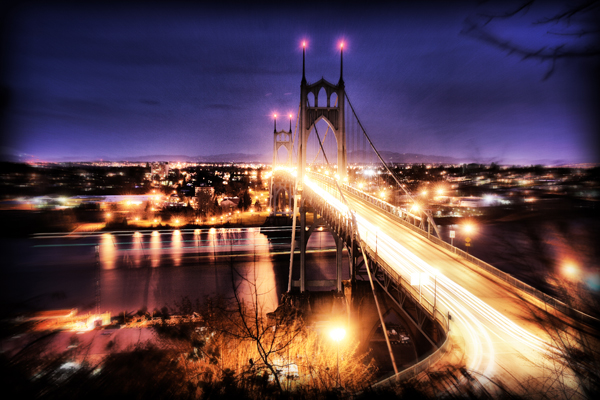
I recently made a concentrated effort to get a satisfying picture of the St. Johns Bridge and found some pretty decent vantage points along the ramp to the west end of the bridge. But all of this occurred well before the clinic, so I wasn’t yet trying to be thematically intentional. Looking back with what I know now, I’d say this is just a narrative/literal snapshot.


Mr. Schulman said he thinks the language of composition is ‘hardwired’ into all of our brains. He didn’t even want to talk about it very much, insisting that if you go out and take a lot of pictures, you’ll automatically begin to refine your sense of composition.

Walking up the road to the bridge, I stumbled upon an entrance to Forest Park’s Ridge Trail. With all the deciduous trees stripped of their leaves, I managed to find a few viable vantage points.

The 200mm zoom lens I’m using here kind of compresses the length of the long middle span so that the arc of the deck is emphasized…which to me, kind of speaks to the principle of ‘suspension’. The lazy counter arc of the main cables belies the heavy work the suspension cables perform. Unfortunately, I’m not using a tripod so I’ve tried to hide how ‘not tack sharp’ this image is by over post-processing it.


Do you think people would get upset if I cut a couple of trees down so I could get a clear shot?


Off trail a little bit, I found what appeared to be a primitive hobo camp with a mostly unobstructed viewpoint. It’s sort of an uncomfortable feeling to lug camera gear into isolated areas that show signs of sketchy habitation. There’s no telling what’s in those plastic bags. It could be stashed blankets, or a Mexican drug cartel stash…or maybe your wife’s head. I ended up feeling a little bit like goldilocks, hoping the three bears didn’t come home too soon… or those banjo players from Deliverance.


I don’t know…I guess it’s the kind of paranoia that’s fostered from the sight of syphilitic mice shuffling away from moss covered stairs and incongruously placed books along the path leading into the dark woods.


At first, some kind of psychological compulsion required me to include the entirety of  the signature gothic towers in my attempted compositions. 


The St. Johns Bridge: Entrance to Oregon’s own Gotham City.


This was my favorite shot, but without a tripod, it suffers from motion blur.


On a subsequent trip with tripod, pepper spray, and other defensive weapons, I tried to re-create my favorite scene. I still struggled with whether or not to amputate the front tower or not. In the end, evidently, I kept zooming in closer. Don’t ask me why. Ask my hard wired sense of composition.


f-14.0,  shutter-60 seconds, ISO-100 


These pictures were also taken before the clinic. But it kind of shows what I mean about hoping something will ‘speak’ to me. For the picture on the left, I walked out onto the span, familiarizing myself with the shapes and the lines and the weight of them. I liked how the first tower framed the second (enough to stand stupidly in the road with my back towards traffic) and how the road rises and hides what may be coming. Doorways and portals just naturally reek with symbolism, and so even without Mr. Schulman’s advice about ‘evoking meaning’, I think these photos may still have captured something evocative. For the picture on the right, I meant to explore underneath the bridge, but as the bridge came into sight, I could see the setting sun was illuminating only one of the towers, and I thought maybe that might work like a really cool spotlight and so… I framed it.


Here, three intrepid sperm swim toward the cervix, but only Sparky (on the left) has had the foresight to bring alcohol beverages with which to seduce the egg.


So I’ll have to go back again with a theme in mind and see if that helps.
If you should happen to capture an image of the St. Johns Bridge that turns out to be evocative, I’d be happy to post it here. Maybe we could all learn something?


Saturday, February 12, 2011

PADDLE THROUGH THE HEART OF PORTLAND

In the middle of the night
I go walking in my sleep
Through the desert of truth
To the river so deep

- Billy Joel
The River of Dreams

I had this idea to paddle down the Willamette through the heart of Portland (actually, I got it from a canoeist I met at the Willamette Park boat ramp during a recent excursion to Ross Island)…but Monkey-Cam didn’t want to go. He and Naked Picasso think they’re going to Nepal to surprise Rudder Starboard. One of the advantages of being imaginary is that there are relatively fewer constraints regarding money and travel. Fortunately, a Facebook friend (Mr. T., but he doesn’t have a Mohawk) materialized into an actual corporeal kind of friend and we were able to set up a shuttle from the Willamette Park boat ramp to the boat ramp at the St. Johns bridge.


Willamette Park Boat Ramp 01-30-11

This is the Willamette Park boat ramp at night. But it also pretty much serves to illustrate what the Willamette Park boat ramp looks like early in the morning, which is when we started – early Sunday morning – in hopes of catching the sunrise illuminating the Portland skyline. You might as well know from the start that I’ve assembled the following collection of pictures from several different trips to the downtown area. Someone (Gayle) talked me into participating in a picture taking project (typically called Project 365), the idea of which is to take at least one picture every day for a year and post it. This has resulted in, what is for me, a somewhat more eclectic range of photo subject matter, and some of these additional pictures happily help illustrate the narrative core of a trip through the heart of Portland.

The Willamette Park boat ramp is on the west river bank. It lies about even with the south end of Ross Island. I’m not sure what Ross Island originally looked like, but today it looks something like a toilet seat liner since its insides have all been scooped out and sent somewhere else to make cement. The remaining ring of land supports the last vestiges of a sand and gravel processing plant. Having thoroughly ‘used’ Ross Island, the Ross Island Sand and Gravel Company is making some effort to restore what is left of it as their profitable operations come to an end. Meanwhile, beavers and ducks wait on the periphery, hoping to move in. Much is made of eagle couples who choose to nest in its protected areas.


Tugboat moored in Ross Island Lagoon 01-30-11


Looking towards the city from the mouth of the Ross Island Lagoon 01-30-11


Support strut for the Ross Island Bridge. OMSI and the Marquam Bridge are in the background. 01-30-11


Marquam Bridge 02-06-11

I took a lot of pictures of the Marquam Bridge, but I guess the view from the river is not its best side. It’s an important bridge though since it supports I-5. It’s pretty much the hardworking, under-appreciated ugly sister to the Fremont Bridge (which is the prettier one that gets noticed). (I know, you’re sitting there thinking, what the hell is he talking about… it’s a picture of a submarine).


Downtown Portland Skyline through Marquam Bridge 02-06-11

Saturday night it was easy to imagine that the weatherman mistook the phrase “…30% chance of showers” for “…100% chance of a Noachian deluge”. But Sunday, the only moisture to be seen, besides the river itself, was the fog that hovered over the surface of the water in the calm air. It is always exhilarating to blunder into these Goldilocksian weather conditions hidden in-between the storms of winter. The temperature was just right and my breakfast beer/Clamato beverage seemed preternaturally nutritious.


Portland as seen from the east bank (Hawthorne Bridge to right) 12-19-10


Paddling under the Hawthorne Bridge 02-06-11


Morrison Bridge 02-06-11


View from the west see-saw-able span of the Morrison Bridge 02-04-11


Looking back up the river from the Morrison Bridge (Hawthorne Bridge in distance) 02-04-11


Looking back up river to the Morrison Bridge 02-06-11


Approaching the Burnside Bridge 02-06-11
(Note: Classic Pungo provided by Luv2Kayak Evangelism Department)


Twin peaks of the convention center from west bank 01-22-11


Steel Bridge framed by the Burnside Bridge 02-06-11


Passing under the Burnside Bridge 02-06-11


The moon over the Burnside Bridge 01-22-11


The twin peaks of the Steel Bridge are echoed in the convention center’s glass towers 01-22-11


A gang of runners crosses the river on the lower deck of the Steel Bridge 02-06-11


Passing under the Steel Bridge 02-06-11


The Broadway Bridge (Fremont Bridge in distance) 02-06-11

Taking this little trip is kind of like taking a mini survey of the evolution of draw bridges. They repeatedly and creatively answer the question, “How do we get street traffic across the river without interrupting river traffic?” Seen in the soft light of a new morning, these structures invoke in me a kind of pride in our specie’s technical cleverness. It is mathematics and physics made manifest (Note: While the Fremont, Marquam, Ross Island, Sellwood and St. Johns bridges are not draw bridges, they do show the stage in bridge evolution in which it was learned we could make them really, really big instead of movable.)


02-06-11

From this angle, the massive Fremont Bridge looks simple and elegant and virtually sings compared to the sturdy, workmanlike Broadway Bridge’s crass bar talk (I don’t know which I like more).


Presumably real stonework holding up the Broadway Bridge. The stone pieces fit so precisely together that you cannot slip a piece of paper between them so it follows that this bridge could only have been built by ancient astronauts possessing a technology far superior to ours (yep, that’s for you Robert). 02-06-11

The Broadway Bridge has been in service since 1913, almost a hundred years. In 1913 they drove horseless carriages – cars that looked something like the Ford Model T.


From the deck of the Broadway Bridge – west end 01-08-11


Looking south from the deck of the Broadway Bridge 01-10-11


Waterfront living along the west bank of the Willamette, as seen from the Broadway Bridge 01-08-11


Looking north from the deck of the Broadway Bridge 01-08-11


Approaching the Fremont Bridge 02-06-1


Bird’s eye view of Fremont Bridge 12-23-10


Perspective from industrial area under east end of Fremont Bridge 01-08-11


02-06-11

During the course of obtaining pictures for The Narrative Image, I’ve come to recognize certain characteristics of the natural world that lead me to constantly update and revise the following list.

Places not to build your house:
  1. On or near a strato-volcano
  2. On or near a river pouring down a strato-volcano
  3. Below sea level
  4. In a tsunami zone
  5. On the coast in the gulf of Mexico
  6. Kansas (just kidding)

And now,

  1. Near any large river unless you live on a boat

In retrospect...


…this was kind of a crappy idea.


02-06-11

As logical as the displacement of water resulting in floating metal ships sounds, me and the people who rode the Titanic have an innate understanding that metal should not float.


02-06-11

Beyond the oversight of the city’s sentinel like skyscrapers, the banks of the river sprout harsh looking buildings and docks with various embedded high pressure pipelines hissing and steaming and releasing unidentifiable odors. Broken and slumping concrete embankments dip into the river. Abandoned campsites, marked by wet blankets and plastic bottles, speckle the muddy beaches and brush between razor wire topped fences.


The St. Johns Bridge appears beyond the stark concrete piers of the railroad bridge 02-06-11


St. Johns Bridge 02-06-11

All day I was looking forward to getting to take pictures of the St. Johns Bridge, but as pretty as it is, I just can’t seem to get an image that does it justice.


St. Johns Bridge 02-06-11

The canoeist told me that it took him and his wife four hours to get from the Willamette Park boat ramp to the St. Johns boat ramp. He said they also stopped along the way and had a nice picnic lunch. It took us about six hours and should have been faster and easier in kayaks. I guess if you want to do this paddle trip yourself and you’re in a hurry, don’t go with a photographer.

Featured Post

EVOLVING ROADS: Car camping with Kip and Rico (Part One)

I don’t know how it started for sure. Some intrepid band of Homo sapiens maybe walked over a land bridge from Russia or navigated the seas i...

POPULAR POSTS

The Narrative Image NAVIGATION AID