Showing posts with label fishing. Show all posts

Wednesday, September 20, 2023

Hawaii, Owyhee...uh, Böglands (The Final Chapter)


Photo Credit: Kip

The light from another morning begins gently assaulting my eyelids, so my comatose body instinctively begins to burrow like a worm, forcing my face into a loose amalgam of swaddled-up fleeces and t-shirts - the makeshift pillow I build every night (because I forgot my pillow). My liver has never really had to metabolize alcohol on a regular basis, so feeling ambushed, it grudgingly does its work to restore what passes as my typical chemical balance, asking only that I be still and unconscious.


A sort of peripheral consciousness jury-rigged by my ears informs me that Kip and Rico are rooting around in their vehicles for implements of destruction, lug nut wrenches, jack handles, hammers, and pry bars, anything that might steal a geode from the grasp of its mother.


My liver is not the only organ of mine that is being taxed. Evidently, a significant portion of my neurons were slaughtered near the end of yesterday and synaptic first responders are desperately trying to rewire decimated transmission lines and repurpose some of the few mental structures that are left standing in a bid to reestablish my baseline reality. It is becoming ever clearer to me that whales cannot float…well, they can’t float on air… especially not in a landlocked desert canyon.


The noise entities that are Kip and Rico begin to fade. Now the aural soundscape is mostly leaves whispering in the dawn breeze and an occasional rock tumbling down a scree slope. Now and then a distant shout of garbled vowels and consonants conveys directions or advice… or exclamations. Now and then heavy metal objects clang and vibrate as they smash into rocks.


The last time I partook in a harvest of geological booty, was with Kip and Rico back in 2018 when we visited Oregon’s sunstone capital (near Plush, OR).


While the hunt for sunstones contains all the joys of hunting for Easter Eggs (minus the dying of, hiding of, and eating of), not having any conception of what to do with them once you obtain them makes them something of a conundrum for me. In desperation, I used my sunstones to bedazzle, Elton John style, a pair of old reading glasses. The resulting fashion accessory works better as an exaggerated narrative than an actual art piece.


As the sounds of Kip and Rico began to recede and morph into the form of distant echos, the fear of ‘missing out’ finally motivates me to resurrect myself from the oblivion of sleep. I squirm out of my rain-fly and begin picking my way up the slope, relearning how to walk. As the angle of the slope becomes more severe, I alternate my route between slippery burnished dirt and teetering slabs of scree depending on which is most likely to give my steps more purchase.


I ran into Kip as he worked his way along the rocky columns that thrust out from the top of the scree skirts. He was already coming back from the high cave we had all seen last night, and his report did nothing to dissuade me from seeing it for myself.
 

It was kind of like, I imagine, seeing the pyramids after the tombs had been ransacked - or a jawbone after all the teeth had been pulled out. But then, that isn’t quite fair. There were geode-shaped cavities, of course, but there was also still a wealth of geode matrix lying in wait for anyone with a geologist’s hammer or shaped C-4 charges.


I looked carefully at the pockmarked surfaces and while I wasn’t sure what the mechanism was for the formation of concentric spheres, at least I could see hints of how minerals leeched into the structures and consolidated over time.


I absolutely would not return here without a rock pick.


Uncle Rico placed a modest collection of various geodes on the picnic table. He had found a distinctive black one and a distinctive white one and arranged it all to conjure an ad-hoc yin-yang symbol. I was beginning to feel pangs of envy regarding his metaphorical-capable artifacts but got distracted by the salsa and avocado leftovers that hinted that tacos, at one time, must have existed here. Synapses sputtered and fired, but clearly, there were holes in my memory.

At this point, Rico began trying to sell the idea that we should go off-road to investigate an anomaly he had observed during the approach to Succor Creek the day before. But all I could think about was the horrifying possibility that I had missed a taco dinner. I mean, you wouldn’t just slice up a plate of avocados and fork the bits into your mouth. You’d obviously use the avocado to dress a taco. Right?


But Rico, oblivious to my distress, kept describing an unnatural black line he’d seen in the hills across a broad valley. Rico felt certain that whatever the black line was, it was a man-made feature. “It’s probably a fence or wall.” He said, “But it’s definitely an ‘unknown’ that we should investigate as we explore these mysterious Böglands.”

Here we go again, I thought.

Whatever!

I was busy focusing on the half empty can of salsa while half listening to Rico. It seemed he somehow attributed this mystery-wall to local baguettes. That made about as much sense as calling the Owyhee Canyon Lands the Böglands (No bogs…and not all that many bugs).

When Kip turned out to be enthusiastic about exploring Rico’s mysterious Bögland’s anomaly, I wasn’t a bit surprised. Besides, I have to admit that I was curious about the supposed connection between long, thin, French bread and unidentified landscape features. GPS data was quickly consulted and we soon set out in our two vehicle convoy, leaving Kip’s tent as a marker to reserve our spot at the campground.


We resumed the familiar neck shimmying rhythm of high-suspension vehicles lurching left to right - consenting to swaths of time during which we resembled nothing so much as bobble-head toys.


The convoy came to a stop at the base of a long stone fence made of the fractured native stones that lay scattered across the hillside. The rocks appeared to be stacked on each other in a haphazard fashion. There was no evidence of any dressing of the stones, or even really any fitting. Nor was there any distinguishable mortar.

Rico popped out of his Jeep and walked around to the back. He raised the hatch, which, stuck wide open, served as a lone spot of shade for him as he rummaged through an ice-chest.

“What does this have to do with baguettes?” I asked.

“Not baguettes,” He replied as he handed out ice-cold beers, “Basques.”


In the late eighteen hundreds Basques, immigrants from Southwest Europe, were so numerous in Jordan Valley that it was called “The Home of the Basques” (In fact, the handball court I thought I saw when we drove into town was really a Pelota Court built by local Basques in 1917). A significant portion of them, the immigrants who arrived after an initial rush of gold prospectors, made their living farming and raising sheep.


Presumably, then, the fence we walked was an artifact of early immigrant farmers, who combined the task of clearing their fields with marking boundaries and limiting the movement of sheep and other livestock. The stone fences stretched for miles, and I suppose the barbed-wire sections we surveyed were later additions that offered a less labor-intensive solution to stacking stones.

Occasionally I’ll bid a small job, something like painting a bathroom, and when all is said and done, I’ll find that my original estimate was very accurate. But as I stand along the stone fence and watch it curve up out of sight beyond the distant hilltop, I find I can’t even hazard a guess on hours required, or even the size of the crew. I get the keen sense that the people who built these fences could never have imagined a future in which it would have been possible to spend a day on a comfy sofa binging a season of a favorite television series.


Rico and Kip, clambering ahead on legs decades younger than mine, reach yet another false summit and determine they’ve explored as far as they need to and rest. I’m lagging behind, intentionally laying out a path of exaggerated switchbacks as I weave between stubbly clumps of grass. I’m doing all I can to avoid planes that are anything but level. The exercise is what I need. The sun squeezes the alcohol out of me through my sweat holes.

The stone fence reminds me of the vast treeless plains of Kansas, where early settlers in need of fences figured out how to substitute limestone posts for wooden fence-posts. I planned to tell Kip and Rico about it when I got to the resting place, but by the time I get there, they are ready to head back down.


Back at camp, Kip takes on the role of chef and begins heating up a frying pan. My assumption is that more fish filets from the coolers will soon be bubbling in hot oil, but when I chance to Iook, I see a horrifying pink composition suitable for a constructivist painting.

Kip is smiling like a mystic in the throes of a beatific vision as he deftly sorts the pink cubes with tongs.


I choose a smiling expression for my face which I hope will temporarily act as a mask. Meanwhile I am in turmoil. Did I ruin my brain yesterday? Did I permanently alter my baseline reality? Everything seems normal, but instead of fish, for some reason, I think I see Spam!

I turn to Rico, hoping to see how he is reacting, but he is wearing a smile like an evil Stephen King clown. He is somehow able to see through my fake smile and he whispers, “What’s the matter? You’ve never seen Spam before?”

I play along and we make our elaborate tacos as usual. They become the best Spam tacos I have ever eaten. Do these qualify as three species tacos, we wonder? But really, there is no telling how many species might be in Spam.


The next morning, we pack up camp and leave the Succor Creek camp area behind us. I ride shotgun with Kip while an actual shotgun rides shotgun with Rico. It isn’t long before one rabbit or another, sitting frozen in perfect camouflage, loses its nerve and breaks into a panicked sprint as the convoy bounces by. This only serves to bring them to Rico’s attention. Rico, in these instances, slams on the brakes and springs out of the truck, shotgun blazing. He is like an Old West gunslinger, except his quick-draw routine has the added complexity of an off-road vehicle element.


I never see the rabbit until I see Rico’s barrel pointing the way. Then, as I focus, I briefly see a fluid streak airborne, with a rhythm diametrically opposed to the mechanical bumping of a Jeep. It’s all muscles and the lever principle honed by millennia of galloping predators and swooping raptors - a masterpiece drafted by generations of masters - giving it a one-step advantage in a race for life - a race it can’t win in a hail of steel pellets.

There’s an explosion and my eyes flinch shut (they always flinch shut) and I smell the gunpowder. And when I open my eyes, there’s a breeze ruffling the soft belly fur of a still, quiet rabbit.

Rico has claimed another treasure from the Earth, and to make full use of it, he immediately field dresses it. He scolds me for taking a picture of the rabbit in its awkward state and yet this is a mystery I seldom have ever seen and can’t look away from - life so immediately gone. The body yet warm and supple - as if it were sleeping.


Rico does his work on a stone altar, next to a nameless creek…


…witnessed by anonymous trees.
 

We climb another long gradient out of a valley, up toward the crowning plateau, stopping briefly to allow the cars to cool.


Then we begin sifting our way down into the Owyhee River Canyon again, this time toward the lower end of the reservoir.


Here is the last stronghold for water in a parched landscape.


Here, the boat ramp still tickles the edge of the water.
 

And visitors have learned to bring their own shade with them.


No store is open at this place, but we do find a vending machine that dispenses ice and take full advantage of it.


That dam glory hole.


Down there out-of-frame off to the right is the dam bridge, and beyond that our next campsite along the river.


Slowly, the natives come out to greet us.


There are more than we first thought, hiding in plain sight. Later, when we break our food out, the lizards make a deal with us, offering to take care of the flies that pester us in exchange for seats around our stove.


We don’t make any friends with the fly-fishermen in these parts when it becomes evident we will be keeping our fish.


Rabbit adds a novel flavor to the evening’s two species tacos.


Tomorrow’s journey will last the better part of the day, and during that time we will be forced to ease our way back into the apocalyptic milieu we left behind. We will see snapshots in time of Oregon East to West, all in one day.


We will once again rejoin daily commutes - retrace the same path day after day - exchange our freedoms for paychecks which we will use to wrest back bits of freedom.


Multi-lane roads happen because of the demands of traffic. Lots of traffic requires a bigger infrastructure. And if a lot of people are on that road…well, there’s wisdom in crowds. Right?

Saturday, August 19, 2023

Hawaii, Owyhee...uh, Böglands (Part Four)

As near as I’ve been able to calculate, the red arrow points to our base of operations on the Owyhee River. This location is at the bottom end of about 48 miles of class II and III rapids - that is, if you happen to be there in the middle of May. If you’re there at the end of August and maybe during a season of drought, traveling by raft is rumored to be problematic.

Sitting in the shade, fishing and drinking beer is nice, but you can’t do it all day. Well, actually, you can do it all day, but we were also cognizant of other points of interest in the canyon.


One such site was archeological in nature, but the people who know of such sites tend to be protective of them - and for good reason.


(LEFT: pictogram peppered with bullet scars. RIGHT: Same image modified with Jon Harmon’s DStretch to better delineate the original art.)

For instance, this antler man that appears near Maupin, Oregon appears to be the victim of fairly intensive target practice.


(TOP: Various carved images - a medallion, a humanoid figure and a sunburst all defaced with spray paint. BOTTOM: The same image modified with Jon Harmon’s DStretch reveals a layer of spray paint that betrays a more modern, angsty origin.)

And these carved petroglyphs (also near Maupin) appear to have been covered in various layers of spray paint.


(Detail of the humanoid carving that appears beneath the ‘N’ in Tanya)
 

(TOP: Original image of pictograms in Picture Gorge. Note graffiti scratched over the top. BOTTOM: The same image modified with Jon Harmon’s DStretch to better reveal the extent of the original pictograms.)

And these Picture Gorge pictograms have likely been damaged by someone wielding a sharp rock as a scraping implement.


Because of the protective reticence to share indigenous rock-art sites, the search for such places becomes something of a puzzle…or a treasure hunt.


Fortunately, Rico is pretty good at teasing the details out of arcane archeological papers and texts…and matching such details to pertinent landmarks.


We end up at a spot that looks like it would have been a pretty nice camp for a slightly bigger, higher river. Perhaps the level area where we parked would have been a nice broad beach.


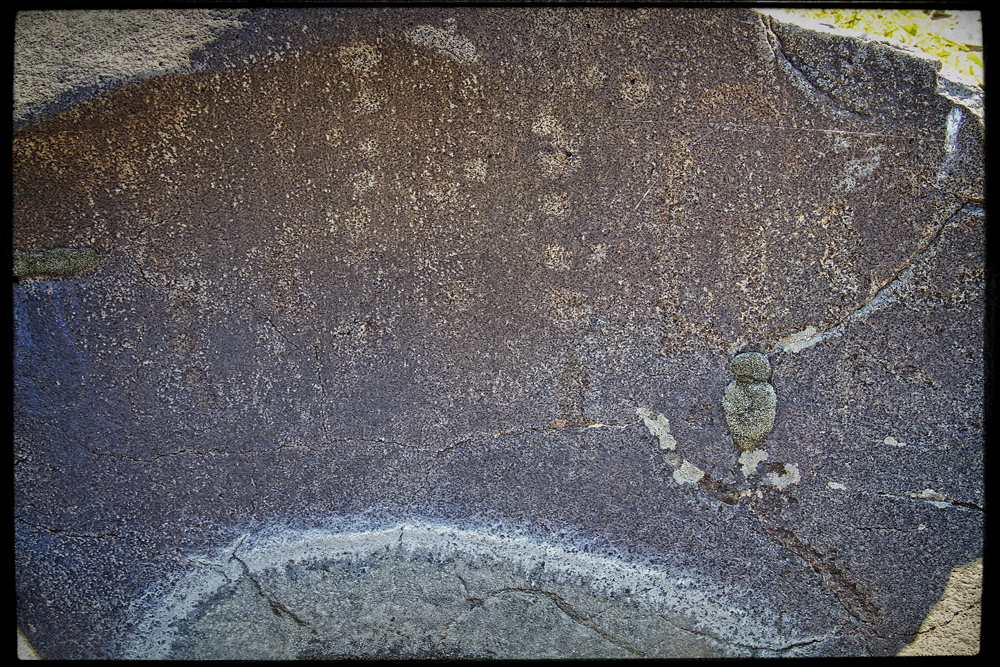
Nearby, a mound of earth features large river polished rocks. Some of these large boulders feature expansive flatish surfaces.


In some cases, it is possible to identify pecked markings - markings formed by the removal of the darker desert patina from the rock’s surface, leaving the lighter substrate to stand out as an intentional design (There may be a pecked oval shape in the center of the rock above).


Elsewhere, where the desert patina does not provide enough contrast, or the artist intended to make a more emphatic point, the pecked lines have been invested with more time and effort until they have become engraved.


I’ve broached the topic of rock art before: https://thenarrativeimage.blogspot.com/2013/11/a-mystery-wrapped-in-enigma-squeezed.html 


…so without going on too much of a tangent, I’ll just say the mystery of it is perpetually tantalizing to me. It’s like finding a message in a bottle…but in a language nobody speaks anymore. How important is the message? Was it sent by someone facing death on a sinking ship? Did seven stranded castaways try to reveal the location of their island? Or is it just advertisements for some shady shaman’s latest herbal remedy or a pubescent youth’s love proclamation for his parallel ‘Tanya’?


Anthropomorphic figures seem to lend themselves to narratives, but it is hard to get beyond pure speculation. I want to know why someone felt it was worth their time to tap a stick figure into a rock next to the river. I try to imagine what the landscape looked like when the drawing was created. I wonder about the art’s placement on the rock. Is the figure obvious, like a sign? Or is the viewer required to climb to a more precarious viewpoint?


Then, while struggling to identify the patterns and the symbols, one must also guard against the tendency to see patterns where they don’t really exist. Am I looking at a meticulously rendered grid pattern, or is this just the way a crystalline basalt weathers over a thousand years?


I find the urge to interpret irresistible.


While this image is visible from the ground, I find I can get a more encompassing shot of it by climbing on top of the rock it’s on and standing. I don’t see it as an animal or humanoid. But maybe it depicts a road - a path - or maybe a map.


(LEFT: Rock-art. RIGHT: Google Earth map)

Just for fun, I check out the landscape as depicted in Google Earth and compare it to the rock-art carving.


Other rocks perhaps carry tally-marks - the counting of specific events, or visits?


Some of the rocks seem to show evidence that a substantially larger river carved and shaped this landscape.


Here, a large boulder appears to have been carved into a big bowl. One explanation for this structure is that it is a pothole - a circular impression in the rock caused by turbulent swirling water that utilizes pebbles and sediments to abrade the rock. These often appear in flowing river beds and absolutely gigantic examples can be found up in central Washington in the landscapes carved by ice-age floods.


In fact, there were countless examples of carved out pot-holes on the Umpqua River.


Closer examination reveals that this naturally formed feature has been further refined and decorated. Could this natural indentation have served as a sort of mortar for the processing of grains or medicinal plants?


Given that context, could the markings then be interpreted as a sort of recipe (especially if we assume a much (much) more verdant landscape)?


Of course, now my naive speculations have taken on the ridiculous timbre of pseudo-scientists hawking ancient alien theories. “Could these deep gouges in the rock really be made by mere humans using nothing but sticks and stones, or, is it more likely that this is evidence of aliens with advanced technology?”


(Shout out to Atomic Arts Theater Company for those 5 years when they did Star Trek in the Park - Scene from Journey to Babel.)


The old rock art makes you wonder. Was this area a village? Was it a well known destination? Did it mark a river crossing? Did it mark a boundary between nations? Was it simply an excellent place to fish?


We can at least test that last one out by running a few experiments.


We head back to base camp as the sun approaches its apex.


(Photo Credit: Kip)

At this point, we have been aware of a cluster of house-like buildings up river, but we don’t yet know if they are occupied. This time is as good as any to see if we have neighbors.


 We appear to be alone.


(Photo Credit: Kip)

Back at camp, Rico uses his meat thermometer to give us some idea of how hot it is. Rather ominously, when the breeze blows, the temperature climbs a few degrees more. I begin to appreciate the culture(s) that came up with the idea of siestas.


Soon, we are able to seek out fishing spots next to the river again.


(Photo Credit: Kip)

 Joyful patterns repeat (This is Kip’s stringer)


We are growing short of ice and gasoline. We begin to contemplate tomorrow’s egress from the canyon.


Do you need to catch up with the story? Then follow these links:


PART 1: Hawaii, Owyhee...uh, Boglands (Part One)


PART 2: Hawaii, Owyhee...uh, Böglands (Part Two) 


PART 3: Hawaii, Owyhee...uh, Boglands (Part Three) 


PART 5: Hawaii, Owyhee...uh, Boglands (Part Five) 

Featured Post

EVOLVING ROADS: Car camping with Kip and Rico (Part One)

I don’t know how it started for sure. Some intrepid band of Homo sapiens maybe walked over a land bridge from Russia or navigated the seas i...

POPULAR POSTS

The Narrative Image NAVIGATION AID