Showing posts with label sunrise. Show all posts

Thursday, February 25, 2016

A FEW MOMENTS I WAS IN (While Moving Furniture)

I helped Mr. and Mrs. P move some furniture to a beach house in Lincoln City.  On the morning we were to load the truck, menacing rain clouds demonstrated their ability to saturate the earth at will with intimidating bursts of precipitation. Not to be nonplussed, Mr. P, who seemingly has the right tool for the right job (no matter how obscure) demonstrated his determination to beat the clouds by pulling a tarp out of his shed that, in its folded state, was just a little bit bigger and heavier than all the furniture we had to move, and unfolded, well... let's just say that standing on opposite ends, we couldn't hear each other over the vast distance unless we used walkie-talkies (and even then we had to gesticulate wildly like near-sighted monkeys).  Once the huge tarp was deployed, the rain clouds moved on to easier prey. In fact, it wouldn't rain again for the duration of the task.


A picture of the coast just South of Lincoln City which doesn't really illustrate anything I've written about so far.
Turns out I like moving furniture with Mr. P. 
Although Mr. P has the stature of a man who could move things by brute force if he wanted to, he doesn't. I'm not saying he's old, but he's lived long enough to have experienced countless moving events (not because there are too many events to count, but because he can't remember them all) and he possesses the native intelligence to remember a few hard-won helpful pointers. This has resulted in a methodical approach to moving that emphasizes economy of energy. So, even though I'm out of shape, I can count on plenty of 'rest pauses' as furniture shapes are mentally juggled like Tetris blocks in Mr. P's impressive mental-simulation where complex problems are solved prior to any physical exertion. Sometimes it takes me a while to come around to his way of thinking, but if I listen to his advice, I'm sometimes treated to mini-miracles, like when three and a half foot wide sofas fit through three foot wide doorways at the bottom of tight stairwells (and all accomplished without saws or sledge-hammers... or sheet-rock repair).


Grass holding on to the land for all it's worth and pointing in alarm at the impending approach of the ocean. This picture is still not addressed in the body of the text.
The quiet diesel engine chattered away in its normal fashion that makes gasoline engine drivers worry about the oil level but which goes unnoticed by diesel engine drivers. The expansive tarp billowed here and there, but couldn't escape from the near infinite number of straps and cords that contained the furniture securely like a papoose strapped to a cradle board. I say 'infinite number' because Mr. P couldn't remember exactly how many straps he has, and every time I thought they were used up, he'd pull another one out of the truck like a magician.


The waves don't seem to be able to reach up this far, so perhaps the erosion is caused by the ceaseless trampling of visitors like me, who scramble up and down the cliffs in search of remarkable vistas. In any case, it is easy to see the exposed roots, and thereby understand how grass can be so important in stabilizing soils perched atop basalt capes.


Once the truck was unloaded and the furniture placed in approximate positions, Mr. and Mrs. P took me on a short orientation tour of the area, the highlight of which turned out to be a journey through a maze of tortured trees to Fishing Rock. The maze was a manicured tunnel through those wiggly trees you only see at the coast or at timberlines - those trees that mark their lives in brutal wind and thin rocky soils by tracing their anguish in the contorted shapes of their limbs. I admired the trees. They manage to grow in the face of adversity. But then, they have to. They have no legs. The fact is, they're stunted, and I bet if they could walk, they'd saunter off immediately like so many whip-smart octopi. This made me begin to feel ashamed for sticking it out so many years at my job because it turns out I have legs. I guess you have to be honest with yourself and figure out if you're NOT quitting because you think you will eventually win, or if you're not quitting because you've got nowhere else to go. I guess you also have to be able to look carefully in a mirror every once in a while and see if you're starting to resemble Quasimodo. I'm not sure what the lesson here is. I still harbor an idealistic notion that one person can make a difference, but the trees make me acutely aware that legs have survival value. 

Speaking of trees and lessons, when someone takes you on a tour through a winding tree maze, you should actively participate in the navigation process and construct a mental map...because you never know.


From atop Fishing Rock, you can look down on various inter-tidal micro eco-systems and marvel at the various manifestations of life that stake out patches of sheer rock as nurseries in the face of  hydraulic battering rams and ultraviolet showers.


Sunday's waves stirred the ocean into a froth and hurled themselves into the pillow-basalt rocks and cliffs of Fishing Rock. The hard basalt retreats a little bit each day, and has done so ever since its molten lobes erupted out of the cold water 50 to 70 million years ago. Maybe it is instructive to note that in the midst of a venue where water perpetually hammers rocks into sand,  a multitude of transparent, passive blobs manage to thrive. While it is never on the perennial list of top ten spirit animals, the jelly-fish, with its 700 million year success story, is perhaps under-rated.


I slipped out of from under my backpack and pulled out the shutter-remote and the tripod and started dicking around with the quick-release tripod legs which haven't really been 'quick release' since the salt-water dunking they took at Thor's Well. I walked back and forth along the rock, comparing views and visualizing scenes, thinking ahead to potential sunset pictures. Mr. and Mrs. P were likely reminded of headless chickens and politely dismissed themselves. While I wasn't paying attention, the sun made a break for the horizon, catching me undecided and unprepared.


Alone, I was able to explore the low light capabilities of my camera, and watch colors bloom and fade in a steadily diminishing dynamic range of light.


Alone, I felt the rumble and the threat of the returning tide. I took for granted that morning was already on its way. The full moon rose behind me as the west horizon's red halo faded to a pinkish pastel. Soon, the stunted forest's unkempt comb-over of a canopy glowed blue in the moonlight and the marine air seemed to thicken and become visible and mute the pounding surf. The calm air felt like a blessing of peace in a land of volatile extremes. I didn't feel at home...but I did feel lucky.


Later - much later - clouds amassed in a vast tower above the end of the shore, like a lopsided mushroom cloud, and spilled out over the ocean... but succeeded only in obscuring the moon-set.


The subtle return of color heralded the sun's approach, long before it became visible.


The Pacific (peaceful ocean) spastically slapped against the steep sand incline, straining for the cliffs it savaged during the night, but the moon slowly pulled it away, much like old Mr. Sullivan breaking up a fight during P.E.. The houses above the cliffs stood at the edge, whether arrogant or slow, still symbols of the good life.


In the morning, I negotiated the stunted tree maze with considerably more success than I did during my nocturnal regress when I unexpectedly explored several wrong paths. Sun beams filtering in through the canopy served to indisputably mark the proper cardinal direction if not the actual path. Still, the path tributaries of the maze point into the forest like a river draining into the mouth of Fishing Rock. Exiting the forest is more like searching for its unknown headwaters.


Not far to the south, Fogarty Creek meets the ocean, but can barely be compelled to enter until coaxed by low tide and the resulting elevation difference. Here the ocean waits for beachcombers who aren't paying attention and sneakily fills their shoes with salt water and sand, also wetting their pants for them if given the opportunity.


It was just cold enough in the morning shade to make emerging sunbeams as welcome as a masseuse's warm fingers on a tired knotted back.


Fogarty creek takes an uncertain path through the sand standing between it and the ocean. Its meanders are determined by the way the ocean has sculpted the beach during it's brief six hour reign. Plants trying to set down roots can get a little frustrated.


Just North of Fishing Rock, the ocean has stripped all the sand off the beach leaving a black layer of what feels, to the finger, like clay but which cushions the shoe like rubber playground mats. Everywhere in this layer is evidence of a vast forest. Fully rooted stumps poke out of the layer, their tops battered and splintered. 


Neighboring stumps twine their roots together as if in support.


Great logs, like fallen soldiers, lie in between the stumps.


If I imagine the scene covered in moss, I could easily pretend to be hiking along any rain-visited coastal forest...albeit with pretty extensive wind damage.
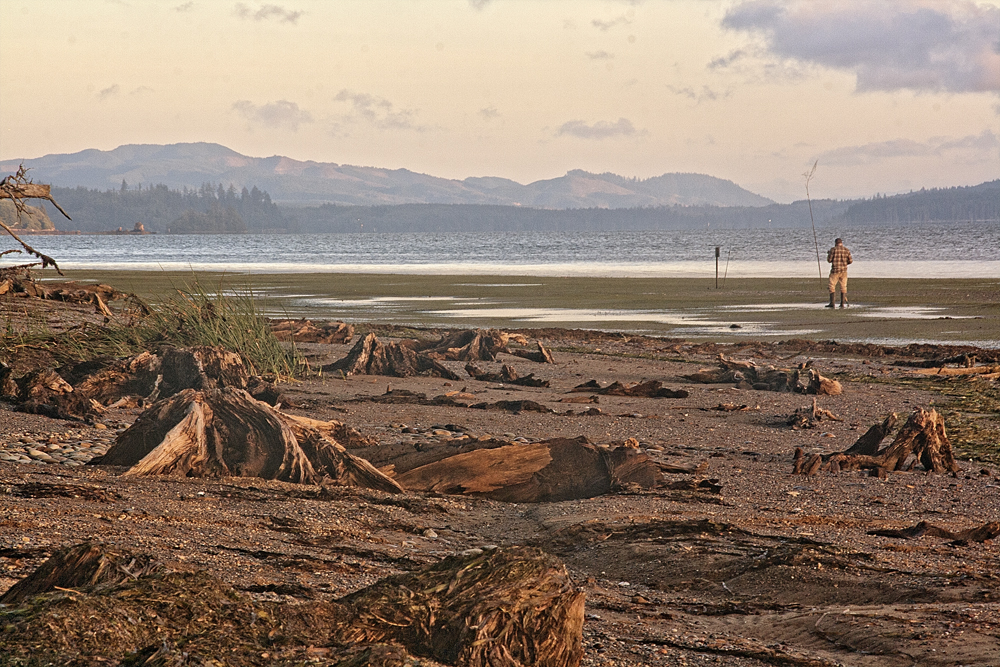


The trees are not petrified, but they don't belong in an intertidal zone and so I was faced with a delightful science mystery. How long does it take for wood to disintegrate? How long does it take wood to disintegrate underwater? Is there enough evidence to say that this was indeed a forest, and not a layer of driftwood buried in something besides sand? If it was a forest, was it a 300 year old coastal forest dropped into the sea by the last subduction zone earthquake (this was the theory propounded by Uncle Rico just before his unfortunate demise during the Dungeness crab spawning event at Willapa Bay back in 2014)?

See also, this short video clip that describes what happens to the coastal geography during a subduction zone earthquake: https://www.youtube.com/watch?v=6wWnWtFQpNE

On the way home from the coast, as the big 'quiet' diesel chattered over the top of the coastal range, the moon suddenly appeared on the eastern horizon in that big way it has of looking like it has escaped its orbit and is plummeting headlong toward earth. Mr. and Mrs. P both thought it would make a wonderful picture, but I knew all I'd end up with is a featureless white dot on a black background, and that the two of them would long be out of patience by the time I'd set up the appropriate gear to get anything more. So I tried to explain how sometimes it's just better to appreciate the moment - to be entirely 'in the moment' and not distance yourself by working to document it - to be a participant and not an observer, just like Sean Penn explains to Ben Stiller as he passes up a chance to photograph the long sought after snow leopard he has tracked down high in the Himalayas. They thought this explanation was funny (or maybe stupid) and Mr. P teased me mercilessly about appreciating the moonrise 'moment' for the entire fifty miles it loomed in the front window, particularly when we passed by a scenic alpine lake that reflected the moon in a breathtaking image that he was sure would have been an award winner.

What were we talking about?

I forget.


Wednesday, February 27, 2013

Holy ground

"...And every common bush afire with God: But only he who sees, takes off his shoes,..."

- Elizabeth Barrett Browning


IN DARKNESS, at the east edge of Smith Lake, I pushed the canoe off the ice rimmed shoreline into the cold dark water and headed west. An icy whisper of wind stirred up a train of wavelets that gently splashed against the bow and retarded my progress, but the paddling kept me warm. In those moments of transition, as the sky lightened, and the trees began to murmur, I recalled the words from the creation myth that my particular culture endorses.

"The earth was without form and void, and darkness was upon the face of the deep; and the Spirit of God was moving over the face of the waters. And God said, "Let there be light".

I turned the canoe around and stopped paddling. I floated in the middle of the lake and watched the sunrise. I thought I could hear the earth turning.


The wind scribbles patterns in the lake as if it were a finger-painting. In the space of minutes, the water's character goes from spastic to languid. I wonder if the author of the creation myth ever had a canoe.

Turning back around, I see the sun has painted the barren trees with fire. As I draw closer, I am reminded of yet another mythic story.


"And the angel of the LORD appeared to him in a flame of fire out of the midst of a bush; and he looked, and lo, the bush was burning, yet it was not consumed."

I know about myths and metaphors. I marvel at the complexity of life as accomplished by the cumulative effects of natural selection. I am sensitive to the beauty of patterns elicited by speeding photons striking the back of my eyes. I even convince myself that I recognize the difference between fiction and truth, that I know the difference between narrative stories and news. Yet some stubborn superstitious, story-telling part of me wants to tell you that in the magic hours of a Saturday morning, I saw a bush that burned without being consumed.

Text and Images copyright scott dietz 2013

Thursday, January 21, 2010

WILLAPA BAY: Decisions with Gravity


Long Island - as seen from the WNWRH boat ramp

The bulletin board at the Willapa National Wildlife Refuge Headquarters’ parking lot had a tide table posted, but it was for December, and I was already more than a week into January. The tide table itself was a marvel of graphic economy: For each day, a vertical sunrise and sunset line were superimposed over two mismatched blue humps in a space the size of a postage stamp, ostensibly to give an approximate idea of when the bay’s water would be high or low.
I tried to divide the space between the lines into twelve units and pick the one that correlated with the high point of the blue graphic, but reckoned my margin of error might be a range of nearly six hours. Then, because I didn’t really know how much the tides shifted each day, I suspected that the unhelpful range I was considering (based as it was on an expired table) was really nothing more than wishful thinking.
Sitting in my packed kayak, poised in the water at the foot of the boat-ramp, I could see grass and sticks slowly floating past, unwitting volunteers headed for the ocean. This made it clear to me that I had missed the high tide, but I still clung to the idea that maybe I had not missed it by much, and honestly, how fast would the bay empty out anyway, even if the tide was ebbing?


The answer (it turns out) is, “Pretty damn fast”.


A maze of mud walls rose out of the water.
Also, it didn’t escape my attention (while I frantically searched for a suitable campsite among the frustratingly meandering, vanishing sloughs of Long Island) that yesterday’s rainclouds were not gone after-all, but only hiding behind a low line of hills.


By paddling along the outside edge of each bend in the slough, I managed to stay in carved channels deep enough to keep me afloat.


A fortuitously placed tree trunk gave me the footing I needed to exit the kayak and scale the increasingly imposing mud bank.


By the time I had the tent set up (on ground that was suspiciously spongy) my avenue of escape was simply gone.
The mud remaining in the channel had the consistency of tomato soup… but it didn’t smell anywhere near as nice.
I would have to survive here until the next high tide.


It wasn’t too bad. The slough had provided (however briefly) passage into the interior of the island where both topography and tall trees provided a sheltered space like the eye of a storm. Mist emanated from the wet grass like steam over a cup of coffee. Birds sang from hidden perches. Whales bounced tiny blasts of sonar back and forth from forested bank to forested bank…
well…probably not whales.
I sat quietly and waited to see if I could identify the unusual noise.
Then, suddenly, the sharp crack of wood on wood came filtering through the thick forest behind me as if free spirited monkeys had stolen all the rhythm sticks from some elementary school music-room and employed them in a spastic sword fight waged high in the swaying tree tops. “Monkey-cam! Is that you?” I wondered.
I went to investigate.
It was only four-thirty but the sun already seemed to be setting. Entering the forest was almost like entering some vast cathedral. Towering bark covered columns (most closely resembling the Corinthian style) reached toward heaven, their capitals supporting a dense green canopy shot through with the last dying rays of the sun, perhaps the inspiration for stained glass.
Even with my camera’s ISO set to 1600, my shutter speed was a miserable 1/10th of a second or longer and I hadn’t brought a tripod. Experienced photographers will instantly recognize that these are precisely the conditions that presage remarkable occurrences likely to make one wish they had brought a tripod.


Back at my emergency camp, as it got darker and colder, I broke out the new stove and cooking gear that my sister and her husband Ron gave me at Christmas and fired it up for the first time. I think my sister sometimes worries about my propensity to hike or kayak solo and she and Ron seem to have taken it upon themselves to provide me with items that might potentially one day save my life. They bought me a headlamp when they noticed I hardly ever made it back from hikes before sunset. They bought me a Gore-Tex paddle jacket after I told the story about Fred capsizing in the Columbia. They even bought me a pocket knife with a wickedly sharp serrated blade when they read the story about the lone hiker who saved himself by cutting his own arm off after he got stuck by a huge boulder for several days.
If that isn’t love…


I poured a 16 ounce beer into a pan and boiled a couple of brats. When they finally split their skins, I crammed them into toasted stadium buns with Tillamook sharp cheddar cheese and Tabasco sauce.
While tackling the second brat, I eyed the steam rising off the golden beer. The world was turning gray and cold and the wafting aroma of beer suggested the ambiance of a brewery. Why not drink the warm beer I wondered. How much worse could it be than coffee?
The answer, it turns out, has something to do with sausage grease.


The stars came out with surprising intensity. To the south, Orion the hunter lay horizontally across the tree line like some Indian yogi lying on a bed of nails.
It was time to try out the new tent.
I’d be interested in knowing what the creators of this particular tent were thinking when they had the audacity to label it a two man tent. Perhaps the word ‘two’ really means ‘one’ in other countries where tents are assembled.


trail mix
And while I’m being critical, just whose idea was it anyway to put so many peanuts in trail mix. I mean, I understand that peanuts are very nutritious and that their protein content allows them to release energy over time, but really, once that stuff goes through the ‘grinder’…


peanut butter

… all I can say is I’m grateful I had a roll of paper towels.
The new tent was fast and easy to set up, but after an hour or so, condensation issues had soaked my sleeping bag, a process that was likely accelerated by the fact that I hadn’t brought one of those foam pads to sleep on. I always considered those foam pads important primarily for comfort, and since the pads I had tried out over the summer were not comfortable and/or screwed up my back, and since they take up considerable space that I don’t have in the kayak, I had mostly been doing without them. This time I think I learned that their insulation qualities are probably their primary purpose and that comfort, if achieved, is just sort of a lucky side effect.
I tried to stave off heat loss through conduction by sleeping on my side and thereby reducing the surface area in contact with the ground, but I got cold anyway. Eventually I ventured out to the kayak to retrieve my personal flotation device and was fairly successful in using it as an insulation layer.
Things to think about in a tent on an island when you can’t sleep:
Are those sirens echoing across the bay part of the tsunami warning system?
Did the guidebook really mean it when it said there were bears on the island?
How many miles per hour is the wind blowing if it makes that whistling noise as it sweeps through the tree tops?
Just how long before the next tide arrives that will be high enough to get me out of here? Six hours, twelve hours, twenty-four hours or more like a month?
When sleeping morphs into an endurance exercise, it becomes pretty clear that you’re doing it wrong.


I dreamed my kayak sailed out to sea while I was sleeping.
I slept on my right side.
I slept on my left side.
I unzipped the tent and tried to see if the water was coming back.
I was compelled to produce half a roll of soiled paper towels.
I dug a giant hole with my camp shovel to bury half a roll of soiled paper towels.
I slept on my back.
I rearranged the PFD.
I slept on my right side.
I dreamed the elk were running full speed with their antlers down, not expecting my tent to be blocking their game trail.
I unzipped the tent and tried to see if the water was back. I took two steps and there it was. I was standing in it. Fortunately the tent was just as quick to take down as it was to put up.
By the time I had the kayak packed, all I had to do was sit in it and push off.


Like I said, the topography of the island and the surrounding trees created a sheltered area from the wind. The surface of the slough was as smooth as glass and as reflective as a mirror when the sky began to brighten.


I don’t have any pictures after this point because the death grip I had on my paddle didn’t really allow me to take any more.
I spent close to three hours paddling into wind and waves, riding an awesome rollercoaster-like wave treadmill. I was scared at first, but the longer I stayed upright, the more I began to relax. At the end, as the boat ramp came into sight, I realized I’d been having fun.
I felt something that I didn’t recognize at first.
I think it might have been a twinge of self confidence…
…and gratitude for that morning.

Featured Post

EVOLVING ROADS: Car camping with Kip and Rico (Part One)

I don’t know how it started for sure. Some intrepid band of Homo sapiens maybe walked over a land bridge from Russia or navigated the seas i...

POPULAR POSTS

The Narrative Image NAVIGATION AID