(Your Mission Should You Decide to Accept It)
St. Johns
Bridge 01-08-2012
Bernadette told me about the class. It was advertised as a
Paddle-sports Photography Clinic, organized by Alder Creek Kayak and Canoe, and
presented by Neil Schulman (www.neilschulman.com)
It was also free.
I bring it up because in retrospect, I think the big
take-home message I distilled from the evening might have helped me with my
ongoing efforts to take a decent picture of the St. Johns Bridge, a bridge that demands - like a
girlfriend on the third week of a rigorous diet - only flattering pictures.
I took this picture from my kayak several years
ago on a hot summer day. I think it was the reflection that caught my
attention. Blue is supposed to be a cool color, but on that day it was so
bright it was blinding. If you turn the thermostat up to 95 and pour some salt
water in your eyes, you’ll get some idea of what it was like. I’ll be damned if
I understand how the picture can still come out looking refreshing.
This picture is also from that same day. I like how the off
center bridge makes me think it’s trying to avoid me…
as if it’s trying to get around me…
…going somewhere important.
But if it sparks any reactions like that in you, it’s
completely an accident.
I think I was just trying to make pretty pictures of the
things I saw on a trip up the Willamette.
Perhaps it’s like a travelogue, “Here we have the beautiful gothic tower of the
longest suspension bridge west of the Mississippi
(at least in 1931).
But that’s it.
Those two pictures.
The best shots of the St. Johns Bridge
I could muster.
Last February, my corporeal friend Mr. T.
accompanied me down the Willamette
and I got another chance to try my hand at photographing the bridge, but ended
up with yet another travelogue snapshot, “Here we gain some impression of the
vast scale of the beautiful gothic towers of the St. Johns Bridge by purposefully using Mr. T as a foreground
element.”
So the take home message? For me it was, “Evoke – Don’t
Narrate.”
Mr. Schulman said several disparaging things about narrative
images. That’s when I started feeling a little bit self conscious, cause…well
you know…narrative images.
I slouched down in my chair a little bit which was silly
because it isn’t like anybody was going to recognize me. I wanted to argue that
telling a story with a picture is a good thing. But I decided to listen and
what Mr. Schulman said started to make sense. As I think about it, I’m not sure
he meant ‘narrative’. Maybe a better
word would have been ‘literal’. On the
other hand, he could have really meant ‘narrative’.
Never mind.
The point is, when we are out in the world, we can’t help
but have emotional responses to it, and evidently good photos make people feel
an emotional response. The question for the photographer becomes how to convey
those emotions in a photograph.
Mr. Schulman thinks that maybe being thematically
intentional will help one to make images that evoke feelings, because such
images will have a subject or meaning. It’s hard to explain, but it’s something
like what would happen if I approached the scene above as a metaphor for
bridging the gap between two cultures instead of attempting a technical drawing-like
representation of the structure of a suspension bridge.
I don’t really think it has been my practice to go out
intentionally thinking of themes. I guess I just head out with a vague idea of
maybe taking a picture of a bridge or something. It’s almost like I hope
something will ‘speak’ to me.
One night I walked around cathedral park after
dark, wondering if the St. Johns’
neighborhood was the tough part of town or not. Sometimes I feel pretty
vulnerable trying to set up long exposure shots, bent intently over the tripod
and fighting with my bifocals for a clean line of sight into the viewfinder.
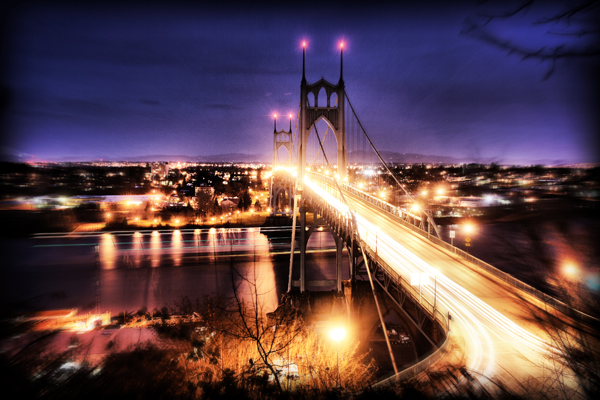
I recently made a concentrated effort to get a satisfying
picture of the St. Johns Bridge and found some pretty decent vantage points
along the ramp to the west end of the bridge. But all of this occurred well
before the clinic, so I wasn’t yet trying to be thematically intentional.
Looking back with what I know now, I’d say this is just a narrative/literal
snapshot.
Mr. Schulman said he thinks the language of composition is
‘hardwired’ into all of our brains. He didn’t even want to talk about it very
much, insisting that if you go out and take a lot of pictures, you’ll
automatically begin to refine your sense of composition.
Walking up the road to the bridge, I stumbled upon an
entrance to Forest Park’s
Ridge Trail. With all the deciduous trees stripped of their leaves, I managed
to find a few viable vantage points.
The 200mm zoom lens I’m using here kind of compresses the
length of the long middle span so that the arc of the deck is emphasized…which
to me, kind of speaks to the principle of ‘suspension’. The lazy counter arc of
the main cables belies the heavy work the suspension cables perform.
Unfortunately, I’m not using a tripod so I’ve tried to hide how ‘not tack
sharp’ this image is by over post-processing it.
Do you think people would get upset if I cut a
couple of trees down so I could get a clear shot?
Off trail a little bit, I found what appeared to be a
primitive hobo camp with a mostly unobstructed viewpoint. It’s sort of an
uncomfortable feeling to lug camera gear into isolated areas that show signs of
sketchy habitation. There’s no telling what’s in those plastic bags. It could
be stashed blankets, or a Mexican drug cartel stash…or maybe your wife’s head.
I ended up feeling a little bit like goldilocks, hoping the three bears didn’t come
home too soon… or those banjo players from Deliverance.
I don’t know…I guess it’s the kind of paranoia
that’s fostered from the sight of syphilitic mice shuffling away from moss
covered stairs and incongruously placed books along the path leading into the dark
woods.
At first, some kind of psychological compulsion
required me to include the entirety of
the signature gothic towers in my attempted compositions.
The St. Johns
Bridge: Entrance to Oregon’s
own Gotham City.
This was my favorite shot, but without a tripod,
it suffers from motion blur.
On a subsequent trip with tripod, pepper spray,
and other defensive weapons, I tried to re-create my favorite scene. I still
struggled with whether or not to amputate the front tower or not. In the end,
evidently, I kept zooming in closer. Don’t ask me why. Ask my hard wired sense
of composition.
f-14.0, shutter-60
seconds, ISO-100
These pictures were also taken before the
clinic. But it kind of shows what I mean about hoping something will ‘speak’ to
me. For the picture on the left, I walked out onto the span, familiarizing
myself with the shapes and the lines and the weight of them. I liked how the
first tower framed the second (enough to stand stupidly in the road with my
back towards traffic) and how the road rises and hides what may be coming.
Doorways and portals just naturally reek with symbolism, and so even without Mr.
Schulman’s advice about ‘evoking meaning’, I think these photos may still have
captured something evocative. For the picture on the right, I meant to explore
underneath the bridge, but as the bridge came into sight, I could see the
setting sun was illuminating only one of the towers, and I thought maybe that
might work like a really cool spotlight and so… I framed it.


Here, three intrepid sperm swim toward the
cervix, but only Sparky (on the left) has had the foresight to bring alcohol beverages with which to seduce the egg.
So I’ll have to go back again with a theme in mind and see if
that helps.
If you should happen to capture an image of the St. Johns Bridge that turns out to be evocative,
I’d be happy to post it here. Maybe we could all learn something?