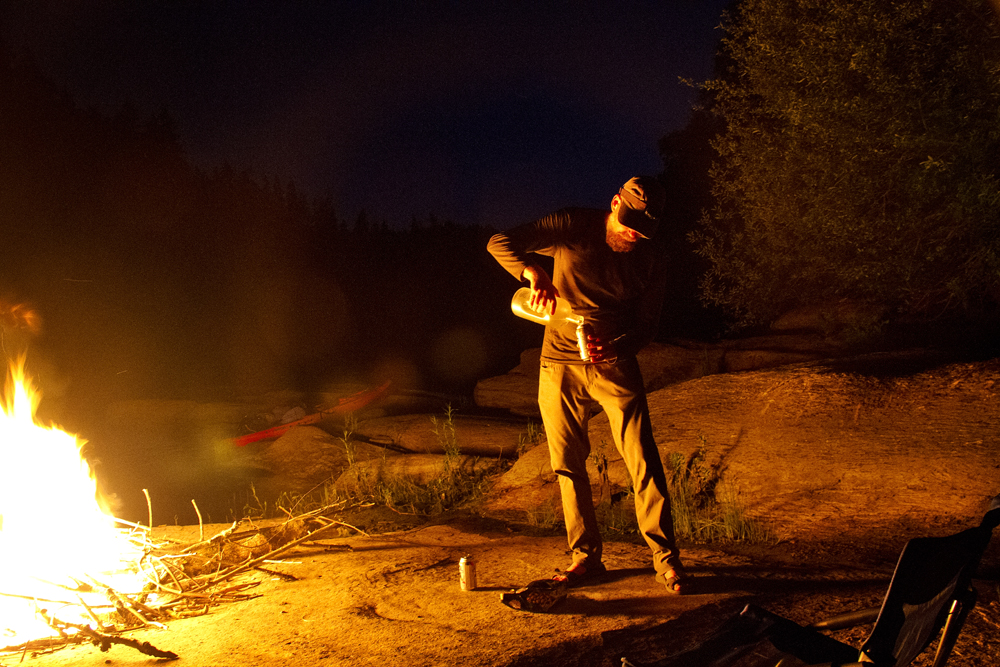
Evidence was piling up suggesting that the Lower Umpqua River was an excellent smallmouth bass fishery. Youtube videos showed happy fisherpeople struggling to hold up stringers laden with fat fish which was enticing, but also multiple pontoon boats careening towards various dubious underwater ends which looked all too probable for long kayaks.
Uncle Rico and
Kip shifted gears into research mode and before long had analyzed the
serpentine path of the river and come up with a figury-eightish route (if
'eights' had 3 or more loops) that only required advanced technical paddling
prowess for two water obstacles over an otherwise negotiable 27 miles of
drifting.
 |
| Photo courtesy Google Earth |
The accumulated Covid-19 death toll for America had only just topped 100,000 at the end of May, just a week after 10 Oregon churches had sued the governor for mandating masks and public distancing. While these kinds of reactions established that the United States was not responding well to the pandemic, Uncle Rico, Kip and I determined our risk outdoors in the sparsely populated Umpqua valley was minimal.

While it would
take us 3 days to cover the 27 river miles outlined by Uncle Rico, the
straight-line distance between our launch and take-out sites was only 8 miles.
The twisty river path was bisected by roads and at one high bridge we were even
able to preview one of our anticipated river hazards - the Smith Ferry
Rapids. We peered at the white-water in the distance with our various
optical aids - Uncle Rico with sportsman’s binoculars and me with a long camera
lens - and tried to formulate strategies. The worst case scenario, if the water
was too threatening, would be to walk our boats through the braided streams
that flanked the main channel carved deep into bed-rock.

Kip didn’t seem
to be very impressed with the rapids. “They look tiny!” he said, showing us the
size of them as measured with his fingers.


At the launch
point, I guarded the boats while Uncle Rico and Kip took care of shuttling a
car to the take-out point in Elkton. Sitting by the river with my kayak loaded
for adventure, I tried to feel if my confidence matched the role I was to
assume with my friends as a man who might be comfortable surviving in the
wilderness. I looked at the water which, from where I sat, looked benign -
almost boring. Yet I was all the time remembering the YouTube previews of our
designated route keenly aware that such ‘accounts’ are outdated the moment they
are shared. ‘River’ is just a name we give to water that follows a recognized
path. So in a way, any river you meet is an imposter - entirely new water owing
to its perpetual running. In a small way, I would be the very first
person to explore this particular river. Sure, I’d experience many things in
common with Kip and Rico, but they too would bring unique sets of skills and
experiences that almost certainly would lead them to different choices and
various other conclusions.

I guess you could
say the river’s course was meandering aimlessly through a forest landscape. But
the transparent water revealed the river was cradled by broad fractured sandstone
beds and this lent a suggestion of pent-up frustration to the water which
collected behind barriers and choke-points until it could spill down to the
next level. Instead of pinched loops and letter C’s It was like the water was
writing expansive question marks into the earth, asking repeatedly, “How do I
get to the ocean?” Meanwhile bass found these long calm terraces of water ideal
breeding grounds.

Occasionally a
fortuitous bank of rock would present itself as a fishing platform and Uncle
Rico was quick to take advantage of these. Of the three of us, Uncle Rico is
demonstrably the most skilled fisherman. To watch him fish is like watching
Picasso paint and I often try to catch candid shots of him applying his
art. But despite over a decade of adventures Uncle Rico is still not
comfortable in front of my camera. The skills he uses to see fish that remain invisible to me in the
shadows are the same skills he uses to spot the
appearance of my camera at which point all hope for a candid shot evaporates.
His first instinct is to adopt a dramatic pose which often translates into
full-body gestural pointing as if he was Lewis Meriwether or Cortez at last
discovering the object of his search.

I guess names
like Uncle Rico, or Kip or Deb are just names we give to human bodies that are
flowing through time. Uncle Rico had been flowing for 30 years or so before I
met him and by that time lots of significant channels had already been
carved - which is what I could say for all of us. Some researchers say that
human bodies completely replace themselves within seven to ten years. That
means all the cells in Uncle Rico and Kip have died and been replaced since I
met them. I still call them Uncle Rico and Kip though. It would be nice if the
old cells handed batons to the new cells so we could be sure of continuity.
 |
| Photo copyright 2020 by Kip |
One way you can
tell if there is a ridiculous number of fish in a river is if I start to catch
some. Based on that yardstick, I hold the John Day River in high regard.
However, the Umpqua has, in my estimation, exceeded that river both in the
number of fish available and in their relative size. Kip caught an impressive
sample (pictured above).

Uncle Rico
caught, conservatively, about a million fish, but kept only the ones he
fancied.
 |
| Photo copyright 2020 by Kip |
And I was pretty
proud of one of the fish I caught. As always, the rule is we only get to eat
what we are able to obtain in the wilderness (plus Kip’s Costco pistachios (not
a metaphor)) and it is always gratifying to meet the necessary quotas that
ensure fish tacos for the duration of the trip.

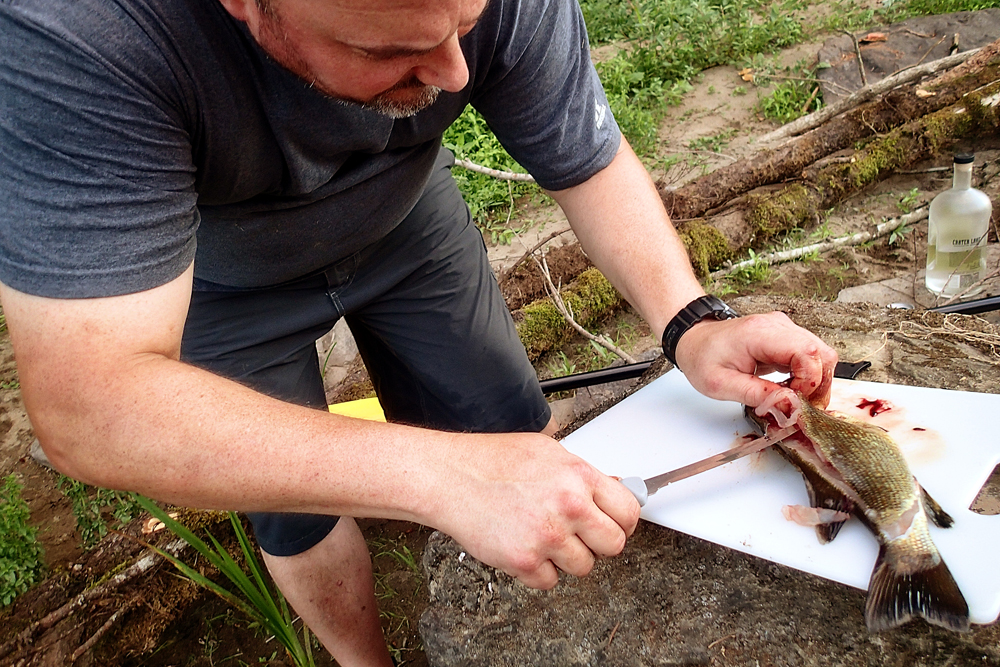
Kip knows how to handle himself around a fish carcass so after a wildly satisfying day of fishing, we all get to experience the Zen of cleaning fish.
I have been insulated from the true process of eating. My food often is presented to me in its finished form, unnaturally uniform beef patties stacked within a segmented sesame seed bun, decorated with lettuce, onion and special sauce, a slice of processed cheese-matter and a pickle. It comes wrapped in tissue paper inside a cardboard box much like a Christmas present. If you had to guess where beef comes from, you’d be inclined to wonder if perhaps it comes from clowns. But cleaning a fish reminds you that your life is prolonged by taking life from others. The filet knife, guided by a skilled hand, glides across the fish’s rib cage, its point ticking off the vertebrae and revealing a body plan optimized for life in water. Vital organs lie in their shielded cavity. Now and again a latent chemical reaction fires a futile signal across a synapse and a muscle twitches. It is evidence that the line between life and death is fuzzy and mysterious and final.

While cleaning fish, Kip notices there is still something in a fish’s mouth, even after the bait has been removed, so a quick investigation ensues.

This leads us to certain ideas about what might make good bait.

Darkness kind of
sidles up to you in a river valley. The sun wanders away behind the hills so you never really see the sunset - just a slow, almost imperceptible slide
through a color gradient that favors hot oranges and reds at first then fades
to violets and blues and finally black.

With our survival
needs met or exceeded, we turn to building the fire - the sentinel which
accompanies us on our journey into night.

Strictly
speaking, we don’t spend energy combing the banks for firewood because we need
the sustaining warmth of a fire. And we didn’t need it for cooking either. We
had more efficient tiny gas stoves for that. I think it must be an instinct. I
think the way we gather around the blue glow of our T.V.s in darkened living
rooms is a distant echo of the communal fire we gathered around as we hiked our
way out of Africa. Staring into the embers - watching the flames consume and
dance and flicker - we humans shared our food, our stories and our experiences
and learned strategies to tame the wilderness. The psychological embrace of the
fire protects us from the coming oblivion of sleep. Whatever spirit animates
the fire and spreads its embers to the stars is a sort of proof of
resurrection, that a fragile spark may be preserved and propagated, that buried
coals may spring back to life in the cool morning.

In the morning I
caught the clouds admiring themselves in the perfect mirror of the Umpqua.

The clouds linger, kissing the surface of the water, the rocks, the ripstop nylon, and the plastic boats. It’s a wet kiss. Beads of water drip from the leaves and from our boats. My sleeping bag isn’t wet exactly, but the ‘out’ side feels...humid. With no requirement but to travel +/- 9 miles down the river and catch fish, the schedule for waking up is leisurely and undisciplined, kind of like if you dropped a planeload of British schoolboys on a desert island with no adult supervision.

Another day of
languorous drifting brings us to a cobbled bank suitable for a campsite.
Typically, there aren’t any developed campsites on rivers flowing through
private land but you are allowed to pick out places below the high-water
mark. Sometimes, on popular river routes, there are well established
camping areas that you shoot for. In this case there was a dearth of
information and so it fell upon us to evaluate possible candidate locations
from our boats in the brief minutes afforded us as we passed by. In a
meandering river, the main channel often winds its way through a wider
flood-plain etched with the courses of the river’s alternate paths. But on that
same river you may enter into narrow rocky canyons that resemble log flumes.
Important considerations are: Is there a wide, safe, approachable landing area
that will accommodate your fleet? Is there enough level space for tents and a
cooking area? Is there access to shade? How hard will it be to find
firewood? Is there an un-necessarily robust mosquito population?
Sometimes the brush growing next to the water is thick enough that you have to
interrupt your drifting and mount scouting expeditions inland. Much depends on
where you happen to find yourself in the late afternoon. The calculation is
always; sure, this place looks nice...but what about around the next corner? If
you pass up a ‘good’ prospect in hopes of a better one, it’s understood
that you may have to settle for a crappy site since it is unlikely you’ll be
paddling back up the river. It’s not as dramatic as wagering your life in a
hunt for a woolly mammoth, but again there is that faint echo from prehistory of
having cast your fate upon an uncertain journey - trusting you can stay on
nature’s benevolent side. I’m reminded of the ‘road song’ from Fellowship of
the Ring:

The Road goes ever on and on
Down from the door where it began.
Now far ahead the Road has gone,
And I must follow, if I can,
Pursuing it with eager feet,
Until it joins some larger way
Where many paths and errands meet.
And whither then? I cannot say.
 |
| Photo copyright 2020 by Uncle Rico |
Kip considers it
briefly, but eventually realizes the folklore on the subject favors the
appearance of a handsome prince, not a princess. I suppose either outcome would
be difficult to explain to Mrs. Kip.

I dwell in a
garage apartment somewhere above I-5 as it ascends the West Hills. To retire
on hot summer evenings is to listen to all manner of heavy tractor-trailer rigs
labor through the Terwilliger curves - the diesel engines modulating their
screams as their drivers downshift through an infinite number of gears. This is
the soundtrack to my dreams. Over time, I’ve become accustomed to the ebb and
flow of interstate traffic. As the city of Portland begins to wake up and
traffic noise builds up to its rush hour crescendo, I find myself, more often
than not, staring at the digital display of my alarm clock well before the
alarm. To sleep along a river is to trade the sounds of internal combustion for
the roar of a thousand tiny splashes. It almost seems counter-intuitive that
the friction of water over rocks could be noisy, but the river chatters
non-stop save for those muted moments when morning mists blanket the valley. In
the beginning, the river’s voice is unintelligible to me. But over time, it
begins to whisper things - river things. “Come with me,” it invites. “Come with
me to the ocean. It’s going to be so beautiful!”

I’ve heard it said that the Inuit have dozens of words for snow & ice. Linguists may quibble, but there does seem to be a much more specific vocabulary for differentiating types of snow in their language than I’ve ever encountered while discussing the weather in Portland. For instance, ice that breaks after its strength has been tested with a harpoon is ‘qautsaulittuq’. When I try to describe my river trips, I find that my vocabulary fails me in environments where my route is not labeled with street signs posted at the intersection of streets. Close to the water line, the bank was covered with river worn cobbles, but elsewhere sections of underlying rock had been scrubbed clear by spring’s high-water events. I struggled to come up with a suitable word for the exposed rock and eventually settled on ‘bedrock’. All in all, it wasn’t a terrible choice, but it seems I may have misunderstood its etymology.

It took a little trial and error, but eventually I found a comfortable resting place. I still get a certain sense of satisfaction to wrongly conclude that 50 million years ago, the earth lay down sediments that would eventually coalesce into the Middle Eocene Tyee Formation which would eventually be carved by the Umpqua river into a suitable Scott-shaped bed for my short visit in 2020.

The morning air is cool and refreshing. The mist blows around in clumps like disenfranchised ghosts. As the rising sun peeks over the coast range mountains, the fog begins to burn off. From my vantage point in the bedrock, the fleeing vapor presents the illusion of bursting into flames.
 |
| Photo copyright 2020 by Uncle Rico |
The first big water obstacle was a fairly simple looking but powerful chute where the whole width of the river seemed suddenly to funnel into a narrow rock-lined passage and buck over several submerged boulders. Both Kip and I have a deep appreciation for what can happen to our long kayaks if we go through such a feature cock-eyed. I’m not sure what factored into Uncle Rico’s calculations, but I suspect that though his aquapod is stable, in dynamic drop situations, it may too easily convert to a submarine with its wide open cockpit. In any case, we all opted to lower our boats down through the braided streams that snaked through the rocks and grass to the right of the river.
 |
| Photo copyright 2020 by Uncle Rico |
Afterward, Uncle
Rico took a few posed shots of me in my kayak so I could later try to pass off
a composite image demonstrating my paddling prowess.

 |
| Photo copyright 2020 by Kip |
Not long after that, we found ourselves at the top of the Smith Ferry Rapids and followed a similar strategy. Kip looked downriver to the bridge from which we had scouted this obstacle at the very beginning of or trip.

“I can’t believe we drove our cars across that little bridge!” Kip exclaimed, “It looks so tiny!” he said, showing us the size of it as he measured with his fingers.

Below the bridge we found a beautiful rock outcropping suitable for camping.

Rico began preparing the final ingredient for the three species tacos.

The frog's skin
didn’t come off as easily as, say…a
rabbits, but it didn’t look any harder than removing straight-leg jeans.