SEEING THINGS
 |
| Finch on San Cristobal |
 |
| Finch on Isla Espanola |
The finches didn't really make an impression on Darwin. He didn't, at first, notice that the finches in his collection were different from each other until long after he left the Galapagos. When the realization finally came to him, his notes were inadequate for matching each sample to its island. It raises the question, "What are you uniquely qualified for and prepared to discover?"
Mitchell: So, uh... so, how go the repairs?
Lee: Well, the main engines are gone, unless we can find some way to re-energize them.
Mitchell: You better check the starboard impulse packs. Those points have about decayed to lead.
Lee: Oh, yeah, sure, Mitch.
Mitchell: I'm not joking, Lee! You activate those packs, and you'll blow the whole impulse deck.
Lee: I'll, uh, get on it right away. I just wanted to stop by and make sure you were OK. See you later.
Lee: Well, the main engines are gone, unless we can find some way to re-energize them.
Mitchell: You better check the starboard impulse packs. Those points have about decayed to lead.
Lee: Oh, yeah, sure, Mitch.
Mitchell: I'm not joking, Lee! You activate those packs, and you'll blow the whole impulse deck.
Lee: I'll, uh, get on it right away. I just wanted to stop by and make sure you were OK. See you later.
 |
| Helmsman Gary Mitchell (Gary Lockwood) and ship's psychiatrist Dr.
Mitchell: He's a fool. Dr. Dehner: A fool? Mitchell: He'd seen those points, and he hadn't noticed their condition. Dr. Dehner: How do you know? Mitchell: The image of what he'd seen was still in his mind. Star Trek, "Where No Man Has Gone Before.
-Paramount Television Maybe it's best to think of seeing as an interactive event. We see things, maybe every day. But then one day we look again and something finally clicks and we say, "Oh! Now I see!" or " |
Education, experience, and familiarity all contribute to the process of seeing, which results in a gaze that can be more discriminating and more encompassing.
Suppose a photo editor needs pictures of World Foods Market on Barbur Blvd. and there are two available photographers, Scott and Monkey-cam. Some background knowledge of the photographers might figure into the editor's decision about who should be assigned, depending on what the goals are for a given article.

Or say the editor needs pictures of Long Island in the middle of Willapa Bay.

Or say the editor needs pictures of 3 species tacos for an unbiased article about the best tacos in the world.

Evolution of a painter

In 1994, I started working as a technician in the synthesis department of a small company that made oligonucleotides, or single-stranded DNA. There I learned that machines (reminiscent of multi-flavored Big Gulp machines) could dispense the 4 different bases (phosphoramidites dAdenosine, dCytidine, dGuanosine and Thymidine) and string them together into specific chains (or sequences) per customer request.

 |
| A bank of synthesis units |
 |
| Section of an oligonucleotide — single stranded DNA |
 |
| Oligonucleotides being injected into an HPLC purification column |
When that process is complete and the amidite chains are dried for shipment, the material looks something like this:

Visually represented here is enough single stranded material to fulfill a 50 nanomole order. If this particular sequence is 21 mers long (21 bases, for instance, 5'-ACT-GGC-ATA-GGA-AAA-TAT-GAT-3') then a leading manufacturer of oligonucleotides could sell you (as of this writing) an unpurified version for something like 8 - 13 dollars.
Once the customer gets their material, they may utilize it as a primer, where it enables DNA polymerase (a complicated DNA zipper) to get a running start at massively amplifying a desired DNA sequence.
 |
| A vague depiction of DNA polymerase assembling DNA according to a single-stranded template (DNA polymerase not pictured) |
The key trick is that, single stranded DNA, uncoiled and open, acts as a template that allow accurate reproduction by DNA polymerase. The polymerase reads the template, finds the complementary base (an A for a T, or a C for a G) and 'zips' them together making long double stranded molecules (or DNA proper).
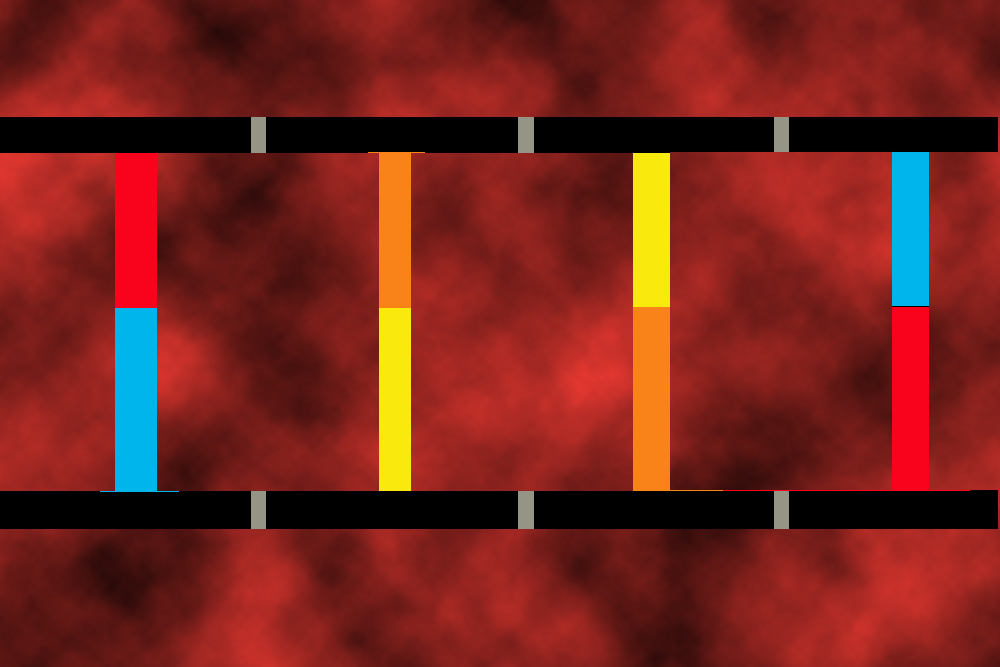
This is the basis for the iconic double helix, (imagine twisting the ends of this 'ladder') a quaternary code able to store the data necessary for growing ever evolving life-forms.

This code is passed down to us from our parents, and the way it works is how a mixture of our parent's physical characteristics ultimately find expression in us.
Really long stretches of DNA are genes. Collections of genes comprise Chromosomes. Collections of chromosomes in a cell define the organism of which that cell is a part, and all the genetic information in a cell is called the genome. The human genome was not sequenced until 2001, seven years after I started working at the oligonucleotide factory.
The amazing thing we know now is that,
"...the DNA code is invariant across all living creatures, while the individual genes themselves vary...a truly astounding fact, which shows more clearly than anything else that all living creatures are descended from a single ancestor...the whole gene/protein system for running life...is the same in all animals, plants, fungi, bacteria, archaea and viruses. What varies is what is written in the code, not the code itself. And when we look comparatively at what is written in the code — the actual genetic sequences in all these different creatures — we find the same kind of hierarchical tree of resemblance."
- The Greatest Show on Earth, Richard Dawkins.

Now the tree of life is informed by molecular biology. I am told it closely correlates to and sometimes corrects older charts that were based on Linnaean taxonomy. (See Tree of Life Web Project: (http://tolweb.org/tree/)
Yet in 1837, Darwin , was formulating his theory, and sketching in his notebook, certain that there was a mechanism for heredity, but never knowing what it was.

1835
 |
| The Popular Science Monthly, Volume 57 p. 87, reproduction of frontispiece from Darwin, Charles (1890), Journal of researches into the natural history and geology of the various countries visited by H.M.S. Beagle etc. (First Murray illustrated edition), London: John Murray (The Voyage of the Beagle). |

For an amazing depiction of life aboard a British Navy ship, see Master and Commander: The Far Side of the World. Bonus: They visit the Galapagos.
http://www.rogerebert.com/reviews/master-and-commander-the-far-side-of-the-world-2003
2016

The Nemo III

Floor plans compared

First stop: North Seymour...to be continued
If you need to catch up with Part 1: https://thenarrativeimage.blogspot.com/2017/03/galapagos-pilgrimage-part-one.html
PART THREE: The Book of Nature is now available:
https://thenarrativeimage.blogspot.com/2017/04/galapagos-pilgrimage-part-three-book-of.html


