Showing posts with label hiking. Show all posts

Sunday, March 10, 2019

THE CASE OF THE LYING WATERFALL

I saw the comment in a social media forum - a private group for hikers. I was yet unaware that the group was a loose confederation of fairly opinionated if not quite warring factions. The comment seemed innocent enough. It was a veiled plea to start a civil debate about editing waterfalls. The gist of it was this, “...the smooth water effect looks very unnatural. Almost looks like it’s trying to trick folks who don’t have the opportunity to go and see waterfalls themselves.” As the post began to generate more and more comments, the ambiguity of “Almost looks like…” slowly became more explicit as in “...it is intentionally deceiving people who have not seen the waterfall... Just curious to hear if anyone feels the same way.”

The “smooth water effect” refers to the silky, blurred look that happens to moving water in long-exposure photographs.
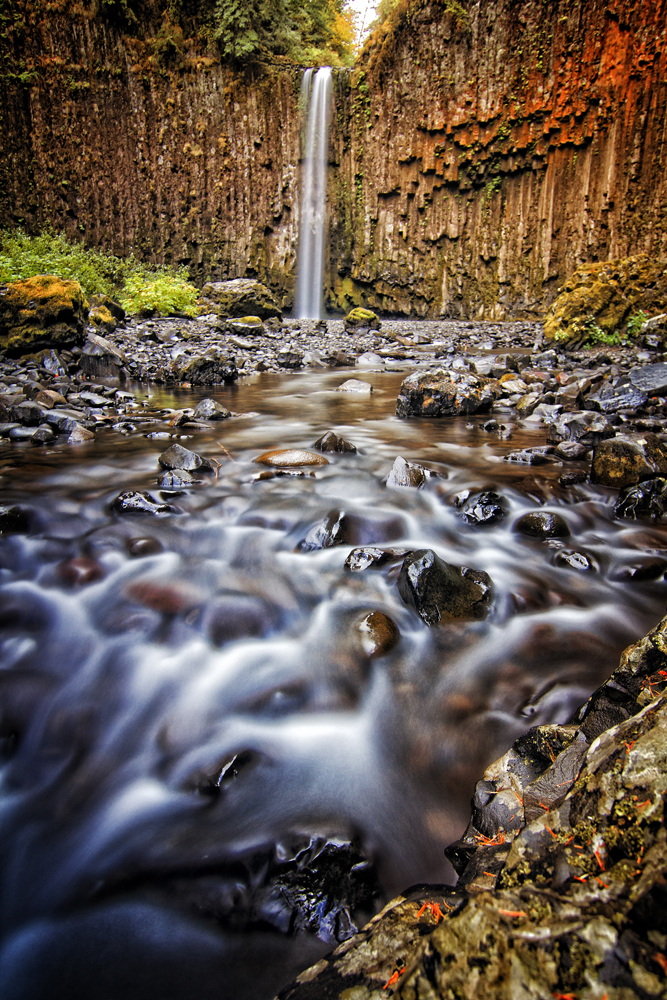
Fig. 1   Abiqua Falls with perhaps a tad too much 'Silky Water Effect'. s.dietz © 2019

At about a hundred comments into the thread, the original poster had distilled his viewpoint to this: “It’s negative in my mind because it’s an inaccurate depiction of a natural place.”

Many others echoed the idea that silky-water images are not natural. The eye doesn’t see water this way, they would say. Others preferred to see water frozen in an instant.

Fig. 2


A few touted the superiority of videography.


Finally, a small but vocal minority took advantage of the discussion to air their prejudices against photographers in general. Besides making ‘untruthful’ pictures, photographers also evidently share too many carefully composed images in hiking forums, ruin the best viewpoints by hogging them in ever-growing numbers, obstruct sight-lines with expensive gear and gangly tripods, and refuse to stay on trails - instead trampling sensitive flora in search of the ultimate never-before-seen angle.

Fig.3            Photographers (presumably), off-trail at Latourel Falls, doubtlessly taking long exposure photographs


I understand that people have personal preferences. I can understand that some people may not like silky smooth water in photographs. I even speculate that some people who hike extraordinary distances to seldom-visited locations become disgruntled when their hard-won snapshots are inadvertently snubbed in favor of more commonly photographed landscapes that are deliberately, even artfully composed. But when it comes to comparing being in the presence of an actual waterfall to viewing a two-dimensional graphic representation of a waterfall, I’m initially compelled to point out that no photograph is ‘natural’. Whether it is a frozen instant, a long-exposure or even moving pictures - all mechanically derived images record aspects of nature that our eyes cannot (and underperform in areas where our eyes excel.)

To be fair, when I commented that all pictures are un-natural, I did get some concessions. But while people were willing to grant the artificial nature of photography in general, there was still a sense that, “...some (photos) are more deceptive than others. The BEST photos are the least deceptive”.

When I saw this sentiment expressed in this way, I did an instinctive Pontious Pilate. I asked myself, “What is ‘truth’?” I suppose I would have washed my hands of the whole conversation, but on my way to the wash-basin, I was ambushed by another unrelated metaphor and found myself falling helplessly down a rabbit-hole.

Fig. 4
Here is a picture of a common scene (at least for people who don’t have washers and dryers but are not yet homeless) as depicted by a typical photograph straight out of a point-and-shoot camera with no modification.  It has many of the characteristics of the type of photograph that typical people feel are among the least deceptive. The photo is sharply focused (well...not exactly tack sharp), the colors are not exaggerated, and there is no silky water.  It allows people to say that they can reasonably expect the laundromat to look like the picture when they get there. In a way, I can see how that’s reasonable.

But part of the acceptance of this kind of picture as ‘natural’ could be the result of our submersion in a media-heavy culture, where we have been trained to interpret such images and correlate them to the real world. News photos and photo documentaries imply that photos are evidence, and such photos carry the implicit promise that this is how things appear - that the image has not been manipulated. However, in my drawing studio, during critiques, my teacher could always tell the difference between a drawing based on a photo and a drawing transcribed directly from nature. The photo always flattens and foreshortens and rigidly provides a single point perspective, an abbreviated form of our stereoscopic vision - mechanical shortcuts to translating a universe of bouncing photons into smudges on a plane. Indeed there is a whole art movement that goes by the term photorealism. Many mistakenly take this term to mean that something appears ‘as real as a photo’, but really, photorealists strive to make their art (paintings and drawings) look exactly like photographs....and perhaps it is this kind of association with the word ‘real’, that fosters the assumption that clear, crisp photos are the best analog of natural vision. Perhaps this convention is useful, like a stenographer’s shorthand, but this is not how the eye sees.

Our eyes do not encompass a limited rectangular view in a fraction of a second. We can’t, for instance, leisurely inspect an instant of a real scene and read the placards at the periphery of our vision (for one thing, we don’t typically have photographic memories, and for two, the placard wouldn’t be in focus).

Instead of taking snapshots, our eyes dart around like hungry chickens looking for birdseed. They scan here and there, searching for patterns, noticing things that are changing or focusing on points of interest.

Fig. 5
Our sharpest vision is at the center of each eye, where we process detail and color best, but the sharp area is small and if one were to view a room with a blink as brief as a camera’s shutter, one might see something more like the image above, with color and acuity fading towards the edge of vision.

It is tempting to imagine that the eyes are like little windows through which light streams into our heads so that little mini-mes can see the outside world. But light never gets beyond the back of our eyeballs where it has been focused by our lenses, regulated by our irises and where it is projected upon rods and cones to be translated into electrical/chemical signals. These signals travel the length of the optic nerves to relevant brain parts for interpretation and integration into a running simulation of the world outside. As close as we can tell, the simulations run in real time (when our eyes are open, and sometimes even when they are not) somewhere amongst the trillions of synapses in the three pounds of gray and white matter encased in our skulls. As we move forward through time, whatever we have ‘seen’ is consigned to memory and buttressed with narratives. The best we can do to share a ‘print’ is to perhaps describe what’s stored away with the best poetry we are capable of, or maybe draw a diagram, or employ a camera for additional documentation (albeit a third party mechanical source).

In his book The User Illusion, Tor Norretranders describes consciousness in terms of bandwidth. He relates several lines of evidence that suggest the sensory information (sight, sound, touch, smell) available to the brain is staggeringly vast, but that our consciousness, facing this sensory assault, is limited to a mere trickle of all that is available on the order of a million to one. Put another way, when we are confronted with the spectacle of a waterfall, each one of us must consciously, like a triage nurse, pick out the parts we can save. This results in what must always be a uniquely personal experience. What part of that experience is reflected in the impersonal, mechanical interpretation of a camera? What settings on a camera’s controls result in the closest approximation to the human visual experience?

Fig. 6
Given that our natural apparatus for seeing shares some characteristics with cameras, I began to wonder what is mechanically possible for eyes to see. While researching that question I found this informative article:

https://www.bhphotovideo.com/c/find/newsLetter/The-Photographic-Eye.jsp

While shutter-speed is not a completely suitable measurement when applied to the human eye, it appears for the sake of comparison that a human eye’s higher-end shutter speed might hover somewhere close to 1/100th of a second. Not all eyes would be that fast, especially if one accounts for lighting conditions and age (and since the eye doesn’t really have a shutter, I’m not sure what the low end would be).  I suppose if I stood before a waterfall on a bright day, blinking very fast, I could duplicate brief images that look kind of like photographs that stop motion in a crisp ‘photorealistic’ style. In fact, with bright light and even faster shutter speeds, cameras are capable of completely freezing motion (which strays from our eye’s natural capabilities in the opposite direction of silky waterfalls). Videos show us that the illusion of movement is created when we see images at ~30 frames per second which shows a certain synchronization with the eye’s function - the point where distinct images are mistaken for moving ones. Motion pictures have historically used 24 frames per second.

Fig. 7      Water dripping from a faucet at a constant rate (albeit not a strictly scientific constant rate. I just opened the faucet to a steady stream and didn't adjust it during the course of the photo session.) Note: click on images to see slightly larger versions.
Given the imprecise estimates above, it appears that photographic renderings of flowing water ‘should’ best match human perception in the range from 1/100th sec. To 1/25th sec.

Yet even if this extrapolation is correct, are the resulting images satisfying? Do they look real?

Fig. 8                       North Middle Falls at Silver Falls State Park on the Trail of Ten (or so) Waterfalls
I like the way the waterfalls are rendered with our optimal-human-range-compatible shutter speeds, but I think it is a mistake to conclude that these images are ‘more natural’. It may sound pedantic, but these images are not waterfalls. They are mechanical interpretations of a three dimensional ‘happening’, frozen in an instant and compressed into a flat image. We have time to examine an instant of falling water and learn about how water moves and how it is distributed. Our eyes are free to roam the image at will, choosing our own focal points, or, if the photographer was careful, we can follow subtle compositional hints to see another’s perspective. We can see the contours of the rocks beneath. We can examine the shrubberies. It’s like a clear memory that won’t have faded into an abstract idea by the end of the week.

The two examples above have resulted from measuring the movement of falling water at speeds and wavelengths with which the human eye is familiar, and knowing this, we can expect to find a similar scene if we venture to this location. And yet, when we get there, we will not be able to see a waterfall that looks exactly like these still images. Are these images deceptive?

Fig. 9                        North Middle Falls at Silver Falls State Park on the Trail of  Ten (or so) Waterfalls

In these two images, the shutter speeds are becoming progressively longer. The obvious difference now is that the moving water begins to transcend the human eye’s experience. We’ve begun to press more and more time into an instant. The visible streams of water are not only showing the distribution of the water but are beginning to show a summary of its probabilities. We can begin to see the favorite paths of water. Are these images deceptive?

Fig. 10               Images straight out of the camera                                 ....same images with tone mapping filters

Here is a series of throw-away shots from a trip to Abiqua Falls. From these three images, I can tell I was still searching for a composition that would echo the excitement and awe I felt when I first came around the corner and saw the falls for the first time. I can also see that I was trying to find the right exposure. The images on the left side are straight out of the camera with no editing. The problem with those images is how dark the basalt amphitheater is compared to the white falls. The darkness is a limitation of the camera’s sensor. It can’t see the range of dark and light that my eyes could see, so, while the photos are honest in terms of a camera’s specifications, they don’t come very close to what I remember seeing when I was there. To compensate for this physical shortcoming in my camera, I’ve applied a filter during post-processing (editing) that attempts to increase their dynamic range. The result is the pictures on the right. My goal is to bring out the details my eyes could certainly see when I was there, the red color of the lichens, the green of the moss, the detail and texture in the white cascade (details blown out in the camera’s view), and the texture of the basalt. From my perspective, I am trying to correct the lies that my camera tells. Which images are the most deceptive?

Fig. 11
Thunder and mist emanate from around the corner


Fig. 12
...and then…


At this point, after reviewing what I’ve written so far, and after having set up the various shutter-speed comparisons above, I think I’m finally able to see what the original poster in that hiking group was saying. Given that all photographs have the limitations of being mechanical renderings, it is still apparent that some more than others manage to depict waterfalls in a fashion that more closely resembles what our eyes are capable of seeing. I will henceforth refer to this viewpoint as Human-centric-pseudo-natural-fundamentalism. For my part, I will attempt to be neutral, but when I stray, I suppose my viewpoint could be referred to as art-dweeb.

Previously, when I wrote, “The obvious difference now is that the moving water begins to transcend the human eye’s experience.” I’m pretty sure I undermined my claim that all photographs are unnatural by giving credence to the idea that some images are more natural than others. I think the problem here is resolved by understanding that when the Human-centric-pseudo-natural-fundamentalists invoke the word natural, what they really mean is that, “in my opinion, these particular results are not how the human eye sees, and therefore, I (for one) don’t like them.”

With that concession out of the way, I still want to press the point that we cannot assume that unedited, straight-out-of-the-camera (hereafter SOOTC) photos are the most natural. To say it more carefully, it is unwarranted to assume that the camera’s default interpretation will best match (to the point that it is possible) the experience of sight.

I think the best way to explain this is to share an example of what goes into taking and editing an image when the intent is to go beyond the ‘literal’ documentation approach and try to address human attributes like feelings and empathetic responses. As a sort of preface, I took a paddle-sports photography class from Neil Schulman back in 2012 in hopes of improving my snapshots. He said that when we are out in the world, we can’t help but have emotional (I would use the word visceral) responses to it. Mr. Schulman felt that a good photograph is one which elicits this emotional response. That’s a big premise  -  the idea that the evocation of emotions is what makes a picture great - and I’m sure that’s not what everyone with a camera is trying to do. I imagine that for some, straightforward documentation suffices. For many, I’m sure photographs act as memory devices - like flashcards. For others, photography may be a matter of attaining exotic selfies for self-promotion or status.

Speaking for myself, as a solo hiker, I use photography to share the experiences I have on the trail because I’m not very proficient at sharing in person. Keeping in mind the sensory tidal wave upon which our consciousness instinctively surfs, it makes sense to me to ensure that the elements which spurred me to pick up a camera in the first place are somehow contained in the images I record.

Fig. 13     (SOOTC)

The following transcript (with some editing for clarity) is essentially the content I sent to a friend who wanted to see how I edited images.

So there I am, unconscious on Long Island in Willapa Bay, Washington. In the pitch black of my tent, noises from the outside world begin to filter over the threshold of awareness. The insistent throbbing of a boat engine, snippets of foreign languages carrying across the water, equipment shifting, banging and being unloaded, all these sounds punching through a brain-pinching hangover - that and the growing realization that I have to pee - drives me out into the night beneath condensate-dripping fir trees. I set about relieving my priorities, but as I stand at the edge of a bluff over a dark shoreline, my eyes become adjusted to the moonlight and I recognize a promising photo opportunity. I hurry back for my camera…

Fig. 14     (SOOTC)
...and after firing off a few shots I quickly realize I’m going to need a tripod. The camera’s auto-settings do that thing they do where it makes everything lighter than what you see with your eyes, at speeds too slow to freeze motion. However, the moon is setting, and it’s close enough to the horizon so that you can actually think you see it moving. Time is limited.

Fig. 15      (SOOTC)
I manage to find the tripod and frantically start looking for my composition. I want the defining landmark of Pinnacle Rock in the picture for the sense of place - the context - but I can’t find a shot that includes the boat and the landmark that doesn’t make all the interesting stuff too small. Anyway, I take a lot of shots. Evidently, I didn’t have the presence of mind to bracket the exposures, but I do at least vary the exposures and work the composition ultimately ending up with 43 different shots.

Fig. 16     (SOOTC)
Things I’m seeing are the reflection in the water, the colors starting to bloom in the sky as the sun rises, the shell harvesters (who could have been pirates for all I knew) and their changing spatial relationships. Things I’m thinking include, where did all the water go? It’s so peaceful! Look at the moon! What are they doing? Is there a body in that bag? My head hurts and I can’t see through the viewfinder with my bifocals, but I’m in manual mode now and I need to see the settings on my camera. I’m amazed by this secret night-time world that, save for a full bladder, I would have missed.

Fig. 17      (SOOTC)
One of my ambitions has always been to get a shot of the moon when it looks so unnaturally big next to the horizon. Now the moon is practically diving toward the treeline. I can’t get Pinnacle Rock in the picture and there isn’t time to move. Besides, if I run down to the beach I’ll lose my altitude and not get the long moon reflection. I wish I could be sure about my focus.

Fig. 18     (SOOTC)
Out of all the unaltered images I took, this one comes closest to what I think I saw. However, I can’t use it because it’s out of focus. The sky doesn’t seem as dark as I remember. The detail in the moon is blown out. The people in the boat aren’t really doing anything interesting. And did I mention it isn’t in focus?

I want to accurately depict some aspect of what it was like to be there, but I feel like this exposure is bland and flat and void of the feelings of rising from a mini-state of death to an other-worldly beauty. The mechanical restrictions of my camera are inhuman.

Fig. 19
In the end, I chose to work with one of the overexposed horizontal images (Fig. 17) because of its better focus and more pleasing (to me) placement of available elements. First, I cropped the image and made it into a vertical image. The portions I cut out didn’t have anything informative in them. Then, I treated the sky half and the water half independently. I made the sky a little bit darker, and the water a little bit lighter. To the water half, I also pumped up the contrast a bit to make it appear ‘not flat’ and added a bit of diffused glow to accent the marine mist. By treating them independently, I was able to restore the detail in the moon’s face, and the colors in the reflecting water.

Fig. 20
I think this is closer to what I experienced when I was there. I don’t think it is anymore unreal than the camera’s misguided efforts to render everything as if it was midday.

I also think it is, overall, less deceptive than the camera’s default rendering. In fact, my waterproof-point-and-shoot camera will try to do alterations like this for you by automatically shooting three exposures and combining them in the camera to create an instant high-dynamic-range photo. The things that dweebs used to do by hand are now automatically available on cameras as a standard feature.

It is important to note here that even if a camera supersedes the limits of human eyesight, it doesn’t mean the resulting image can’t be true. It just means that human eyesight is limited. The visible light spectrum is, by some accounts, less than one percent of the electromagnetic spectrum of which it is a part. The electromagnetic spectrum beyond visible light is certainly a part of nature, it just isn’t possible for the human eye to see it unaided. To see images of the infrared realm via specialized photographic equipment is not blasphemy.

In the same way, just because a camera’s sensor can remain active for hours, it doesn’t mean the resulting long-exposure images are deceptive. It means we’ve found a mechanical way to extend our vision beyond its limitations. It gives us a greater understanding of the world around us, just like microscopes or telescopes or x-ray machines. Think of Rosalind Franklin's X-ray diffraction image of crystallized DNA that was crucial in determining the molecule's structure.


Fig. 21
The picture of my kitchen sink that has me rethinking the concept of water.


Fig. 22
A picture of The Vista House that makes me wonder if there are rapids in the sky.


Fig. 23
Perhaps a method to discover something about gnats?


Fig. 24
Something about the shape of water...not as flat as I thought.


Fig. 25
Not streams of water after all...


Fig. 26
Perhaps just to evoke a sense of deep time...


Fig.27
...or to capture the visit of a heavenly visitor.


All text and photos by s.dietz © 2019

Tuesday, January 24, 2017

WILLEXIT

Kip showed up at the bar with a detailed river-keepers' map and guide-books that explicated his proposed route down the Willamette River. He had performed a careful analysis of the water route, marking potential launch sites, sensible campsites, and devising preliminary outlines for shuttling the boats. He had even spaced the campsites apart according to his estimates about river velocity based on seasonal water volumes and the river gradient, and also which sections of river would require extra time for thorough fishing. It was almost as if he was some kind of project manager. But as the early July launch-date approached, it became clearer and clearer via meteorologists that the trip would test our resilience to rain—lots of it.


Though  I often imagine myself to be a daring and self-sufficient outdoorsman (and by often I mean whenever I spend several hours at a bar), the fact is that so far, my camping experiences in the rain have been accidental, infrequent and generally less than vacation-like. Realistically, when it comes to surviving in the wilderness (if I even manage to reach the wilderness), the only reason I think I'm still alive is because I appear to have a self preservation instinct strong enough to keep me from putting myself in life-threatening situations (I'm a big chicken) and more often than not, I've been lucky. It's like when the three of us make the now tacit agreement to eat only the things we find or catch on the fishing excursion (which doesn't apply to beer) yet, because of my keen appreciation for my own fishing skills, I find myself inclined to hide potatoes and sausages out of sight in my cooler. So, at the bar, while I pretended that a little rain would never hurt me, I was relieved when Uncle Rico and Kip began suggesting that perhaps we should come up with an alternate plan—maybe one that would tuck us into the rain-shadow extending East beyond the Cascades.   

On decision day, our two car caravan pointed Southeast and after hours of driving, we entered the maze of forest-service roads beyond Oakridge where malevolent, tipsy trees had previously jumped out at me in the night and left their impression on my truck, impressions written in wrinkled sheet metal and the shocking revelation of primer-coat (at least I'm pretty sure that's how it played out). This time, although we arrived in the day time, the maze was no less confusing. Thankfully, I was riding with Kip in his vehicle because he charitably recognized my fear of these particular trees. Occasionally the caravan would stop as Uncle Rico consulted the GPS or as the evil branch fingers reached out and impinged on our path like fences in a slaughterhouse (or maybe something more like gillnets), driving us into a single file.

Somewhere in this puzzle landscape, we established a base of operations on high ground next to some nameless meandering minor tributary of water, manifesting as a creek for now, but showing evidence for the capacity to become wetlands or even a lake. For now, instead of a lake, we were perched at the north tip of a vast flat field, perhaps 5 miles in circumference, all of it decorated with sparkling ponds strung together by tentative necklaces of crystal clear water.


Despite our best efforts to escape the predicted rain, a nimbostratus cap of clouds concealed the sky and gently explained to us that we should take some care in preparing the evening's shelter. Kip rose to the occasion by providing a —well, I think it was something like a transportable house— which not only provided protection from rain, but also a defense against mosquitoes, who though we did not know it, were silently waiting undercover for the arrival of dusk and the cessation of an initially gentle but present breeze.


Compared to the energy Kip had put into planning his Willamette River proposition, our situation was very much ad hoc. We had meant to fish in our various watercraft, but the tributary we camped next to was better suited to roving fishermen on foot. Fortunately, we had an old book (I can't remember if it was Uncle Rico's or Kip's), a sacred out-of-print text of sorts that listed all the nearby lakes and what kind of fish could be reasonably expected to be harvested there.


An article on Crescent Lake incentivized us to wage a small campaign in pursuit of capturing Kokanee salmon. The first step in our campaign was to gather intelligence. We infiltrated a bait shop close to the lake and Uncle Rico, speaking the native tongue of the fishermen, was able to glean some helpful data about the condition of the lake and what bait the resident Kokanee considered attractive. This information informed our decisions to purchase giant reflecting spinners in silver and bronze, heavy kidney shaped sinkers, and leader-lines with imitation squid thingies hiding multiple hooks festooned with corn underneath their colorful umbrella of plastic wiggly arms. For my part, I kept my distance from Kip and Uncle Rico because I was afraid my inability to understand or make comments using the secret vocabulary of fisher-people would accidentally reveal us as outsiders and perhaps prejudice the locals to feed us misinformation.


The next step was to find the lake and then find a suitable launch point. Finding the lake wasn't that hard, but a suitable launch site was somehow more difficult. Dogs, when they are looking for someplace to poop will often conduct extensive surveys for just the 'right' spot. This evidently is a complex calculation for a dog which involves considerable sniffing and walking first one way and then another and then back again. Finding a suitable launching site was something like that.


Eventually, we found our spot. Uncle Rico set off in his inimitable AquaPod, while Kip and I set out in our sleek kayaks. Our makeshift fishing fleet then proceeded to 'troll' the lake. When we started, the lake was smooth for the most part, but as time wore on, low dark clouds blew in on wind that stirred the lake and raised rolling waves. In this setting the kayaks performed like futuristic independence-class littoral combat ships in comparison to Uncle Rico's Edmund Fitzgerald-like AquaPod. Because of it's low pancake-like profile, the AquaPod has unsurpassed stability, but that same low profile means that paddling into waves and wind is an invitation to take-on water with no appreciable gain in nearing a specified destination. Despite this gap in technology, Uncle Rico was the only one of us who managed to catch the stunningly-bright-silver land-locked salmon. We speculated it was because his vessel's inherent trolling speed was best matched to the fish's preferences. I don't know about Kip, but I was also having a hard time visualizing how deep the hooks were running in the water in relation to the amount of line I had out, how much weight I should have on the line, and how fast I was trolling. In the process of making adjustments to my rigging, keeping plump corn-kernels on the hooks, and positioning my pole holder so the pole didn't interfere with my paddling, I managed to drop the pole holder over the side of the kayak into the depths of the lake. Evidently for me, it isn't really kayak fishing until I lose a pole over the side or some other essential bit of gear.

This photo copyright 2016 by Kip

Sometimes, the weather relents and stops doing the troubling thing that it's doing. But the wind kept blowing and waves ran the length of the lake, gathering momentum and breaking on the shore as if we had been traversing a mini-ocean. The work-to-fun ratio was veering sharply to the work end of the scale and with the sun long past its zenith, the temperature was reaching new lows.

Kip uses his cage-fighting instincts and refined sense of balance to ride his kayak ashore on the lake-surf

Here and there you could see the gray slanting smudges between cloud and surface that betrayed approaching rain.


We packed up the boats and headed back to our base-camp to see if our trout catching efforts would be better rewarded.


Fish are beautiful. They are also tasty. Having to (there isn't a easy way to put it) kill your food somehow adds a level of holiness to the process of eating. It reminds me that the preservation of my life comes at the cost of another's life—whether that life is a fish, a cow or a carrot. When I eat a fresh fish, pan-fried in butter, I am thankful in a way that I never am when I eat a processed fish stick. Will I become a better man, making the world a better place? I don't know. But I feel like I owe it to these fish.


Branches of meandering streams carved their little arcs into the grassy field. According to the vagaries of gravity and erosion, some arcs become isolated, transforming into 'C' shaped ponds. I suppose from an airplane one would be able to read a long history of the river's writing. The streams rise or fall according to season and precipitation, to melting snow-packs, and to strategically placed beaver damns. Mysteriously, trout are omnipresent.


Hiding back from the edge of the stream, I emulated Uncle Rico and Kip and cast doomed earthworms into the water in order to trick trout into biting the sharp hook concealed inside the worm. I treated the worm like a puppet, moving it as if it were just an ordinary drowning worm with no strings attached. Sometimes I saw torpedo shaped shadows draw close to the bait, or imagined I did. Sometimes they would strike, like an electric shock. Each step of the process is one more level up the improbability slope for me so that, when a fish does bite and I do manage to reel it on to the bank, it is a thrilling gift.


Of course, what isn't evident in these pictures is that while we were acting as if we were apex predators, we were actually being eaten alive by mosquitoes. Frightening clouds of them would hover about our heads and settle on our leeward surfaces, taking time to poke through any material less thick than their proboscises. I sprayed enough Deet on me to poison myself, but the perpetual hovering mass before my eyes convinced me that I needed more.  Even with lips swelling and eyes tearing-up from the toxic insecticides, I felt compelled to repeatedly slap myself wherever I felt a tickle on flesh. Still, those little bastards found plenty of ways to leave their infuriatingly itchy marks. The trick is to become fully entranced in the moment, to fixate on the project of fishing. Any other route leads to hysteria—like a fat man of limited endurance freaking out, screaming and trying to outrun the buzzing aerial plague only to collapse in a quivering heap of itchy scabs, unable to breathe (I'm not saying that actually happened).


Miles and miles of stream were laid out like a particularly sinuous snake. As I followed along the bank, I saw long undulating plants stretched out as if in an underwater ballet—reaching to break the surface and touch the sun. These stretches were interspersed with deep pools and sheltered undercut banks and sprawling sunken tree stumps where I imagined smart trout ran silent and deep.


Nothing but an occasional game trail interrupted the continuity of the tall grass, and heavy with fallen rain, the grass clutched at our legs thereby impeding our progress and weighing our pants down with all the water thus imparted. As we regressed toward the forest and found ourselves among the shelter of the trees, the mosquito plague briefly expanded exponentially. I think this is partly because of the wind-break provided by the trees, but also partly because standing puddles of water in swampy ground is an ideal environment for mosquito eggs.

Uncle Rico seems 'excited' to discover this tree. Though expert outdoorsmen often participate in conservation efforts, this activity does seem to transcend classical examples of 'tree hugging'.

Photo copyright 2016 by Kip

When we finally found a sun drenched clearing on dry ground, the mosquitoes seemed to disappear, and we relaxed briefly and basked in a rare outbreak of sunlight.


Schrodinger's forest. 
Unfortunately for this forest (that was both dead and alive while depending upon the outcome of a quantum superposition), it collapsed into the definite state of death when it was finally observed.


Rain showers walk the length of the plain, like long skirts worn by giant rain ghosts.


I took a hike along the stream one evening with the goal of reaching a railroad trestle Uncle Rico told me about. In my head, I imagined one of those tall, precarious, picturesque, wooden-trestles so I set out with a camera and one of Rico's GPS walky-talkies. Like most technology that isn't your own, I had only the faintest glimmerings how to use Uncle Rico's GPS walky-talky. Since its voice transmitting feature stopped functioning after about a mile or so, it didn't really matter. In any case, Uncle Rico didn't think it would take me very long to finish the hike. But in retrospect, he didn't know how slow I was, and I didn't know how far it was, and right about when night fell, I realized I didn't have a flashlight.


The trestle had turned out to be a rock and earthen embankment, topped with rails and also with a stone tunnel at its base to accommodate the stream. The bank along the river was pockmarked with what I tend to call nutria burrows, which made walking in the daytime challenging, and which, in the dark, made it something more akin to scary. Generally, there is a lot of light available after sunset, and I continued walking while I watched that light slowly fade. But the heavy clouds had not dispersed which left no hope for redemption by moonlight, nor did the clouds stop dispensing showers. This ensured that I was soaked from the waist down as I  plowed through the high grass. Venturing into the brush-choked woods beyond the flood-plain returned me to the domain of the mosquitoes who were now invisible but still sonically distinct. I alternated my time between the two unpleasant optionsall the time growing more and more hopeless until I stopped and started planning how I might find shelter until the morning. My plan; something I call the mud and stick blanket. But just as I started searching for sticks, the wail of distant coyotes broke the silence. They seemed to be howling the word, "Tacos!" which is when I realized it was Uncle Rico and Kip in the distance, giving me a beacon of hope in the darkness.


It turns out Uncle Rico and Kip, while they sat by the fire, had been able to monitor my progress with the map feature of the GPS (the walky-talky I carried served to identify my position on their map). So they had decided to put-off making the 3-species tacos until I returned. When it became evident I had stopped, they filled the night air with the one word they thought would most likely spur me to action.


Often I feel sad like I don't have any friends. But that night I learned I have real friends who would even postpone eating 3-species tacos for my sake.


That night, eating the sacred fish, sitting before the warm fire instead of sleeping in my proposed mud and stick blanket, I felt rich and comfortable and was content to watch sparks from the fire naively attempt to ascend to the heavens from beneath the interminable drizzle. And uncle Rico's beers were still icy cold.


Later, passing through Woodburn, we discovered a wealth of Mexican Restaurants (not pictured). As is customary, we ate at one and appreciated the little things like clean plates, napkins and a marked decrease in the number of mosquitoes.


Even later, while examining the hull of the AquaPod, I noted the existence of aboriginal drawings. As I do for native American artwork, I later subjected these images to computer analysis...


...but did not arrive at any conclusions regarding the psychological state of the aboriginals...though I do have some concerns.

Featured Post

EVOLVING ROADS: Car camping with Kip and Rico (Part One)

I don’t know how it started for sure. Some intrepid band of Homo sapiens maybe walked over a land bridge from Russia or navigated the seas i...

POPULAR POSTS

The Narrative Image NAVIGATION AID