 |
| The Columbia spanning bridge at Astoria |

However, once the weekend started in earnest, so did the rain. I don’t mind cool weather and a little bit of rain, but this spring’s prolonged rainfall, and the increasingly foreboding incidence of animal pairs traveling towards a single large boat in the Middle East made me reconsider my plan to maroon myself on an island.

I wandered in and around the Long Beach peninsula for the better part of a day…but there was none of the frenzied clam killing that I witnessed the last time I visited.

…just a long beach.
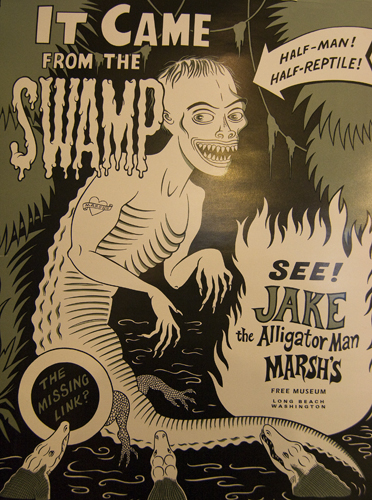
I wasn’t very impressed with Jake, the Alligator Man, who resides at Marsh’s Free Museum.
 |
| (I wonder if this is what Aldous Huxley meant when he used the word ‘pneumatic’?) |
But my estimation of him improved when I saw a picture of his bride.

I’ve recently spent some time searching for old rock paintings in the Columbia River Gorge. If I could read them, I’m sure it would tell me something about a civilization that is all but gone – tantalizing messages from across time. The still bright red and white paintings must surely preserve some truth or fact about the past. But I can’t read them. I can only apply my cultural context to a mystery – and end up with a lousy translation.

I’m in a much better position to regard the artifacts left behind by my own civilization.

…some of which testify to a gradual shift in how we perceive each other.

I enjoy those moments when evolution’s long work results in behavior that appears to transcend instinct and creates the illusion of conscious, creative problem solving.


I’m not sure, but I have a sneaking suspicion that this is an oyster farm. I think so because I’ve taken this picture from the main pier in Oysterville.

Of course…

…there is other circumstantial evidence.

Some of the locals head out from Leadbetter Point with rakes. When I was out in my kayak, watching the bay wash out from under me, I imagined the resulting soupy mud would have been much like quicksand, trapping me until the next high tide. I guess sometimes you just don’t know until you try.

As highway 101 sidles around Omeara Point, it affords a picturesque view of something that topographical maps call Round Island, but which I’ve heard referred to as Baby Island. It’s postcard pretty (when you happen to be there in person), and this time as I passed it on my way to the Wildlife Refuge Headquarters, setting sunlight from the horizon snuck under the cloud ceiling and painted swaths of harmonious pastels behind the island’s silhouette. I wanted to stop and take a picture, but the road is narrow and curvy and by the time I found a place to pull over without infuriating the inevitable tailgater (apparently bent on destruction in what appeared to be a monster truck), I practically ended up in another time-zone. The first place I found to pull over had trees and bushes in the way, so I had to walk back and forth looking for a clear shot or a way to incorporate a foreground element. The picture above is what I ended up with, and as I stared at it on the LCD display of the camera, I was once again frustrated by the difference between what I thought I saw, and what my camera chose to record.
You can try this yourself. Drive around that point and experience the view. The sky is immense and the colors vibrant. The Island is reflected in what water remains and its diminutive size and artful placement create a feeling one might experience when appreciating a particularly elaborate bonsai garden – somehow both natural and planned.
But the snapshot – damn-it – crams the sky into a tiny little square and washes it clean of all its color and freezes the dynamic motion of its cloudscape while at the same time failing to distinguish any foreground detail or color in what was a rich garden of green accented with Queen Anne’s Lace.

Even worse, the camera works desperately to impose its concept of ‘correct’ exposure on the scene, believing in its soulless heart that the details of the island’s vegetation must be revealed at the expense of all other concerns - after-all it is at the center of the composition.

I fool the camera into exposing for the value of the sky and regain some of the color bled out of the first images, but now my close up of the island strips it of its environmental context. The sky is flat and mono-colored and the island silhouette could be almost any dark blob. Even in this subdued lighting, the camera is unable to see a range of color wide enough to capture even half the scene. This isn’t what I remember seeing.

I return to the vehicle and drive back and forth until I find a broad rocky beach from which to try again. While I like this composition, the images I capture still must be compromises between exposing for the sky or exposing for the foreground. The image above doesn’t really please me until much later, when I am able to post process it with Photoshop and brighten the foreground enough to show the texture of the beach. By de-saturating the color in the foreground, I accidentally introduce an element of barrenness that I did not feel when I was really there.

Already clued in to the fact that I have a dynamic range problem from the feedback from the LCD screen, I try throwing light from my flash onto the foreground in hopes of balancing the light coming from the sky. It almost works, but creates an obvious circle of artificial light that looks kind of …un-natural.

I return to the vehicle and search out yet another vantage point. The puddles in these tire ruts give me some interesting illuminated foreground elements, but compositionally, they point away from my center of interest.

I try different viewpoints, but ultimately, I can’t move the road. So I keep walking.

All the while, the light is fading and I have to stop and pull my headlamp out of my messenger bag. I keep looking for the image that matches my mind’s eye and stumble upon this fortuitously placed tidal pool. I set up my tripod first to the left and then to the right, backward and forward and finally end up with the picture above. It’s almost what I’m seeing.

Later, with Photoshop, I brighten the foreground to see detail and pump up the contrast a bit.
As I reflect on the process of vision and how the human eye works, darting this way and that, sampling brightness and darkness, adjusting on the fly and filtering electro-chemical impulses through a brain that imposes its lifelong paradigm on all the data streaming in from the senses, I know that a photograph must always be a different experience than 'seeing', but these images, at least for me, trigger my memories and remind me of what it felt like to look over an alien landscape caught in the midst of an eternal tug-of-war fought between the earth and moon.


