Wilderness
Systems has broadened their sit-on-top offerings this year with the
introduction of the Thresher (this includes a 14 and 15.5 foot version). The
Thresher seems designed to bridge a gap between overly stable, relatively slow
fishing platforms and sleeker more touring-orientated craft, all for the sake
of fisher-people who need to cover significant distances to reach their intended
fishing locales, whether that's in the middle of a huge bay or out beyond the
breakers in the open sea
The
characteristics that make this boat a good fishing option, should also make it
a killer expedition photography platform/beer barge. I knew my test trials wouldn't
be complete until I auditioned this state of the art bid for kayak fishing
supremacy.
 |
| The Thresher 140 |
I've
probably been remiss for not highlighting this before, but the reason I've been
able to rent and evaluate various sit-on-top kayaks is because of the
reasonable and renter friendly policies of the Next Adventure team at the
paddle sport center on S.E. 7th and Alder. For 35 bucks, they give you a kayak
for 24 hours, a paddle, and a personal flotation device (if you need one). The
staff is friendly and they are knowledgeable about - even experienced with - the
products in their inventory.

Unfortunately,
Next Adventure allocated their only rental Thresher 140 to the Scappoose Bay
Paddle Center, and that outfit's 'water-front service' with exorbitant hourly
rental rates is punitive in comparison to the excellent deal available at 7th
and Alder. When you rent a kayak from Scappoose Bay Paddle Center, you're
essentially going to go kayaking in Scappoose Bay. They don't let you car-top
the boats and take them elsewhere. They also roll the kayaks down to the
dock for you, so you can't really evaluate whether or not you're going to be
able to put them on top of your car. I
noticed the Thresher doesn't have traditional side handles, but instead has
recessed hand-holds built into the cockpit area plastic. I have no idea if
that's a good idea or not. The bow and stern handles are sized just about right
for the Hulk and are probably not breakable, even when he is angry.

Where the Tarpons have a sealed hatch for internal storage in the front of the boat, the Thresher has a distinctive storage compartment covered by a big plastic hood. The plugged up scupper holes in this compartment should have served as foreshadowing that this compartment is not really intended to be dry. For those who intend to do a lot of fishing, it seems like the thing you'd want to do is maybe take those plugs out and fill it with ice and then periodically throw in the fish you catch. But me, I just assumed a new fangled fancy hood would be water-tight and I put my old dry bag in there.

The next new feature down from the hood is something called a 'flex pod sonar console'. This is a fishing specific item that is intended to hold a fish finder and its battery.

The
idea is that you can pull this whole module out at the end of the day, throw it
in your car and go home, or vice-versa.

Underneath the module, there's a protected hole that goes all the way through the boat. That hole is where the transducer goes, and I'm told that there's enough space in there to keep the transducer from getting scraped off when the boat runs aground... but since I've never installed a fish finder, I'm going to bet you might want to measure all your particulars before you take my word for it.

My
rental Thresher came outfitted with a rudder. The pedals are a new style
compared to the kind that were in the Tarpon 160 that I tried back in January. The
old style pedals slid backwards and forwards in the guides bolted into the side
of the boat. The new style pedals are stationary, and you press on them just
like you do a gas pedal. I had a hard time correlating the percent I pressed on
the pedal to the percent I actually turned the boat, but I imagine that it all
becomes more clear with experience. Conditions were such that I really didn't
have any use for the rudder. I also found the giant adjustable knobs at the end
of the pedal guide (see arrow) uncomfortable against my calves.

The
second hatch on the Thresher is a long rectangular hatch that opens up into the
interior of the boat. While this hatch doesn't high-center you like the one on
Ocean Kayak's Trident Ultra 3.4 when you try to access the storage at the front
of the boat, it is kind of narrow and it didn't easily accept my dry bag.
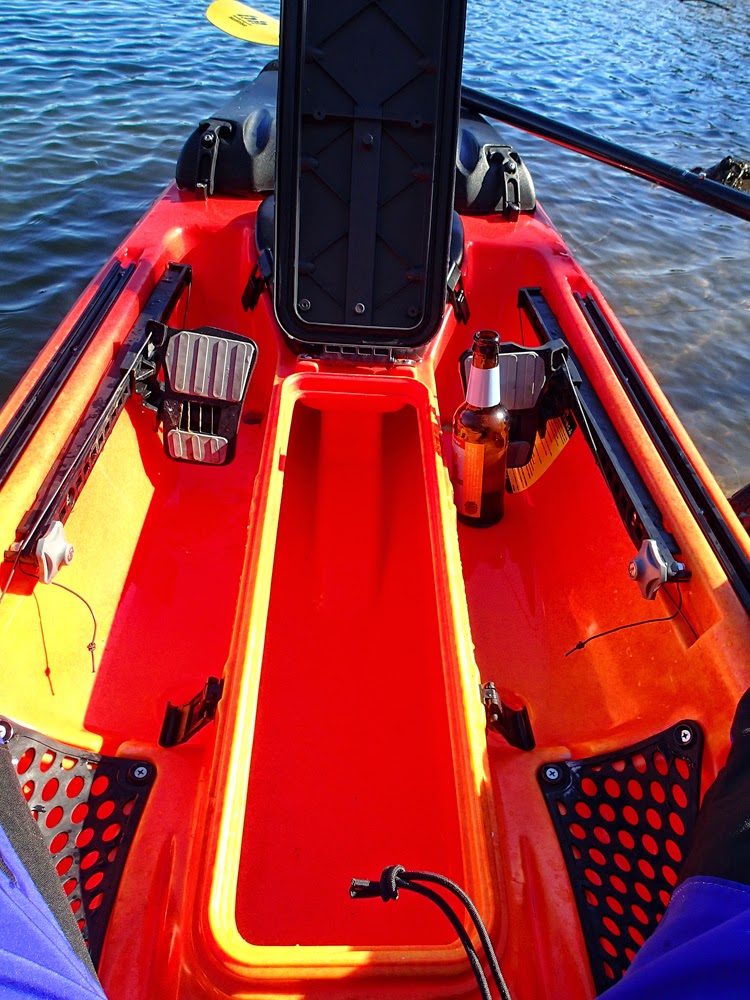
Looking
forward into the interior of the Thresher, it appears this space is designed to
easily accommodate fishing poles, spear guns and perhaps exceptionally long baguettes.

The back of the boat consists mainly of a sizable tank-well. Besides the adjustable bungee straps that criss-cross the tank-well, the Thresher also has two built in gear straps to make sure something like an ice chest isn't going anyplace if you tip over.

I
don't think I've ever spent any time detailing Wilderness Systems' seats. I've
never really noticed them, but I mean that as a compliment. The one time I
noticed a kayak seat was that one time I rented the Trident Ultra. Honestly,
with the ample natural padding I already come equipped with, you wouldn't think
I'd even really need a fancy kayak seat, but the Trident Ultra taught me how
much my kayaking pleasure depends on the comfort provided by Wilderness
Systems' seats.
 |
| Thresher Tarpon |
I took a pretty careful look at the hull of the Thresher to determine why it's supposed to be such a great boat for punching through surf and taming the 'big' water. At first glance, the design looks kind of Tarponesque. But then the rocker becomes fairly obvious and the nose begins to look a little more bulbous and the bottom doesn't look so flat, and yet, it still manages to look sleek and dolphin-like, or at the very least, Beluga whale-like.

I paddled the Thresher out to the Warrior Rock lighthouse where I knew there was sometimes a sizable eddy. I was pleased to find that the kayak joyfully leapt into the roiling water like a Labrador eager to please. I found I could cross the eddy-line backwards, forwards and sideways, headed upriver or downriver, or spinning in circles, and to someone who learned about eddies the hard way with a canoe, it was a little bit like magic.


There's a lot to explore at Scappoose Bay. There's an eerie expanse of old pilings and inscrutable concrete blocks at the northern tip of Sauvie Island. There's access to the Ridgefield Wildlife Refuge just across the Columbia, there's abandoned industrial docks and a finger-y network of sloughs and minor tributaries...but with an exorbitant hourly rental scheme hanging over one's head, one tends to make conservative decisions about what's worth exploring. It doesn't help that the hourly scheme is modeled after complex algorithms designed to mislead you about how long you can go before you just say, 'screw it, give me the daily rate.' And that's not even considering that they'll charge you an extra hundred bucks to send a boat out looking for you if you don't have the kayak back a half hour before they close.

It
was time to head back. The sun had passed it's zenith, but without the cover of
Sauvie Island's treeline, I quickly began overheating in my dry-suit. The
conditions were finally right for practicing wet exits and re-entries.
I've
practiced re-entries in my Tsunami, and I have a special paddle float that
makes it manageable for a sit-inside kayak, but it is still a challenge.
After my session with
the Thresher, all I can say is that while it is relatively easy to right the
kayak and drape yourself over the top (without a paddle float), you still don't
want to get overconfident when you try to spin your butt back into the seat. |
| This underwater view makes me seriously question why I bought a snorkel last year. |
While
I didn't realize it at the time, this was also where I filled the front
compartment with water. Sometime later, at the dock, this would help reveal that my old dry
bag isn't really water-tight anymore. Also noteworthy, the sonar console
thingy, the one that's supposed to hold a battery...that also half-filled with
water.


Throughout the day, the Thresher proved to be extremely maneuverable and I kept wishing I had picked a day with scarier water to fully test its capabilities.


It
took a couple more detours, but I finally resigned myself to the idea that I'd
be paying the full day rate. I cracked open a beer and prepared for a leisurely
paddle back to the kayak center. The beer, which utilized genetically modified
hops to present a subtle citrus flavor tasted exceptional. Usually, at work -
or in almost any social situation - I feel a little bit like Gilligan. But
there in the waning sun, commanding the Thresher, I began to feel like a unique
combination of the Skipper, the professor and the millionaire.
I
picked up my paddle and scanned the cockpit for a place to set my beer
down...and that's when it hit me.
No
cup holder.


