Showing posts with label Oregon City. Show all posts

Wednesday, March 16, 2016

TIME TRAVELING: Clackamas River Edition

Thousands of years of human exploits ought to be recorded around here, but the roads that native Americans pioneered, or earlier, the 'highways' employed by whoever it was that thought traveling across a cold land-bridge from Russia was a great idea, have either been reclaimed by the ocean or been paved over by opportunistic Europeans.
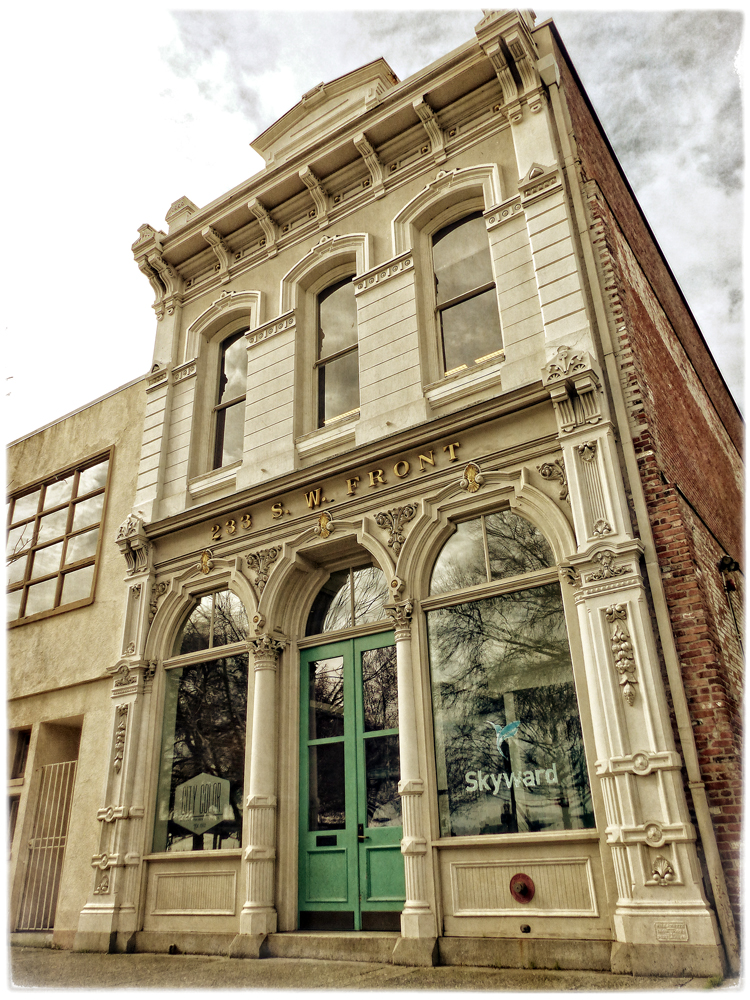

Prominent in this image is the Fechheimer & White building (approximately 131 years old). The smaller building just to the left is the Hallock-McMillan building, thought to be Portland's oldest existing commercial building (maybe 159 years old).

The oldest buildings in Portland are barely one-hundred and fifty years old


A small architectural accouterment at the North end of reservoir #1 on Mt. Tabor.

There is no Acropolis on Mt. Tabor weathering the millennia - no birthplace of Portlandian democracy - instead, crumbling concrete reservoirs are poised to become ruins at the tender age of one-hundred and twenty-two.


01

Just half an hour from the boundaries of our modern city, the landscape quickly becomes indistinguishable from what we imagine primordial forests might look like, if primordial forests had patchworks of clear-cuts. I guess it isn't surprising that in watersheds where clouds simply sink into the creased landscape, keeping the shadow-lands perpetually wet, painted messages (if any) run off rock, their colors dispersing in rivulets of rain and condensation, human memories transmogrified into mineral supplements for moss and mushrooms.


12

Red oxides accent evidence of human encroachment otherwise obscured by creeping vines and mosses. 


02.  Memaloose Road Bridge

So it is intriguing to read of abandoned water works on a tributary of the Clackamas river. To give credit where credit is due, I first read about the South Fork Clackamas/Memaloose Falls hike in a post by Shane Kucera at Outdoorproject.com. 


There was enough information to get me to the trailhead...


...though the effects of a forest fire have resulted in the closure of the road that leads to it, which adds a little over a mile of uphill-walking to the mileage tally.


03

The first time I went, I found the ropes left behind by previous benevolent trailblazers, but when I took Sgt. Rock, we overshot and ended up straying too far South.


04

The terrain is steep and the brush thick.


06

But watching Sgt. Rock bound up steep hills, 


...much like a deer,


05

...helped me appreciate his value as a forward scout.


07

We found more information about the hike from a post at OregonHikers.org by Brian Edwards. When there was another break in the weather, we found the ropes leading into the canyon. From there, following the trail is pretty straightforward.


08

This tunnel is in close proximity to Memaloose falls.


09


10

Past the tunnel, I went off trail and descended down to the base of the falls. Meanwhile, Sgt. Rock previewed the rest of the trail.


11

Sgt. Rock was able to confirm that the trail was passable all the way to the Clackamas River.


28

So the next time the rain let up, we assaulted the trail by river, thus cutting out the mile long climb to the trailhead (thanks once again to the luv2kayak evangelical outreach).


13

An incongruous fire hydrant.


14

Tunnels along the way.


15

Lower falls on the South Clackamas fork. Note the pipeline just to the right of the falls.


16

Valves and wheels along what looks like a stone retaining wall mark (perhaps) where pipelines from Memaloose Creek and the South Fork Clackamas converge.


17

The Memaloose Creek pipeline crosses just below the convergence of Memaloose Creek and the South Clackamas Fork. A short distance up the trail are the remains of what some have called a settling pool. Watch that last step off the bridge headed East.


18

This is the end of the long tunnel that leads to the top of the big falls where the diversion dam is located. The last tunnel is long and the floor is dominated by a deteriorating elevated wooden walkway featuring plenty of pointy things that could easily enter your skull cavity through your eye-socket if you should happen to trip in the dark. I recommend a reliable artificial light source.


19


20


21


22

Headed back down to the high bridge.


23

Notes about the bridge:
If it's wet, it's very, very slippery.
At the end of February, it was rated at a load capacity of 280 pounds...one way.


24

The detour around the high bridge is short, and in comparison, relaxing.


25

26

Constrained by time, we commandeer giraffes to cover more of the harsh terrain before the sun sets. For provisions, we carry plenty of 3 species tacos.


27

Possible bigfoot sighting. 


Approximate positions of numbered photos
Brown dots = trip A
Yellow dots = trip B
Red dots = trip C 

Monday, June 18, 2007

FISHING for SHAD: Instinct, Cultural Transmission or Therapy?

I don’t spend a great deal of time imagining why extraterrestrials might be interested in visiting Earth. But if they did somehow manage to visit, even though they would be piloting advanced ships that bend space/time, probably the first thing they would want to do once they finished with their obligatory survey is to try driving our cars, boats and planes.

Our vehicles are wonderful examples of evolving form following function. We’ve developed cars that are excellent at hauling families, going very fast around oval tracks, and even some that compensate for tiny genitalia.

Boats fill niches in transportation, entertainment, research, defense, and also fill a critical role in harvesting food from the ocean. In each case, the function of the vehicle has much to do with its final shape and appearance. For example, over the course of history, the sportsman’s fishing boat has evolved to hold enough beer to satiate two, sometimes three fishermen during the course of an entire afternoon.

I’m not an extraterrestrial, but I am kind of an alien when it comes to the body of knowledge required to fit in with fishermen. Though my grandpa was in the Navy, he died when my father was just a boy, and so it seems the long chain of passing on fishing secrets from father to son was interrupted.

Traditional route for cultural transmission of fishing lore

There are some migratory birds that instinctively know what country to fly to and what time to go there, even though their mother and father migratory birds never showed them how to do it. As an animal that depends on a relatively big brain for symbol manipulation and an extended juvenile stage to facilitate learning, I often feel gypped about not having obvious fishing instincts.

River deltas, falls and lakes provide a rich interface between land and water – places where land dwelling creatures can tap into the aquatic food chain. Perhaps humans have been drawn to such environments since before the first cities sprung up around the Fertile Crescent. I often wonder if it is only a coincidence that I find such places beautiful. Even now, there are many who insist on building luxury homes on obvious flood plains.


Willamette Falls at Oregon City

Though there are not many sports fishermen I know whose reproductive success depends on how many fish they catch, vestiges of the evolutionary process are seemingly still in play. The process of selection starts almost immediately at the boat ramp, an obstacle which subjects would-be fishermen to several unforgiving physics tests. Provided truck and trailer don’t accompany one’s boat into the river, the would-be fisherman next faces a delicate but important quest for prime fishing territory. Incidentally, prime fishing territory isn’t something that is immediately obvious. Fishermen seem to rely heavily on their own experience to determine where fish may be found, but often attempt to glean helpful data from other experienced fishermen. Verbal information from other fisherman may or may not be true, so the ability to detect deceptive behavior in others is another critical skill set. Often it seems that much information is acquired simply through careful observation of those who are actually catching fish. A simple innocuous statement like, “We have nothing but green jigs in this boat.” from a fisherman who has just reeled in five fish in as many minutes should cause the attentive would-be fisherman to question whether one should really continue using white jigs.

The fishermen I observed use a strategy of collaboration. They pool their individual experiences thereby improving their chances at fishing success. To keep each other sharp, they often tend to teach each other lessons through adversarial play fighting. One tends to think of the impressive play-fighting displays of elephant seals and/or silverback gorillas. However, just like their ferocious counterparts, fishermen rarely inflict serious damage upon each other since the infliction of such injuries would be prohibitively costly in terms of survival.


Sitting on a boat in a slow moving river on a clear warm day is peaceful and relaxing and conducive to meditation. Once, when I was trying to learn how to put a roof on a house, an old contractor told me that the secret to doing it right was simply to be smarter than a raindrop. The process of extrapolating this idea to the act of fishing results in the assumption that successful fishing depends on being able to out-think a fish. Presumably this process is enhanced by learning to drink like a fish.


The skill-sets required for successful fishing are varied and complicated and include everything from piloting a boat on moving water to setting up fishing poles with fish-specific rigging to keeping focused on the task at hand while in an altered state. Eventually, all of these elements meld together at the right place and time, and the fisherman experiences the transition from ‘fishing’ to ‘catching’.


These fish were all released without complications.

As alien as I am to the process of fishing, I never-the-less took exceptional pleasure in hooking and reeling in these surprisingly spirited fighters. The flash of silver, the splash of their tails, the play of line all contribute to a sense of excitement and … familiarity… and perhaps some small consolation that I am at least, with the help of my friends, able to out-think shad.


Fish are probably another one of those animals that must rely primarily on their instincts. It is unlikely that Mom and Dad fish hung around to teach survival tactics. When I consider that it is instinct that causes a fish to strike at a phony plastic insect looking thingy that is obviously dangling from a string, I don’t feel so gypped after-all.


I-205 bridge across the Willamette River


Featured Post

EVOLVING ROADS: Car camping with Kip and Rico (Part One)

I don’t know how it started for sure. Some intrepid band of Homo sapiens maybe walked over a land bridge from Russia or navigated the seas i...

POPULAR POSTS

The Narrative Image NAVIGATION AID