Cows, emboldened by the cover of darkness, venture out to the dry lake’s terminal puddle where the last delicate grasses rise from drying mud.

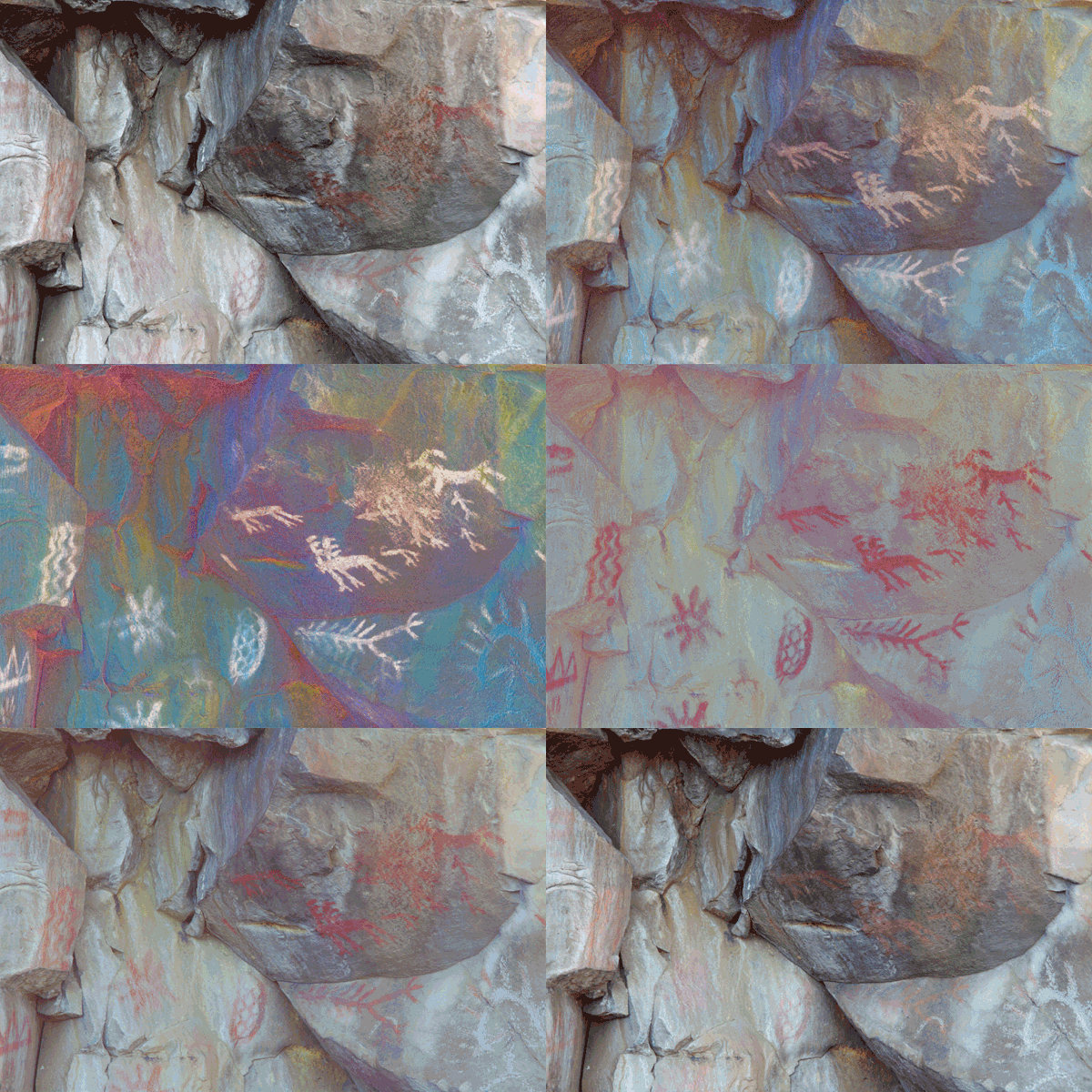
Minds, free from the constraints of day to day routines, become free to ponder the day’s events and images — to decipher messages preserved in stone for hundreds, maybe even thousands of years.

We are by no means the first to sit comforted by our campfire in this shallow basin. Doubtless, others sat before us, watching the universe display its bright jewels. Here, perhaps before a more convincing lake, those others noted the arrivals and departures of skittish deer and elusive big-horn sheep — not today’s tame cows that pulverize sensitive shorelines with great bovine hooves and trample into the mud a generous portion of their specialty pies.
Our campfire crackles and sparks and spits embers into the sky — earthborn messengers sent to consort with the stars. The constellations shuffle — the eternal multi-limbed project-deadline is banished before the promise of more ideal game.

During the early morning hours, aerosol rain periodically wets my face, waking me and forcing me to consider whether to string up the rain-fly. Stars visible between patchy clouds wink as if to reassure me that the clouds aren’t all that serious about releasing their load. Besides, the mist is cool and refreshing on my sunburnt cheeks. When the sun eventually peeks over the summit rim, it warms the gentle morning breeze, drying everything instantly.

After breaking camp, we resume fishing close to where we left off yesterday, but further downstream.

Here the water is deeper. What appears to be a gently sloping mud bank drops sharply at the water’s edge — a steep rock face.

I lower a GoPro over the side and obtain these images of a world that until this moment, existed in my imagination as a kind of naive cartoon. In this domain, finely tuned, underwater, meat-seeking missiles effortlessly negotiate the currents in three dimensions.


Yet they can still be fooled.


Another river yields a catfish and a bass. Though small, these fish will technically allow the preparation of our traditional 3 species tacos.

We set up camp high on a long ridge of buttes that provide an expansive view of the basin below. In wetter months, the basin is likely a marsh, but even in its arid state, it appears beautiful in the growing shadows of the setting sun. Wikipedia informs me that this entire basin was once a vast Pleistocene lake. It was, however, a lake with no place to go — no exits to the sea — so as the ice age came to an end, it began a long process of evaporation, concentrating salts and alkalis until only Abert Lake (full of brine shrimp) and Summer Lake remain.

It doesn’t escape my notice that this campsite is bereft of trees which makes sleeping in a hammock somewhat problematical. Rico’s sleeping solution of preference is a cot. Kip relies on a tent. For tonight I’ll be sleeping with the scorpions on a lightweight, self-inflating sleeping pad. The threat of mosquitos is a constant on this trip, but I’ve brought lots of repellants. Also, since we have occupied a zone that sits well over 4000 feet in altitude, the night temperature will be cool enough to permit sleeping with a blanket over my head.

Rico expertly deep-fries the three species of fish. We savor the flavors that could not be any fresher.


It is a precious experience, to feel at home in the universe…however briefly.

Like a kid filled with wonder, Uncle Rico brought along 3 ultraviolet flashlights. The lights emit radiation in the ultraviolet range, and Rico encourages us to search for otherwise hidden biologicals in the darkness of night (like those scorpions). Unexpected things, like lichens, glow like neon under the ultraviolet beams. Conversely, if one is still hungry, it is best not to scrutinize one’s food preparation area too closely since leftovers scattered across used greasy plates appear grayish and moldy.
The next morning, Rico outfits us with shotguns to carry along in case we flush rabbits out of the sage while we search for arrowheads. We learn to walk into the sun to facilitate the reflections that betray the presence of flaked obsidian. Thankfully, I do not encounter any rabbits. But Rico does.

I am all at once horrified, awestricken and fascinated by Rico’s workmanlike reduction of the rabbit into meat for our evening meal. This is the cost all animals pay to fill our plates with steaks and stews. I recognize the homologous organs of my fellow mammal as Rico slips the pajama-like hide off the cottontail’s skeletal armature. There is a miracle here, in that these parts — bone, muscle, sinew, nerves, lungs, and heart —were, just seconds ago, a graceful, leaping, zig-zagging master of elusion. If I choose to eat meat, I must acknowledge this process of stealing life to sustain my own.

We follow the road along Lake Abert. A squadron of geese set sail out into the salty waters, trailing wakes that replicate the ‘V’s that are so often a part of their aerial signature.

Occasionally, we stop to seek out petroglyph locations, but our primary goal today is to find the public sunstone gem collection area.

Sunstones are crystals that formed from minerals coming to rest in the scaffolding of a vast lava bed which lay underwater for thousands of years. Now, as the lava weathers in the arid high desert, these crystals can be found, loose in the topsoil. A superficial reading of the Bureau of Land Management’s kiosk might lead one to believe that sunstones are “Found only in the high desert of Eastern Oregon…” which sounds impressive. A more careful reading shows the claim is only being made for ‘Oregon sunstones’ which… seems totally reasonable. You wouldn’t expect to find Oregon sunstones amongst Norwegian or Swedish sunstones. Technically, the point they’re really trying to make is that these particular sunstones are uniquely infused with copper which gives them distinct colors.

20 acres or so of land is designated for public gem collection (with hand tools only), but the public land is surrounded by private claims where more methodical, mechanical methods of collection are employed.


Kip’s haul (with something we convinced ourselves was a significant fossil shark tooth).

Uncle Rico’s haul (with what he claims, straight-facedly, is a remarkably rare and valuable green sunstone)
Coming down from the high plateau, we stopped for ice and beer in Plush, then drove along the Warner Lakes until we came to Deep Creek. Traveling up the canyon, we found a suitable site a short distance above the Deep Creek Falls.
At first, the mosquitos worked to drive us away from our chosen camp, but Kip had brought the giant portable house with mosquito netting, so setting up that emergency shelter provided psychological re-enforcement (perhaps in the same way that designated fallout shelters helped cushion the horror of nuclear war). Kip also deployed a surprising number of mosquito coils and Rico ignited another needlessly conspicuous fire to smoke them out. Eventually, these measures and the addition of a reliable breeze allowed our panic to subside.

I was curious to see how Rico would prepare the rabbit. I imagined, perhaps, a nice hasenpfeffer or seared rabbit with rosemary potatoes. We ended up nibbling on deep-fried legs and incorporating the rest into rabbit tacos.

Our camp nestled in the trees and tucked into a canyon didn’t provide the expansive views of the previous evenings. But the falls we had passed on the road seemed a target rich photo opportunity, so I set out on foot to capture them in the long red rays of sunset. I was a little bit late.

Still, it was instructive to see how the crystal-like structure of basalt makes it so susceptible to time, water and temperature.


Back at camp, the ambient noises of the gently gurgling creek and the cooing of doves were shattered by Bluetooth speakers blaring Rico’s mariachi music. Both Kip and Rico began commenting on the sentiments expressed in the lyrics and how they so closely compared to Country-western music and the human condition in general. When they realized my shameful monolingualism precluded me from this conversation, they proceeded to speak solely in Spanish. It was in this way that I quickly became certain of the meaning of ‘cerveza’.
Several margaritas and an undetermined amount of sangria put me in a somewhat nostalgic state of mind and I timidly asked if perhaps we could, in addition to the mariachi music, maybe slip in a Jim Croce tune now and again. This proposal met with an unabashed denial. I countered with John Denver, but little progress was made until we finally reached an uneasy truce over the Avett brothers.

Early in the morning, I found myself in the mosquito-proof house. Rico was outside under his cot. I believe Kip was still in his chair.
Continue to PART THREE?