Saturday, March 25, 2017

GALAPAGOS PILGRIMAGE - PART TWO

SEEING THINGS

Finch on San Cristobal

Finch on Isla Espanola
The finches didn't really make an impression on Darwin. He didn't, at first, notice that the finches in his collection were different from each other until long after he left the Galapagos. When the realization finally came to him, his notes were inadequate for matching each sample to its island. It raises the question, "What are you uniquely qualified for and prepared to discover?"
 
Mitchell: So, uh... so, how go the repairs?
Lee: Well, the main engines are gone, unless we can find some way to re-energize them.
Mitchell: You better check the starboard impulse packs. Those points have about decayed to lead.
Lee: Oh, yeah, sure, Mitch.
Mitchell: I'm not joking, Lee! You activate those packs, and you'll blow the whole impulse deck.
Lee: I'll, uh, get on it right away. I just wanted to stop by and make sure you were OK. See you later.


Helmsman Gary Mitchell (Gary Lockwood) and ship's psychiatrist Dr. Elizabeth Dehner (Sally Kellerman) evolving.  Picture by Paramount Television
Mitchell: He's a fool.
Dr. Dehner: A fool?
Mitchell: He'd seen those points, and he hadn't noticed their condition.
Dr. Dehner: How do you know?
Mitchell: The image of what he'd seen was still in his mind.

 
Star Trek, "Where No Man Has Gone Before.
-Paramount Television 
 
Maybe it's best to think of seeing as an interactive event. We see things, maybe every day. But then one day we look again and something finally clicks and we say, "Oh! Now I see!" or "Eureka!"

Education, experience, and familiarity all contribute to the process of seeing, which results in a gaze that can be more discriminating and more encompassing.

Suppose a photo editor needs pictures of World Foods Market on Barbur Blvd. and there are two available photographers, Scott and Monkey-cam. Some background knowledge of the photographers might figure into the editor's decision about who should be assigned, depending on what the goals are for a given article.


Or say the editor needs pictures of Long Island in the middle of Willapa Bay.


Or say the editor needs pictures of 3 species tacos for an unbiased article about the best tacos in the world.


In each case, the photographer's background and life experience greatly factor into what gets noticed. I guess my point is, the hard time I did at the oligonucleotide factory changed the way I see.


Evolution of a painter


In 1994, I started working as a technician in the synthesis department of a small company that made oligonucleotides, or single-stranded DNA. There I learned that machines (reminiscent of multi-flavored Big Gulp machines) could dispense the 4 different bases (phosphoramidites dAdenosine, dCytidine, dGuanosine and Thymidine) and string them together into specific chains (or sequences) per customer request.


A bank of synthesis units
Section of an oligonucleotide — single stranded DNA
The machines don't do as good a job of making oligonucleotides as nature does. Each time a coupling happens, there are failures which, if the sequence is long, have to be removed later during a purification process.

Oligonucleotides being injected into an HPLC purification column
When that process is complete and the amidite chains are dried for shipment, the material looks something like this:


Visually represented here is enough single stranded material to fulfill a 50 nanomole order. If this particular sequence is 21 mers long (21 bases, for instance, 5'-ACT-GGC-ATA-GGA-AAA-TAT-GAT-3') then a leading manufacturer of oligonucleotides could sell you (as of this writing) an unpurified version for something like 8 - 13 dollars.

Once the customer gets their material, they may utilize it as a primer, where it enables DNA polymerase (a complicated DNA zipper) to get a running start at massively amplifying a desired DNA sequence.

A vague depiction of DNA polymerase assembling DNA according to a single-stranded template
(DNA polymerase not pictured)

The key trick is that, single stranded DNA, uncoiled and open, acts as a template that allow accurate reproduction by DNA polymerase. The polymerase reads the template, finds the complementary base (an A for a T, or a C for a G) and 'zips' them together making long double stranded molecules (or DNA proper).
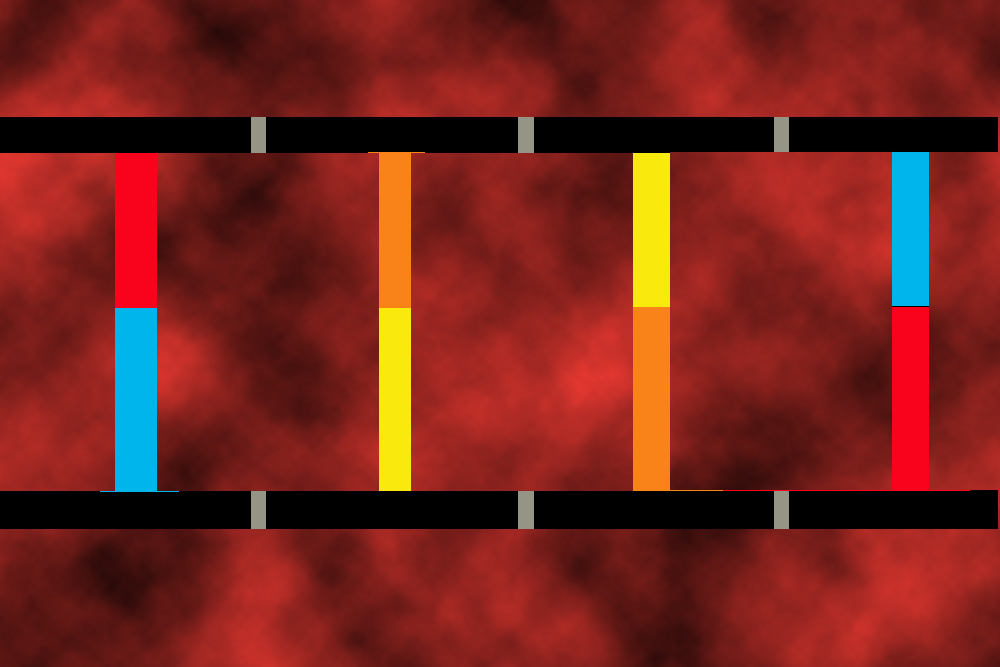


This is the basis for the iconic double helix, (imagine twisting the ends of this 'ladder') a quaternary code able to store the data necessary for growing ever evolving life-forms.


This code is passed down to us from our parents, and the way it works is how a mixture of our parent's physical characteristics ultimately find expression in us.

Really long stretches of DNA are genes. Collections of genes comprise Chromosomes. Collections of chromosomes in a cell define the organism of which that cell is a part, and all the genetic information in a cell is called the genome. The human genome was not sequenced until 2001, seven years after I started working at the oligonucleotide factory.

The amazing thing we know now is that,

"...the DNA code is invariant across all living creatures, while the individual genes themselves vary...a truly astounding fact, which shows more clearly than anything else that all living creatures are descended from a single ancestor...the whole gene/protein system for running life...is the same in all animals, plants, fungi, bacteria, archaea and viruses. What varies is what is written in the code, not the code itself. And when we look comparatively at what is written in the code — the actual genetic sequences in all these different creatures — we find the same kind of hierarchical tree of resemblance."
                         - The Greatest Show on Earth, Richard Dawkins.


Now the tree of life is informed by molecular biology. I am told it closely correlates to and sometimes corrects older charts that were based on Linnaean taxonomy. (See Tree of Life Web Project: (http://tolweb.org/tree/)

Yet in 1837, Darwin, was formulating his theory, and sketching in his notebook, certain that there was a mechanism for heredity, but never knowing what it was.


1835

The Popular Science Monthly, Volume 57 p. 87, reproduction of frontispiece from Darwin, Charles (1890), Journal of researches into the natural history and geology of the various countries visited by H.M.S. Beagle etc. (First Murray illustrated edition), London: John Murray (The Voyage of the Beagle).

For an amazing depiction of life aboard a British Navy ship, see Master and Commander: The Far Side of the World. Bonus: They visit the Galapagos.
http://www.rogerebert.com/reviews/master-and-commander-the-far-side-of-the-world-2003

2016


The Nemo III


Floor plans compared


First stop: North Seymour...to be continued

If you need to catch up with Part 1: https://thenarrativeimage.blogspot.com/2017/03/galapagos-pilgrimage-part-one.html

PART THREE: The Book of Nature is now available:
https://thenarrativeimage.blogspot.com/2017/04/galapagos-pilgrimage-part-three-book-of.html

Tuesday, March 14, 2017

GALAPAGOS PILGRIMAGE - PART ONE

WHY THE GALAPAGOS?

A blue-footed booby. This picture is inexplicably composed to exclude the signature bright blue feet.

By then, I had already watched boobies ham-footedly seducing each other with incongruous bright blue feet, disappointed pirouetting sea lions with my graceless, spastic snorkeling — unable to join in their joyous dance — and seen the fork-tailed silhouettes of magnificent frigate birds gliding beneath a near full-moon. That evening, we (me and eleven other travelers) sat in the common area of a 75 foot catamaran being introduced to the crew. 

Crew of the Nemo III with our guide Veronica acting as translator

Through our guides, the crew asked us, "Why did you come to the Galapagos?"

Up until that point, I'm not sure that I had ever put my reasons into words — and as I stuttered and paused too long looking for the right ones, I began to realize that it wasn't just for exotic 3 species tacos, it was because I wanted to articulate a story of discovery and revelation — to flesh out an account of a scientist deciphering the underlying truths of our existence in the universe. But I felt like an evangelical missionary who hadn't and couldn't read Greek or Hebrew texts — or a witness at a trial who hadn't actually seen the crime.

My short answer was, that while there are some who journey to Jerusalem, and some to Mecca, I was on that boat, 600 miles off the coast of Ecuador, because I wanted to see the peculiar islands that jarred something in Darwin's mind — something that years later shaped his thinking in regards to the origin of species. I wanted to affirm Darwin's observations. I wanted to feel the blind hands of nature shaping life as if by design

Early mariners noted the Galapagos would often disappear into the mist caused by the cold Humboldt current spilling into the tropics earning them some references as the Enchanted Islands.

As Darth Vader said, "... let me... look on you with my *own* eyes."

So there I was on a naturalistic pilgrimage, not to retrace the stations of the cross or purchase relics, but to follow in the metaphorical wake of H.M.S. Beagle to study the ripples left by its passage through history.

As David Byrne said, "Well...How did I get here?


THIRTY-EIGHT YEARS EARLIER - AM I A CHRISTIAN?

The Elephant of Surprise spots my Dad.

I was away at Bible College one year, learning to present sermons via Pastor Jim Cook's patented 3-point-outline method. All the while, unbeknownst to anybody, the Elephant of Surprise trampled roughshod through the ranks of my family.


Later, as the recipient of increasingly ominous news, I found myself surrounded by people who optimistically saw God as active in their daily lives, helping them to prepare for tests, providing money for them just when it was needed, and (in some fashion that was never explicitly clear) helping them with their life decisions. Often, daily existence was viewed as just another day of spiritual warfare, in which we young Christians were encouraged to gird up our loins (http://www.artofmanliness.com/2014/10/02/how-to-gird-up-your-loins-an-illustrated-guide/) and enter the secular fray wielding the sword of the Spirit — His word (or as narrowly defined by my conservative college, the Bible (hence the likely etymology of the term Bible beaters)). Kind hearted people (some of them strangers) prayed for and otherwise cared for me and my family, so much so that it was hard to tell if it was God working, or just kind hearted friends and strangers. It turns out there are all kinds of Christians and they all have slightly different versions of what they think God is like, and what they think God wants us to do. 

Left to right, top to bottom: 1. Traditional kind of oily Jesus. 2. Rugged Jesus. 3. Pretty good singer Jesus, but kind of bitchy. 4.Whitest Jesus ever. 5. White haired man in sky. 6. Scientificly ethnic Jesus. 7. God as a Lion. 8. God as a cheating wrestler (Still loses to Jacob). 9. Ganesh. 10. Burning bush. 11. Popular idol in 2017. 12. Elephant of Surprise.

But you never really "see" God, unless he looks like the people of faith who feed the hungry, heal the sick, and welcome the stranger. In fact, that's my big take-away from my year among the Baptists. If God works in the world, he uses human hands. Well... I say that's the big take-away, but there was also this joke. Why don't Baptists typically have sex while standing up? Because they're afraid it might lead to dancing.

"But Scott!" you exclaim, "Why are you bringing this up at the beginning of your Galapagos story?

Well, because there's another elephant in this story — the elephant in the room. It's the elephant that pits Bible believers against science — creationists against those who, through science, are learning how life evolved on earth. This year's political climate is accelerating the already extreme polarization between liberals and conservatives. Much is being done to cast doubt on our institutions of learning. Agencies that have marshaled our best technologies to examine the earth and the life upon it are being muzzled and defunded. Some of this (certainly not all of it) is happening because sincere people of faith believe they must stand up for God. It doesn't escape me that my whole-hearted excitement regarding what's being learned about evolution will be seen as heretical and threatening by some of my conservative friends. For them, I'd like to propose a temporary suspension of disbelief.

Consider this allegorical aid. Imagine a potter sitting before a potter's wheel (Personally, I like to imagine Demi Moore).

From the motion picture, Ghost: Paramount Pictures

Now imagine Demi Moore is the theory of evolution. Imagine she is shaping an animal (pot) through natural selection. Keep in mind that Demi Moore is blind, but you can see that even so, she has successfully shaped many different animals on the shelf behind her.

Now, in terms of science, that's all the further I have to go. But for the sake of my conservative friends, lets introduce Patrick Swayze.

From the motion picture, Ghost: Paramount Pictures

In this picture, we'll imagine that Patrick Swayze is God. Demi Moore is still doing all the work, but let's say she works for Patrick. As far as science is concerned, Patrick is invisible. He (so far) can't be measured, and his activity in the world, so far as we can see, looks an awful lot like Demi's work. Since we can't rule out Patrick, and if it helps you to see him helping in some way, say making the raw materials (Universe, earth, clay) or making Demi in the first place (but not so much guiding her hands), then lets do that until I finish my story.

 THREE YEARS LATER - ARE ARTISTS SCIENTISTS?

Bronze pour with: Professor (Vicky R.), Hooker (Mike E.), Guy you can't see (Probably Brian H.), and me driving the crucible.

Our ad-hoc furnace roared like...well, the blower that forced burning gas around the now radiating crucible like a tornado. It sounded something like a jet engine, and as the air above the furnace shimmered and rippled, I imagined the tightly-focused spinning conflagration we engineered was causing the ground to vibrate. We armored ourselves with leather and asbestos garments to protect our skin from the searing heat and to, perhaps, fend off molten projectiles should the liquid metal contact water hidden in improperly heated ingot-molds. Driving the crucible to the waiting molds, bearing the weight of the bronze, feeling the sweat dripping down my forehead, watching the metal flow like lava — it is at this moment that I feel like Prometheus stealing fire from the Gods.

When the crucible is empty, when we who have toiled have commenced eating meat and cheese from great paper platters and drinking cold beers enriched (or diluted?) by tomato juice, the bronze filled molds will still be steaming in the sand, cooling, becoming a new thing. By doing this, I have become a brother to men who worked in foundries over four thousand years ago, sharing elemental secrets that have shaped today's technology and which I now use to give shape to my ideas and emotions.

TOP: Bronze scraps from ancient Greece (on display in the archeological museum in Athens)
BOTTOM: Bronze scraps on the floor from one of my bronze pours and why when I saw the display in Athens, I felt connected to history like never before.


Investing wax piece in ceramic shell, an alternative to plaster.

This is a gift of science. I don't know who the first person was to figure out how to make a crucible. But somebody tried, failed, and tried again. It took insightful observations and repeated experiments. Doubtless, limbs and lives were lost along the way. And now we stand atop a hard-won pile of all the knowledge collected before us. We can do this because the universe though often inscrutable, is also reasonably consistent for objects longer than the Planck length.


TEN YEARS LATER - A FORK IN THE ROAD


When it comes to telling biographical stories, the most salient aspect seems to be that you can't really do a very definitive job unless you start from the end. At the entrance to a fork, a trivial decision based on a whim or intuition may result in finding the job of your dreams on one hand, or death by a rabid beaver who severs your carotid artery on the other. Sometimes, it isn't really a matter of even making a decision.

One year, when I was 14, I was sent to spend part of a summer on a wheat farm in Kansas with my Great Uncle Carl and Aunt Alvina. 

My long suffering Aunt Alvina and Uncle Carl being patient while 14 year old scott tries to pose them like that American Gothic painiting

In one of the outbuildings, there was an old workbench, and tacked to a low lying rafter were rows of rabbit ears. I inquired about the unexpected decorations and learned that during various years and seasons, rabbits, doing what rabbits do, earned themselves a bounty. Enterprising youth, I also learned, could make money in exchange for rabbit ears. This inspired in me a certain Elmer Fuddish compulsion to shoot a rabbit, and it was not long before Uncle Carl set me up with an old .22 rifle.

My dreams of making money soon evaporated as I began to realize that shooting the wiry jack rabbits was  no easy task. The rabbits were well camouflaged in the straw colored fields, and I only ever saw them if I spooked them by walking too close. When they were startled, they'd leap into action like those antelope on T.V. trying to evade cheetahs. They knew how to zig-zag.  Try as I might, my errant bullets did little but kick up tiny fountains of dust in the rich Kansas top soil, or pinged off stone fence-posts and ricocheted off old farm-machinery so that technically, I was more dangerous to myself than I was to the rabbits. It became obvious that my expenditure in ammunition was going to exceed any foreseeable bounty-income. Soon it simply became a challenge to see if it would be possible for me to shoot a rabbit at all.

Then, one evening it happened. The rabbit took off. It started zigging to the left. I anticipated it's zag to the right, got a good lead on it, pulled the trigger. I watched in amazement, then horror as the rabbit ran at top speed into the path of my bullet. In an airborne instant, the heavy impact of the bullet shattered the graceful rhythm of its stride. It fell from the sky in uncoordinated, sloppy summersaults, like a rag doll — like a race car flipping end for end.

I walked out to my kill. I looked down at my victim with conflicting emotions. I was excited and proud that I had finally achieved my goal, but I was also surprised by the finality of my act, the taking of life. I reached down to claim my trophy. I picked it up by the back legs and headed back to the homestead. The body was limp, but still warm, and as I walked, some last firing of synapses caused those back legs to kick and spasm as if resurrected and angry. It frightened me and I dropped it like a hot potato.

When that rabbit was running, it was beautiful. It had been shaped by its environment over endless millennia to evade its predators. Now it lay in the dirt growing cold — a bloody bag of organs and meat.

 Uncle Carl added the rabbit's ears to the collection with a tack and we looked at them for a silent moment. I looked to Uncle Carl for a clue about how I should be feeling. He didn't give me any clues.

Ol' Blue, the truck in which I learned to drive.

There once was a guy named Steve C. He was a foreman for a construction company — a company that I worked for as an employee of a painting sub-contractor. One year, Steve built a laboratory for a biotech company. He was a handy guy to have around since he was both intelligent and resourceful. As he worked at finishing the building, the client began moving biotech equipment into the new facility, and Steve found he was able to help with setting up the production line and evidently demonstrated an aptitude that won him a new job as the new production manager for the biotech company.

Soon the new biotech company began to grow and Steve found he needed to hire more people to run the machines. He began hiring his close friends from the construction industry. This made sense, because they were people he knew he could work with. However, they all had similar interests, the greatest of which was a common appreciation for hunting. When hunting season rolled around, Steve suddenly realized his mistake. Everyone wanted to go hunting which would leave the production line understaffed. What they needed was another worker who didn't hunt.

That's how I became a laboratory technician.


To be continued...

Part 2 is now available at: https://thenarrativeimage.blogspot.com/2017/03/galapagos-pilgrimage-part-two.html

Tuesday, January 24, 2017

WILLEXIT

Kip showed up at the bar with a detailed river-keepers' map and guide-books that explicated his proposed route down the Willamette River. He had performed a careful analysis of the water route, marking potential launch sites, sensible campsites, and devising preliminary outlines for shuttling the boats. He had even spaced the campsites apart according to his estimates about river velocity based on seasonal water volumes and the river gradient, and also which sections of river would require extra time for thorough fishing. It was almost as if he was some kind of project manager. But as the early July launch-date approached, it became clearer and clearer via meteorologists that the trip would test our resilience to rain—lots of it.


Though  I often imagine myself to be a daring and self-sufficient outdoorsman (and by often I mean whenever I spend several hours at a bar), the fact is that so far, my camping experiences in the rain have been accidental, infrequent and generally less than vacation-like. Realistically, when it comes to surviving in the wilderness (if I even manage to reach the wilderness), the only reason I think I'm still alive is because I appear to have a self preservation instinct strong enough to keep me from putting myself in life-threatening situations (I'm a big chicken) and more often than not, I've been lucky. It's like when the three of us make the now tacit agreement to eat only the things we find or catch on the fishing excursion (which doesn't apply to beer) yet, because of my keen appreciation for my own fishing skills, I find myself inclined to hide potatoes and sausages out of sight in my cooler. So, at the bar, while I pretended that a little rain would never hurt me, I was relieved when Uncle Rico and Kip began suggesting that perhaps we should come up with an alternate plan—maybe one that would tuck us into the rain-shadow extending East beyond the Cascades.   

On decision day, our two car caravan pointed Southeast and after hours of driving, we entered the maze of forest-service roads beyond Oakridge where malevolent, tipsy trees had previously jumped out at me in the night and left their impression on my truck, impressions written in wrinkled sheet metal and the shocking revelation of primer-coat (at least I'm pretty sure that's how it played out). This time, although we arrived in the day time, the maze was no less confusing. Thankfully, I was riding with Kip in his vehicle because he charitably recognized my fear of these particular trees. Occasionally the caravan would stop as Uncle Rico consulted the GPS or as the evil branch fingers reached out and impinged on our path like fences in a slaughterhouse (or maybe something more like gillnets), driving us into a single file.

Somewhere in this puzzle landscape, we established a base of operations on high ground next to some nameless meandering minor tributary of water, manifesting as a creek for now, but showing evidence for the capacity to become wetlands or even a lake. For now, instead of a lake, we were perched at the north tip of a vast flat field, perhaps 5 miles in circumference, all of it decorated with sparkling ponds strung together by tentative necklaces of crystal clear water.


Despite our best efforts to escape the predicted rain, a nimbostratus cap of clouds concealed the sky and gently explained to us that we should take some care in preparing the evening's shelter. Kip rose to the occasion by providing a —well, I think it was something like a transportable house— which not only provided protection from rain, but also a defense against mosquitoes, who though we did not know it, were silently waiting undercover for the arrival of dusk and the cessation of an initially gentle but present breeze.


Compared to the energy Kip had put into planning his Willamette River proposition, our situation was very much ad hoc. We had meant to fish in our various watercraft, but the tributary we camped next to was better suited to roving fishermen on foot. Fortunately, we had an old book (I can't remember if it was Uncle Rico's or Kip's), a sacred out-of-print text of sorts that listed all the nearby lakes and what kind of fish could be reasonably expected to be harvested there.


An article on Crescent Lake incentivized us to wage a small campaign in pursuit of capturing Kokanee salmon. The first step in our campaign was to gather intelligence. We infiltrated a bait shop close to the lake and Uncle Rico, speaking the native tongue of the fishermen, was able to glean some helpful data about the condition of the lake and what bait the resident Kokanee considered attractive. This information informed our decisions to purchase giant reflecting spinners in silver and bronze, heavy kidney shaped sinkers, and leader-lines with imitation squid thingies hiding multiple hooks festooned with corn underneath their colorful umbrella of plastic wiggly arms. For my part, I kept my distance from Kip and Uncle Rico because I was afraid my inability to understand or make comments using the secret vocabulary of fisher-people would accidentally reveal us as outsiders and perhaps prejudice the locals to feed us misinformation.


The next step was to find the lake and then find a suitable launch point. Finding the lake wasn't that hard, but a suitable launch site was somehow more difficult. Dogs, when they are looking for someplace to poop will often conduct extensive surveys for just the 'right' spot. This evidently is a complex calculation for a dog which involves considerable sniffing and walking first one way and then another and then back again. Finding a suitable launching site was something like that.


Eventually, we found our spot. Uncle Rico set off in his inimitable AquaPod, while Kip and I set out in our sleek kayaks. Our makeshift fishing fleet then proceeded to 'troll' the lake. When we started, the lake was smooth for the most part, but as time wore on, low dark clouds blew in on wind that stirred the lake and raised rolling waves. In this setting the kayaks performed like futuristic independence-class littoral combat ships in comparison to Uncle Rico's Edmund Fitzgerald-like AquaPod. Because of it's low pancake-like profile, the AquaPod has unsurpassed stability, but that same low profile means that paddling into waves and wind is an invitation to take-on water with no appreciable gain in nearing a specified destination. Despite this gap in technology, Uncle Rico was the only one of us who managed to catch the stunningly-bright-silver land-locked salmon. We speculated it was because his vessel's inherent trolling speed was best matched to the fish's preferences. I don't know about Kip, but I was also having a hard time visualizing how deep the hooks were running in the water in relation to the amount of line I had out, how much weight I should have on the line, and how fast I was trolling. In the process of making adjustments to my rigging, keeping plump corn-kernels on the hooks, and positioning my pole holder so the pole didn't interfere with my paddling, I managed to drop the pole holder over the side of the kayak into the depths of the lake. Evidently for me, it isn't really kayak fishing until I lose a pole over the side or some other essential bit of gear.

This photo copyright 2016 by Kip

Sometimes, the weather relents and stops doing the troubling thing that it's doing. But the wind kept blowing and waves ran the length of the lake, gathering momentum and breaking on the shore as if we had been traversing a mini-ocean. The work-to-fun ratio was veering sharply to the work end of the scale and with the sun long past its zenith, the temperature was reaching new lows.

Kip uses his cage-fighting instincts and refined sense of balance to ride his kayak ashore on the lake-surf

Here and there you could see the gray slanting smudges between cloud and surface that betrayed approaching rain.


We packed up the boats and headed back to our base-camp to see if our trout catching efforts would be better rewarded.


Fish are beautiful. They are also tasty. Having to (there isn't a easy way to put it) kill your food somehow adds a level of holiness to the process of eating. It reminds me that the preservation of my life comes at the cost of another's life—whether that life is a fish, a cow or a carrot. When I eat a fresh fish, pan-fried in butter, I am thankful in a way that I never am when I eat a processed fish stick. Will I become a better man, making the world a better place? I don't know. But I feel like I owe it to these fish.


Branches of meandering streams carved their little arcs into the grassy field. According to the vagaries of gravity and erosion, some arcs become isolated, transforming into 'C' shaped ponds. I suppose from an airplane one would be able to read a long history of the river's writing. The streams rise or fall according to season and precipitation, to melting snow-packs, and to strategically placed beaver damns. Mysteriously, trout are omnipresent.


Hiding back from the edge of the stream, I emulated Uncle Rico and Kip and cast doomed earthworms into the water in order to trick trout into biting the sharp hook concealed inside the worm. I treated the worm like a puppet, moving it as if it were just an ordinary drowning worm with no strings attached. Sometimes I saw torpedo shaped shadows draw close to the bait, or imagined I did. Sometimes they would strike, like an electric shock. Each step of the process is one more level up the improbability slope for me so that, when a fish does bite and I do manage to reel it on to the bank, it is a thrilling gift.


Of course, what isn't evident in these pictures is that while we were acting as if we were apex predators, we were actually being eaten alive by mosquitoes. Frightening clouds of them would hover about our heads and settle on our leeward surfaces, taking time to poke through any material less thick than their proboscises. I sprayed enough Deet on me to poison myself, but the perpetual hovering mass before my eyes convinced me that I needed more.  Even with lips swelling and eyes tearing-up from the toxic insecticides, I felt compelled to repeatedly slap myself wherever I felt a tickle on flesh. Still, those little bastards found plenty of ways to leave their infuriatingly itchy marks. The trick is to become fully entranced in the moment, to fixate on the project of fishing. Any other route leads to hysteria—like a fat man of limited endurance freaking out, screaming and trying to outrun the buzzing aerial plague only to collapse in a quivering heap of itchy scabs, unable to breathe (I'm not saying that actually happened).


Miles and miles of stream were laid out like a particularly sinuous snake. As I followed along the bank, I saw long undulating plants stretched out as if in an underwater ballet—reaching to break the surface and touch the sun. These stretches were interspersed with deep pools and sheltered undercut banks and sprawling sunken tree stumps where I imagined smart trout ran silent and deep.


Nothing but an occasional game trail interrupted the continuity of the tall grass, and heavy with fallen rain, the grass clutched at our legs thereby impeding our progress and weighing our pants down with all the water thus imparted. As we regressed toward the forest and found ourselves among the shelter of the trees, the mosquito plague briefly expanded exponentially. I think this is partly because of the wind-break provided by the trees, but also partly because standing puddles of water in swampy ground is an ideal environment for mosquito eggs.

Uncle Rico seems 'excited' to discover this tree. Though expert outdoorsmen often participate in conservation efforts, this activity does seem to transcend classical examples of 'tree hugging'.

Photo copyright 2016 by Kip

When we finally found a sun drenched clearing on dry ground, the mosquitoes seemed to disappear, and we relaxed briefly and basked in a rare outbreak of sunlight.


Schrodinger's forest. 
Unfortunately for this forest (that was both dead and alive while depending upon the outcome of a quantum superposition), it collapsed into the definite state of death when it was finally observed.


Rain showers walk the length of the plain, like long skirts worn by giant rain ghosts.


I took a hike along the stream one evening with the goal of reaching a railroad trestle Uncle Rico told me about. In my head, I imagined one of those tall, precarious, picturesque, wooden-trestles so I set out with a camera and one of Rico's GPS walky-talkies. Like most technology that isn't your own, I had only the faintest glimmerings how to use Uncle Rico's GPS walky-talky. Since its voice transmitting feature stopped functioning after about a mile or so, it didn't really matter. In any case, Uncle Rico didn't think it would take me very long to finish the hike. But in retrospect, he didn't know how slow I was, and I didn't know how far it was, and right about when night fell, I realized I didn't have a flashlight.


The trestle had turned out to be a rock and earthen embankment, topped with rails and also with a stone tunnel at its base to accommodate the stream. The bank along the river was pockmarked with what I tend to call nutria burrows, which made walking in the daytime challenging, and which, in the dark, made it something more akin to scary. Generally, there is a lot of light available after sunset, and I continued walking while I watched that light slowly fade. But the heavy clouds had not dispersed which left no hope for redemption by moonlight, nor did the clouds stop dispensing showers. This ensured that I was soaked from the waist down as I  plowed through the high grass. Venturing into the brush-choked woods beyond the flood-plain returned me to the domain of the mosquitoes who were now invisible but still sonically distinct. I alternated my time between the two unpleasant optionsall the time growing more and more hopeless until I stopped and started planning how I might find shelter until the morning. My plan; something I call the mud and stick blanket. But just as I started searching for sticks, the wail of distant coyotes broke the silence. They seemed to be howling the word, "Tacos!" which is when I realized it was Uncle Rico and Kip in the distance, giving me a beacon of hope in the darkness.


It turns out Uncle Rico and Kip, while they sat by the fire, had been able to monitor my progress with the map feature of the GPS (the walky-talky I carried served to identify my position on their map). So they had decided to put-off making the 3-species tacos until I returned. When it became evident I had stopped, they filled the night air with the one word they thought would most likely spur me to action.


Often I feel sad like I don't have any friends. But that night I learned I have real friends who would even postpone eating 3-species tacos for my sake.


That night, eating the sacred fish, sitting before the warm fire instead of sleeping in my proposed mud and stick blanket, I felt rich and comfortable and was content to watch sparks from the fire naively attempt to ascend to the heavens from beneath the interminable drizzle. And uncle Rico's beers were still icy cold.


Later, passing through Woodburn, we discovered a wealth of Mexican Restaurants (not pictured). As is customary, we ate at one and appreciated the little things like clean plates, napkins and a marked decrease in the number of mosquitoes.


Even later, while examining the hull of the AquaPod, I noted the existence of aboriginal drawings. As I do for native American artwork, I later subjected these images to computer analysis...


...but did not arrive at any conclusions regarding the psychological state of the aboriginals...though I do have some concerns.

Featured Post

EVOLVING ROADS: Car camping with Kip and Rico (Part One)

I don’t know how it started for sure. Some intrepid band of Homo sapiens maybe walked over a land bridge from Russia or navigated the seas i...

POPULAR POSTS

The Narrative Image NAVIGATION AID