Sunday, May 18, 2014

Mother's Day


My mom lives in Portland.
She's lived there for close to half a century.

But she's never been to the Portland Japanese Garden.


During Portland's Spring, it is often ill-considered to depend upon non-rainy weather for outdoor events, but as the weather reports grew more and more optimistic for the weekend, I began planting the idea of a garden visit. I expected the 'ole trick knee excuse, but Mom surprised me by accepting my offer.


My mom's trick knee excuse is not without corroborating  anecdotal evidence. She often (and by often I mean really often) tells the story about how, when I was an innocent baby cradled in her protective arms, her trick knee suddenly went out on her causing her to fall and somehow jettison me high into the air. Later, she reports, they managed to find me under a bed where I had evidently bounced. This story may explain some of my trust issues. It also may explain why she walks carefully, eyeing the ground as if it has betrayed her in the past.


We brought a folding stool with us, in case she needed to sit down along the trail, but were pleased to find ample quantities of comfortable benches.


There are so many benches that I was initially going to make this blog post be exclusively about The Benches at the Japanese Gardens. I thought it would be pretty funny to ignore all the beautiful parts of the garden and just show my mom's favorite benches...but there were many beautiful parts of the garden.


While not actually a bench, countless butts sit on this bridge rail, helping their owners pose for stealth portraits - stealth portraits because the rules forbid portrait photography which mostly means the garden society doesn't want visitors to have to put up with portable-studio wielding professionals.


This bench, at the east end of the bridge, really fits well into its environment, though mom thinks it's a little bit short.


This bench provides a marvelous view of what I like to call the Portrait Bridge, and the infinite line of portrait takers.


There's a bench off to the right, but it didn't fit in with my efforts to capture a maze-like picture of the zigzag bridge.


I think there were 3 benches at this location. 


I think my mom enjoyed the time she spent on this bench. She has a deep appreciation for the beauty in creation. However, she is not likely to be pleased to find out  she was included in some of the pictures I was taking.


This bench graces the intersection that leads to the Natural Garden. The path through the Natural Garden is narrow and uneven and supposedly one-way. I was concerned that maybe this path would be too challenging, but by this time on our visit, I found Mom sitting on this bench, filling out an application to become a Sherpa.


Here Mom is reading the map saying, "I think this is the Three Arch Rocks national wildlife area, but I can't see the ocean." 


From the Stone Garden, a significant staircase climbs to the Pavilion, but this bench is strategically placed about half way up. 


This bench sits at the top of the stairs.


My mother gives this particular bench very high marks.


A bench on the pavilion veranda.


This picture reveals the Flat Garden, but what I seem to remember most is the curves.


The bench next to the Gift Shop.


My parents brought me into the world, and with all the experience gained from a twenty year head start, they began blazing a path through life, teaching me to walk, showing me directions to go, giving me examples to follow...and my Mom is still up ahead on that path, encountering new challenges...forever dispensing grace and love.


Thanks Mom.


Sunday, April 6, 2014

Road Trip Fossils

While chronologically not appearing at this point in the narration, this strategically 
picked picture is intended to attract the attention of internet passers-by. 
Sgt. Rock and I set out in my un-trusty automobile under something I like to call a photographically promising sky - a 'shit-ton' (scientific term) of discrete clouds growing and calving...and stampeding here and there as the day wore on.


Impending 'retirement' and homelessness, a giant monster that I refuse to see looming on the horizon, never-the-less whispers subliminal threats to my ego (I guess) and causes me to stop out of fascination at scenes loaded with lost purpose. Sgt. Rock alternatively looks for lost treasure that only he can recognize.


I've been here before. There are more empties. More bird crap. More graffiti (including an impressive new pornographic triptych). And there is more peeling away of sheetrock skin from brittle wooden ribs.


Peering out at the wonders of the world from inside a neglected shell.


The gas station attendant's dog doesn't 'stay' very well.


Cleverly disguised Cylon Raider.


Brick walls and painted signs - a time collage.


Former School building.


Unlucky house


Sgt. Rock descends to an old hydro-electric power plant.


Oh yeah. There's a fairly incredible double tiered waterfall too, if you're into that kind of thing.


Exploring places like this, filled with technology perhaps a hundred years old, I'm reminded of A Canticle for Leibowitz. I stand before the arcane instruments and artifacts (to me) and tell myself I need to read a good engineering book, you know, just in case.


(Jedi hand-wave motion) These aren't the droids you're looking for.


A challenging lighting situation. I pulled out my graduated neutral density filters and tried this and that, but didn't crack the code for figuring out how to get the top tier to show.


Saturday, November 2, 2013

"a mystery wrapped in an enigma squeezed into a skirt that's just a little bit too... tight." - Dr. Who

An Elk, somewhere above The Dalles Dam, but below the John Day Dam, below the stereo and on this side of the Bicentennial glasses, between the ashtray and the thimbles in this three inches that includes the Chiclets, but not the erasers.

I had a teacher once (Vicky) who posited with a straight face that the most important thing you can give to starving people is art. Now as then, I still vote for bread, or more specifically, an educational program that teaches sustainable farming and a financial package to help such an endeavor along, but the outlandishness of my teacher's claim haunts me to this day.

I wish I could remember the words my teacher used, her normally brash and cool character terrifyingly subverted by the threat of oh-my-god-actual-tears, as she tried to convince us, a handful of her young sculptor's in training, that what she said was true. But I can't. It was thirty years ago or so, and while that may not pose a great problem for gospel writers, it does tend to make me, at least, a little sketchy on details.

I'm not a great student. What I got out of that teachable moment was that my teacher was very likely crazy...but also that art was important, probably more important than I've ever since been able to imagine.


A gallery wall at the Portland Art Museum

Art is a funny thing. It's hard to define. And, as with most things that enter the realm of culture and taste, people of privilege survey, record and contribute to its history and subtle nuances, ultimately creating a complex narrative or context to impose on the uninitiated. Art intellectuals might go on and on about what a painting says (overtly or symbolically) about motherhood or welfare states or perhaps feminism, but about half the people I know, seeing the same painting, will simply shrug their shoulders and comment matter-of-factly, "nice rack". 


A gallery wall in a narrow rock shelter

If you know culture and context, then you have a better chance of determining what art means. One of the problems for me is that when I chance to look at a 'gallery' of art that spans not only cultures, but centuries, I don't know for sure if I'm looking at... 


An inscribed painting of mountain sheep

a masterpiece,


Large scale 'public art' at the beginning of a once difficult river passage.

graphic design, 


d-stretch* enhanced detail of rock shelter image

or graffiti . 


Modern view from site of rock shelter.

It doesn't help that the context for much of the rock art in the Columbia Gorge has been drastically altered by the serial damming of the Columbia River. This has created 'lakes', where formerly, the river cut through narrow rock channels.


Markings that were still accessible when I was eleven have long been submerged under 'lake' Umatilla. 


Preserved petroglyph at Columbia Hills State Park

People did what they could to save bits and pieces from inundation by chipping them from their original sites and preserving them in arbitrary collections. 


Horsethief Butte from the middle of the Columbia River.

I do what I can to imagine the environment the way it must have looked hundreds of years ago.


Note: Photosynth is no longer supported by Microsoft...and I haven't found anything else like it to put in its place.

Specialized software from Microsoft, called Photosynth, attempts to recreate three-dimensional space by linking together overlapping photographs. I've tried to use this software to help provide a better idea of what it's like to visit a largely intact rock painting gallery. (Note: There are 73 photos incorporated into the 'photosynth' so, depending on your connection speed, be patient and wait for images to snap into full resolution.)

When some people look at rock paintings, they're tempted to think they're looking at something primitive - that half-naked aborigines struck with the first glimmerings of consciousness set about recording their first abstract thoughts - as if it was the apex of their civilization...


A mask from the Portland Art museum composited onto a picture of the interior of Chief Lelooska's long  house.

...but that's a mistake.


yep...it's a dumpster

It's kind of like discovering a graffiti covered dumpster and assuming it was done by Picasso - although, you never know.


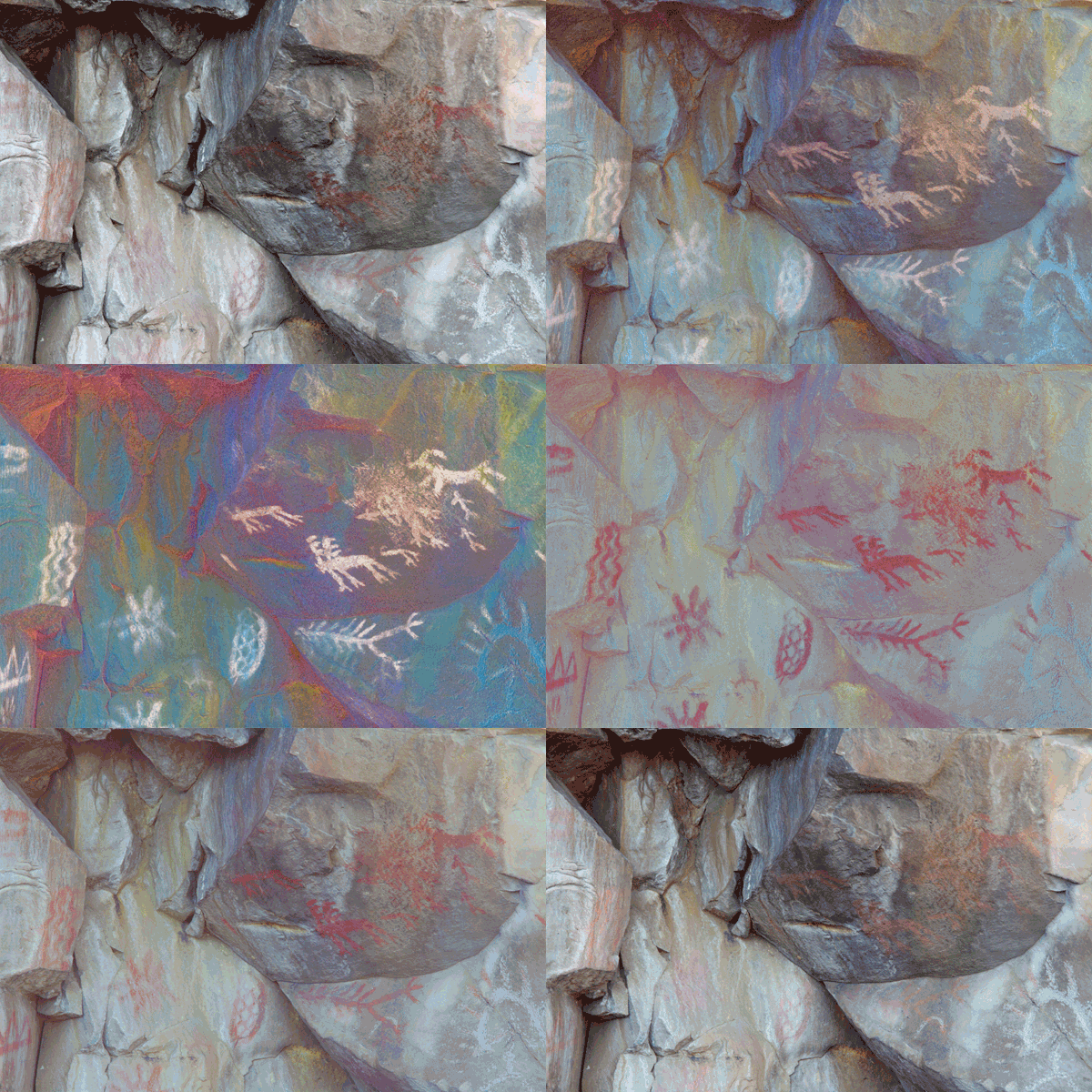
Detail of Rock Shelter wall incorporating d-stretch* enhancements and assembled as an animated GIF file.

The artifacts of Native American cultures preserved in the Portland Art Museum testify to the fact that they had sophisticated artists just like we do. While some surviving rock paintings divulge the craftsmanship of their creators, many seem to have more utilitarian functions. Perhaps they act as signatures or attendance marks, or perhaps they serve to record events or tally them.


Detail of Rock Shelter wall incorporating d-stretch* enhancements and assembled as an animated GIF file.

Some panels appear to tell stories and include a rich vocabulary of visual symbols.


Detail of Rock Shelter wall incorporating d-stretch* enhancements and assembled as an animated GIF file.

Detail of Rock Shelter wall incorporating d-stretch* enhancements and assembled as an animated GIF file.

And some paintings, collaborative works visited again and again over time, seem to transcend the mere recording of earthly things ... 


Vandalism of petroglyphs at Sherer Falls

Unfortunately, there are some who have come to the conclusion that the most important thing you can give a starving person is not art or bread so much as it is beer.

Detail of vandalized petroglyph at Sherer Falls

And the remaining rock art suffers because of them.


Vandalism of rock paintings at picture canyon

Even the Earth and Time itself seem anxious to erase the lessons our species has wrested from nature. Erosion, moisture, ice, heat, mineral leeching, fire, abrasion from plants - it all chips away at our most timeless recordings.


Before and after wildfire pictures. The artwork seems mostly intact. Changes in color are likely attributable to the difference between sunny and overcast skies as well as time of day.

I can't help but think that there are important messages preserved in these paintings - warnings and signs from people who faced the end of their world. So I visit them when I can, and try to collect more context...

...and pictures.


*Dstretch,  is a specialized plugin for a graphics program called ImageJ. It allows for the enhancement of rock art images through...magic I guess...and seems particularly clever at picking out red pigments on rock. It can do much more, but there is a learning curve. It was written by Jon Harman and can be obtained here:

(http://www.dstretch.com)

ImageJ can be acquired here:
(http://rsbweb.nih.gov/ij/index.html)

Featured Post

EVOLVING ROADS: Car camping with Kip and Rico (Part One)

I don’t know how it started for sure. Some intrepid band of Homo sapiens maybe walked over a land bridge from Russia or navigated the seas i...

POPULAR POSTS

The Narrative Image NAVIGATION AID