I helped Mr. and Mrs. P
move some furniture to a beach house in Lincoln City. On the morning we were to load the truck, menacing
rain clouds demonstrated their ability to saturate the earth at will with intimidating
bursts of precipitation. Not to be nonplussed, Mr. P, who seemingly has the right
tool for the right job (no matter how obscure) demonstrated his determination
to beat the clouds by pulling a tarp out of his shed that, in its folded state,
was just a little bit bigger and heavier than all the furniture we had to move,
and unfolded, well... let's just say that standing on opposite ends, we couldn't
hear each other over the vast distance unless we used walkie-talkies (and even
then we had to gesticulate wildly like near-sighted monkeys). Once the huge tarp was deployed, the rain
clouds moved on to easier prey. In fact, it wouldn't rain again for the
duration of the task.
 |
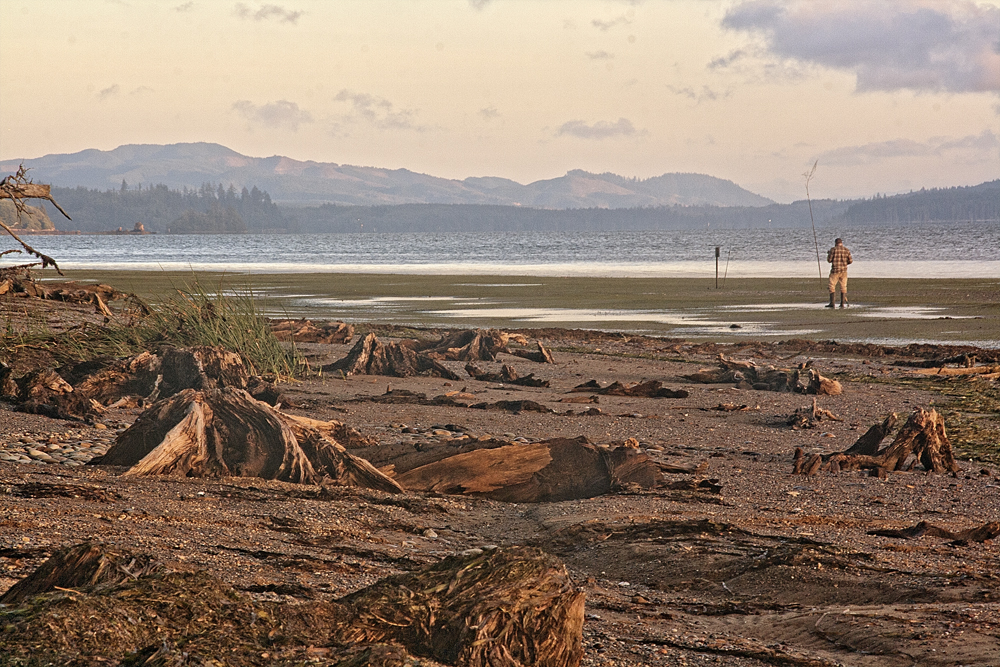
A picture of the coast
just South of Lincoln
City which doesn't really illustrate anything I've written about so far.
|
Turns out I like moving
furniture with Mr. P.
Although Mr. P has the stature of a man who
could move things by brute force if he wanted to, he doesn't. I'm not saying
he's old, but he's lived long enough to have experienced countless moving events (not
because there are too many events to count, but because he can't remember them
all) and he possesses the native intelligence to remember a few hard-won
helpful pointers. This has resulted in a methodical approach to moving that
emphasizes economy of energy. So, even though I'm out of shape, I can count on
plenty of 'rest pauses' as furniture shapes are mentally juggled like Tetris blocks
in Mr. P's impressive mental-simulation where complex problems are solved prior
to any physical exertion. Sometimes it takes me a while to come around to his
way of thinking, but if I listen to his advice, I'm sometimes treated to mini-miracles,
like when three and a half foot wide sofas fit through three foot wide doorways
at the bottom of tight stairwells (and all accomplished without saws or sledge-hammers...
or sheet-rock repair).
 |
Grass holding on to the
land for all it's worth and pointing in alarm at the impending approach of the
ocean. This picture is still not addressed in the body of the text.
|
The quiet diesel engine
chattered away in its normal fashion that makes gasoline engine drivers worry
about the oil level but which goes unnoticed by diesel engine drivers. The
expansive tarp billowed here and there, but couldn't escape from the near
infinite number of straps and cords that contained the furniture securely like
a papoose strapped to a cradle board. I say 'infinite number' because Mr. P
couldn't remember exactly how many straps he has, and every time I thought they
were used up, he'd pull another one out of the truck like a magician.
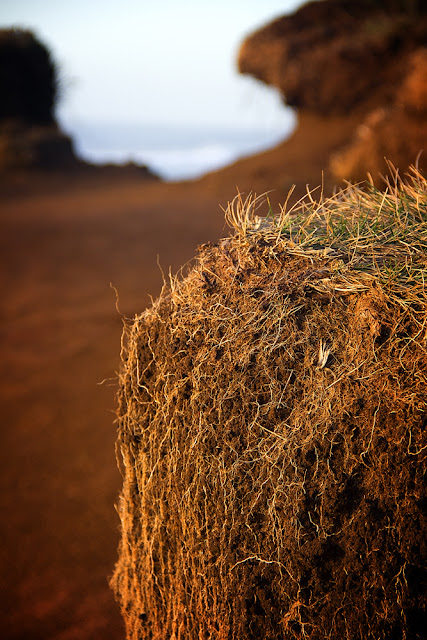 |
The waves don't seem to be
able to reach up this far, so perhaps the erosion is caused by the ceaseless
trampling of visitors like me, who scramble up and down the cliffs in search of
remarkable vistas. In any case, it is easy to see the exposed roots, and
thereby understand how grass can be so important in stabilizing soils perched
atop basalt capes.
|

Once
the truck was unloaded and the furniture placed in approximate positions, Mr.
and Mrs. P took me on a short orientation tour of the area, the highlight of
which turned out to be a journey through a maze of tortured trees to Fishing
Rock. The maze was a manicured tunnel through those wiggly trees you only see
at the coast or at timberlines - those trees that mark their lives in brutal
wind and thin rocky soils by tracing their anguish in the contorted shapes of
their limbs. I admired the trees. They manage to grow in the face of adversity.
But then, they have to. They have no legs. The fact is, they're stunted, and I
bet if they could walk, they'd saunter off immediately like so many whip-smart
octopi. This made me begin to feel ashamed for sticking it out so many years at
my job because it turns out I have legs. I guess you have to be honest with
yourself and figure out if you're NOT quitting because you think you will
eventually win, or if you're not quitting because you've got nowhere else to
go. I guess you also have to be able to look carefully in a mirror every once in a
while and see if you're starting to resemble Quasimodo. I'm not sure what the
lesson here is. I still harbor an idealistic notion that one person can make a
difference, but the trees make me acutely aware that legs have survival value.
Speaking of trees and lessons, when someone takes you on a tour through a
winding tree maze, you should actively participate in the navigation process
and construct a mental map...because you never know.
From atop Fishing Rock,
you can look down on various inter-tidal micro eco-systems and marvel at the
various manifestations of life that stake out patches of sheer rock as
nurseries in the face of hydraulic
battering rams and ultraviolet showers.
Sunday's
waves stirred the ocean into a froth and hurled themselves into the pillow-basalt
rocks and cliffs of Fishing Rock. The hard basalt retreats a little bit each
day, and has done so ever since its molten lobes erupted out of the cold water
50 to 70 million years ago. Maybe it is instructive to note that in the midst
of a venue where water perpetually hammers rocks into sand, a multitude of transparent, passive blobs manage
to thrive. While it is never on the perennial list of top ten spirit animals,
the jelly-fish, with its 700 million year success story, is perhaps under-rated.

I slipped out of from
under my backpack and pulled out the shutter-remote and the tripod and started
dicking around with the quick-release tripod legs which haven't really been
'quick release' since the salt-water dunking they took at Thor's Well. I walked
back and forth along the rock, comparing views and visualizing scenes, thinking
ahead to potential sunset pictures. Mr. and Mrs. P were likely reminded of
headless chickens and politely dismissed themselves. While I wasn't paying
attention, the sun made a break for the horizon, catching me undecided and
unprepared.
Alone, I was able to
explore the low light capabilities of my camera, and watch colors bloom and
fade in a steadily diminishing dynamic range of light.
Alone, I felt the rumble
and the threat of the returning tide. I took for granted that morning was
already on its way. The full moon rose behind me as the west horizon's red halo
faded to a pinkish pastel. Soon, the stunted forest's unkempt comb-over of a
canopy glowed blue in the moonlight and the marine air seemed to thicken and
become visible and mute the pounding surf. The calm air felt like a blessing of
peace in a land of volatile extremes. I didn't feel at home...but I did feel
lucky.
Later - much later -
clouds amassed in a vast tower above the end of the shore, like a lopsided
mushroom cloud, and spilled out over the ocean... but succeeded only in
obscuring the moon-set.
The
subtle return of color heralded the sun's approach, long before it became
visible.
The Pacific (peaceful ocean) spastically slapped
against the steep sand incline, straining for the cliffs it savaged during the
night, but the moon slowly pulled it away, much like old Mr. Sullivan breaking
up a fight during P.E.. The houses above the cliffs stood at the edge, whether arrogant or slow, still symbols of the good life.
In
the morning, I negotiated the stunted tree maze with considerably more success
than I did during my nocturnal regress when I unexpectedly explored several
wrong paths. Sun beams filtering in through the canopy served to indisputably mark
the proper cardinal direction if not the actual path. Still, the path
tributaries of the maze point into the forest like a river draining into the
mouth of Fishing Rock. Exiting the forest is more like searching for its
unknown headwaters.
Not far to the south,
Fogarty Creek meets the ocean, but can barely be compelled to enter until
coaxed by low tide and the resulting elevation difference. Here the ocean waits
for beachcombers who aren't paying attention and sneakily fills their shoes
with salt water and sand, also wetting their pants for them if given the
opportunity.
It was just cold enough in
the morning shade to make emerging sunbeams as welcome as a masseuse's warm fingers
on a tired knotted back.
Fogarty
creek takes an uncertain path through the sand standing between it and the
ocean. Its meanders are determined by the way the ocean has sculpted the beach
during it's brief six hour reign. Plants trying to set down roots can get a
little frustrated.
Just North of Fishing
Rock, the ocean has stripped all the sand off the beach leaving a black layer
of what feels, to the finger, like clay but which cushions the shoe like rubber
playground mats. Everywhere in this layer is evidence of a vast forest. Fully
rooted stumps poke out of the layer, their tops battered and splintered.
Neighboring stumps twine
their roots together as if in support.
Great logs, like fallen
soldiers, lie in between the stumps.
If I imagine the scene covered in moss, I could easily pretend to be hiking
along any rain-visited coastal forest...albeit with pretty extensive wind
damage.
The trees are not
petrified, but they don't belong in an intertidal zone and so I was faced with
a delightful science mystery. How long does it take for wood to disintegrate?
How long does it take wood to disintegrate underwater? Is there enough evidence
to say that this was indeed a forest, and not a layer of driftwood buried in
something besides sand? If it was a forest, was it a 300 year old coastal
forest dropped into the sea by the last subduction zone earthquake (this was
the theory propounded by Uncle Rico just before his unfortunate demise during
the Dungeness crab spawning event at Willapa
Bay back in 2014)?
On the way home from the
coast, as the big 'quiet' diesel chattered over the top of the coastal range,
the moon suddenly appeared on the eastern horizon in that big way it has of
looking like it has escaped its orbit and is plummeting headlong toward earth.
Mr. and Mrs. P both thought it would make a wonderful picture, but I knew all
I'd end up with is a featureless white dot on a black background, and that the
two of them would long be out of patience by the time I'd set up the
appropriate gear to get anything more. So I tried to explain how sometimes it's
just better to appreciate the moment - to be entirely 'in the moment' and not distance
yourself by working to document it - to be a participant and not an observer,
just like Sean Penn explains to Ben Stiller as he passes up a chance to
photograph the long sought after snow leopard he has tracked down high in the
Himalayas. They thought this explanation was funny (or maybe stupid) and Mr. P
teased me mercilessly about appreciating the moonrise 'moment' for the entire fifty
miles it loomed in the front window, particularly when we passed by a scenic
alpine lake that reflected the moon in a breathtaking image that he was sure
would have been an award winner.
What were we talking
about?
I forget.